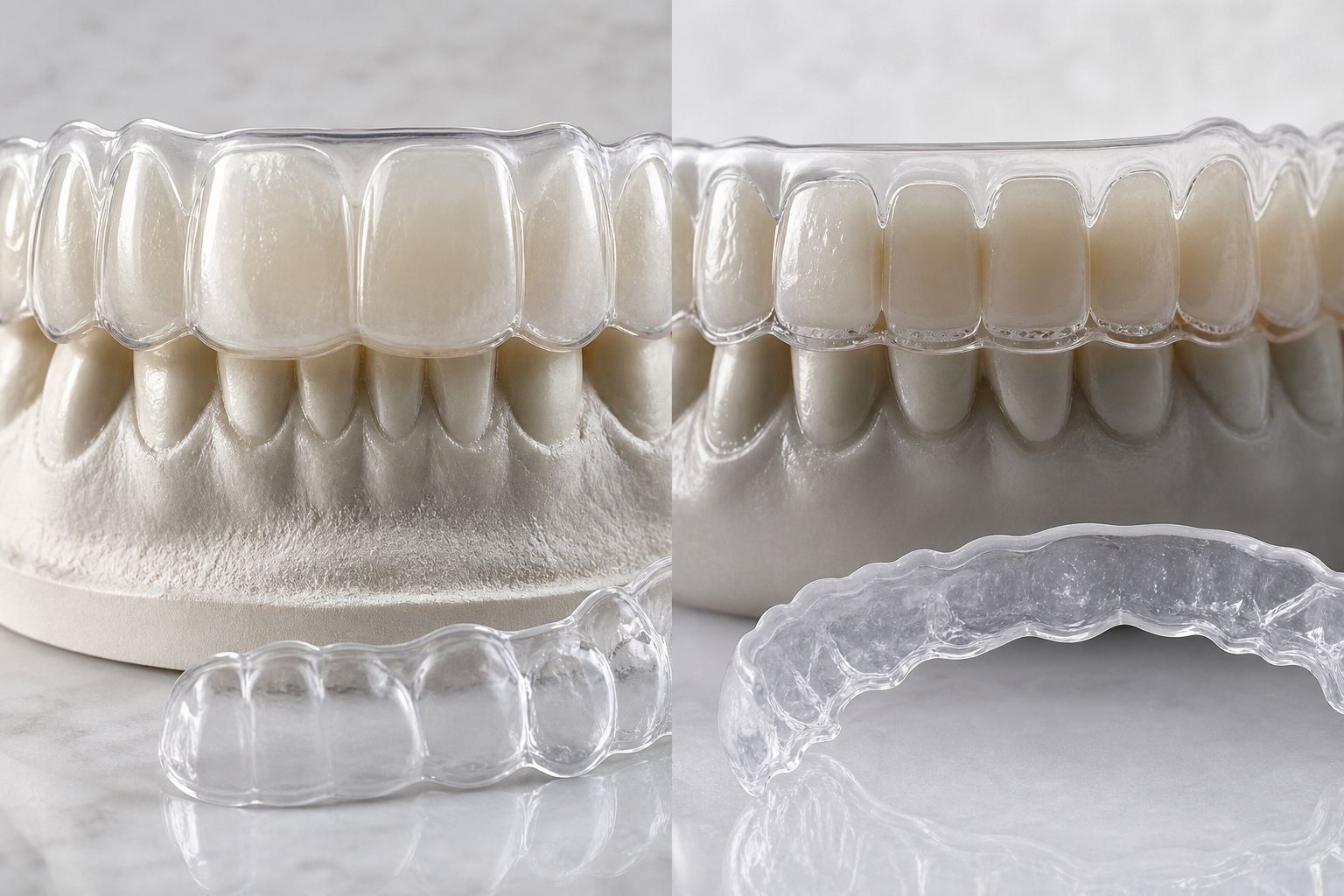
If you are comparing teeth whitening trays, I would usually regard dentist-made custom trays as the more controlled option. They are made to fit your teeth, supplied after an oral health assessment and used with dentist-prescribed whitening gel. Shop-bought trays can be cheaper and convenient, but their fit, comfort and results are more variable.
The important distinction is not simply home whitening versus treatment at a practice. Custom whitening is often done at home too. The difference is the assessment beforehand, the fit of the tray, the whitening product supplied with professional instructions and the support available if you develop sensitivity or have questions during treatment.
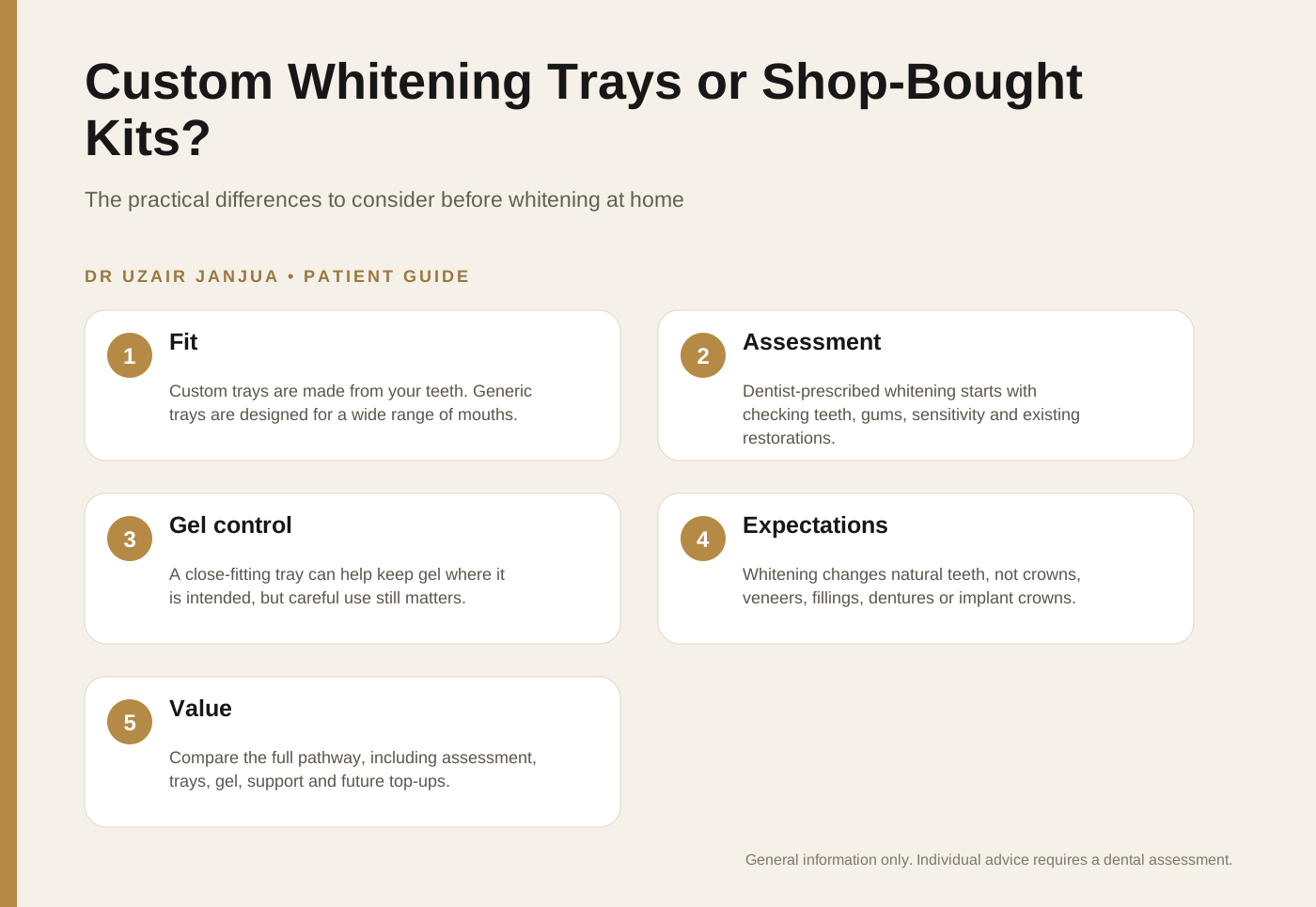
Custom vs shop-bought teeth whitening trays at a glance
When I assess someone considering whitening, I encourage them to compare the whole treatment pathway rather than the tray alone. A generic tray may be a reasonable lower-cost choice for someone with modest expectations, but it is not equivalent to a dentist-prescribed home whitening plan.
| What you are comparing | Custom dentist-made trays | Shop-bought or generic trays |
|---|---|---|
| Fit | Made from impressions or a digital scan of your teeth. | One-size-fits-most design, which can be loose or tight depending on your teeth. |
| Gel placement | Designed to keep gel close to the tooth surfaces with more control. | Gel may spread unevenly, particularly around the gumline or crowded teeth. |
| Assessment | Includes checking whether whitening is appropriate before treatment. | Usually no clinical examination of teeth, gums or restorations. |
| Whitening product | Dentist-prescribed product used under specific instructions. | Ingredients, strength and evidence vary considerably between products. |
| Comfort and sensitivity plan | I can adjust the schedule, amount of gel or approach if needed. | Instructions are standardised and may not suit every mouth. |
| Upfront cost | Usually higher because it includes bespoke trays and professional care. | Usually lower and available immediately. |
| Future use | May be reused for professionally advised top-ups if they still fit correctly. | Often disposable or not designed for reliable repeat use. |
What is the real difference between the two types of tray?
A custom tray is made around the shape and position of your own teeth. I would take impressions or a digital scan, then arrange for trays that sit closely over the teeth. This helps with gel placement and can reduce unnecessary gel contact with the gums, although it does not make irritation or sensitivity impossible.
Generic teeth whitening trays are designed to suit a broad range of mouths. That can work reasonably for some people, especially where teeth are fairly straight and expectations are limited. However, a loose tray can allow gel to move around, while a tray that presses awkwardly can be uncomfortable.
This matters more where you have crowded, rotated or uneven teeth, spaces between teeth, recession at the gumline, or a history of sensitivity. The tray is only one part of the result, but it affects how consistently the gel reaches visible tooth surfaces.
I also usually explain that the word “professional” is sometimes used loosely online. A home whitening kit is professionally supervised only where a GDC-registered dental professional has assessed you, provided the appropriate whitening product and given you instructions for your situation.
Are custom teeth whitening trays worth the extra cost?
For many people, yes, particularly if they want more predictable treatment, have sensitive teeth, uneven tooth positions or visible dental work. The additional value is not just the plastic tray. It is the assessment of your teeth and gums, a tailored fit, appropriate instructions and a route back to the practice if the treatment needs adjusting.
That said, I would not suggest that everybody needs custom trays. If your aim is simply to improve light surface staining and you understand that an over-the-counter product may give limited or uneven change, a legal shop-bought option may be enough for you.
A cheaper kit can become poor value if you need to keep buying products, get gum irritation, or find that the result is patchy. Conversely, custom trays are not automatically worthwhile if the underlying problem is not general tooth colour. Whitening will not correct chips, spacing, worn edges, enamel defects or a crown that no longer matches.
If you are unsure whether the extra cost is justified, a whitening consultation in Birmingham can clarify what is affecting your tooth colour, whether your restorations are likely to show and whether custom trays would offer a meaningful advantage in your case. You can also read more about dentist-supervised teeth whitening in Birmingham before deciding.
What I would assess before recommending whitening trays
Before I recommend any whitening treatment, I would first check that the teeth and gums are healthy enough to proceed. The exact examination depends on your symptoms and dental history. Not everybody needs the same investigations, but whitening should not be used to cover up a problem that needs treatment.
- Gum health and deposits: plaque, calculus and gum inflammation can make whitening uncomfortable and may need addressing first.
- Decay, cracks and leaking fillings: these can contribute to sensitivity and should be assessed before placing whitening gel against the teeth.
- The type of discolouration: tea, coffee, smoking and red wine staining are different from a single dark tooth or colour changes within the tooth.
- Existing restorations: fillings, crowns, veneers, bridges, dentures and implant crowns will not whiten.
- Sensitivity and enamel condition: if your teeth are already sensitive, I may suggest a modified approach or advise against starting immediately.
- Your intended outcome: I would want to know whether you want brighter natural teeth, a better match before bonding, or a solution for one noticeably darker tooth.
- Age and dental development: tooth whitening is generally not provided to under-18s in the UK unless there is a clinical reason. I would assess this individually rather than treating whitening as a routine cosmetic option for younger patients.
If one tooth has become darker than the rest, I would not treat that as a straightforward cosmetic whitening question. It needs assessment first because trauma, decay or a problem affecting the tooth nerve may be relevant.
Are shop-bought teeth whitening trays safe and effective in the UK?
Shop-bought whitening products are not all the same. Some may help with surface staining or produce modest lightening, while others are unlikely to meet the expectations created by marketing. Their ingredients can include strips, gels, toothpastes, pens and non-peroxide formulations, so it is not accurate to say that every pharmacy or online product works in the same way.
In the UK, products containing or releasing more than 0.1% and up to 6% hydrogen peroxide are restricted to supply through dental professionals. This is one reason I would be cautious about online sellers offering supposedly high-strength whitening gel directly to the public, especially where there is no clear GDC-registered dental professional, examination or advice.
A higher concentration is not automatically a better choice. Using too much gel, wearing a tray for longer than instructed or repeating treatment too frequently can increase the likelihood of temporary sensitivity and gum irritation. If you are comparing kits, I would focus less on dramatic claims and more on whether the seller clearly identifies what is being supplied, who is responsible for the treatment and what support is available.
If you are specifically weighing up home products, my guide to at-home teeth whitening kits in the UK may help you compare the claims more carefully.
What can go wrong with whitening trays?
Whitening trays are not risk-free, whether they are custom or generic. The most common issues I discuss are temporary tooth sensitivity and gum irritation. These are often manageable, but they are a reason to follow the prescribed or product instructions carefully rather than assuming more gel or longer wear will improve the result.
Poor fit can make gel leakage more likely. This may irritate the gums, and it can also leave some tooth surfaces less evenly exposed to the whitening product. Crowding, gaps and irregular tooth shapes can make generic trays particularly difficult to use consistently.
Another common disappointment is expecting every visible tooth to change colour equally. Natural tooth structure responds differently from one tooth to another, and existing crowns, fillings and veneers stay the same shade. If you whiten natural teeth beside older composite bonding, the difference can become more noticeable. I explain this further in my guide to whitening around composite bonding and planning the final shade.
I would also advise stopping and seeking dental advice if you develop significant pain, persistent irritation or a concern about a tooth during whitening. Do not keep trying to whiten through symptoms.
Which option makes sense for different situations?
The best choice depends on what is actually bothering you about your smile. I would not choose a tray solely because it is the cheapest, fastest-looking or most heavily advertised option.
| Your situation | What I would usually consider first |
|---|---|
| Mild tea, coffee or smoking stains | Professional cleaning or stain removal may be useful first. This can remove external deposits and stains, but it does not change the underlying natural tooth shade. |
| General yellowing of healthy natural teeth | Custom trays can offer a controlled home whitening approach if examination confirms suitability. |
| Sensitive teeth | A dental assessment is sensible before whitening. The schedule or product may need adapting. |
| Crowded or uneven teeth | Custom trays are often more practical than generic trays because fit and gel control matter more. |
| Visible crowns, veneers or fillings | Plan the final shade carefully, as restorations will not whiten with natural teeth. |
| One dark tooth | Assessment before cosmetic treatment, rather than assuming ordinary whitening trays are the answer. |
| Considering bonding or veneers | Whitening may need to happen before the new shade is selected, but the order should be individually planned. |
What affects the final cost of custom whitening trays?
I would be wary of comparing an advertised tray-only figure with a professionally supervised plan without checking what is included. The initial cost of custom trays can be higher, but the final cost depends on more than the trays themselves.
| Cost factor | Why it matters |
|---|---|
| Initial examination | Confirms whether whitening is appropriate and identifies issues needing attention first. |
| Upper and lower trays | Custom trays may be made for one or both arches, depending on the plan. |
| Impressions or digital scan | These are used to produce trays that fit your teeth. |
| Whitening gel and instructions | Products, quantities and prescribed schedules differ between treatment plans. |
| Pre-treatment care | Hygiene treatment, fillings or gum care may be needed before whitening. |
| Sensitivity management | A modified schedule or desensitising approach may be appropriate for some people. |
| Future top-ups | Existing trays may be useful later if they still fit and professional advice confirms it is appropriate. |
| Restorative changes | Whitening may reveal a mismatch with visible crowns, fillings or veneers that need separate consideration. |
For patients travelling into Birmingham from elsewhere in the West Midlands, I would also ask how many appointments are needed, whether tray fitting and collection can be coordinated, and how advice is handled if sensitivity develops while you are at home.
How I would help you prepare for a whitening consultation in Birmingham
Bring a clear idea of what you want to improve, but do not feel you need to arrive knowing which gel or tray type you need. My role is to assess whether whitening is sensible, explain the likely limitations and help you avoid paying for a treatment that does not address the real issue.
Useful questions to ask include:
- Does the fee include an examination, custom trays, gel and a fit check?
- How much gel should I use, and what is the recommended wear schedule for this product?
- What should I do if my teeth become sensitive or my gums feel irritated?
- Can the trays be used for professionally advised top-ups later?
- Will my existing fillings, crowns, veneers or bonding look different after whitening?
- Do I need cleaning, gum treatment or restorative work before starting?
If you have had orthodontic treatment, new dental work or changes to your gumline since your trays were made, I would want to check their fit before you reuse them. A tray that once fitted well may not remain suitable indefinitely.
Alternatives if whitening trays are not the right answer
Whitening trays are useful for changing the shade of natural teeth, but they are not a universal cosmetic solution. If the issue is mainly external staining, a professional clean may be enough. If speed is your priority and you are suitable, I can discuss in-practice whitening options alongside home treatment.
If you are concerned about shape, chips, small gaps or a localised colour discrepancy, composite bonding may be more relevant. For more extensive concerns involving tooth shape, colour and structure, veneers may be considered after a proper discussion of the alternatives and the amount of tooth preparation involved.
If you are deciding between custom teeth whitening trays and a shop-bought kit, an examination is the sensible next step where you have sensitivity, gum concerns, one darker tooth, crowns, veneers or visible fillings. I can assess the condition of your teeth, explain what whitening is likely to change in your case and advise whether a professionally prescribed home plan represents good value for you.