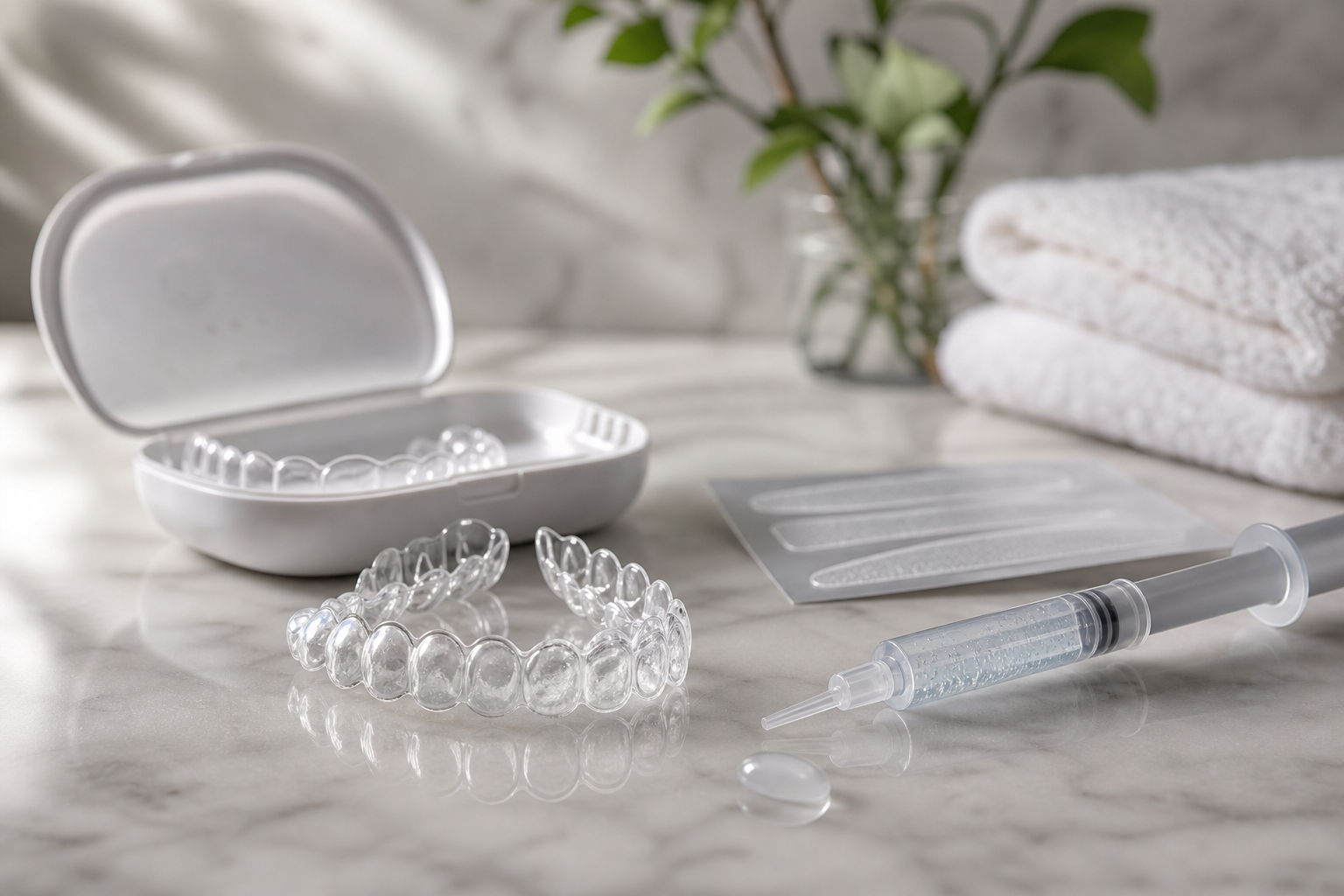
If you want a noticeable, controlled change in tooth colour, I would usually recommend dentist-supervised home whitening with custom-fitted trays rather than relying on a shop-bought kit. Whitening strips, pens and toothpastes may lift some surface staining, but they tend to offer a more limited and less predictable change.
The best at-home teeth whitening kits are not necessarily the ones with the boldest claims or brightest packaging. I would look at the active ingredient, how clearly the concentration is explained, whether the tray fits properly, who is supplying it and whether your teeth and gums are suitable for whitening in the first place.
For patients in Birmingham and the West Midlands, a proper assessment is particularly worthwhile if you have sensitive teeth, crowns, fillings, bonding, gum problems or one tooth that has become darker than the others.
What actually works in an at-home teeth whitening kit?
Whitening works when an appropriate bleaching gel stays in contact with natural tooth enamel for the correct amount of time. Dentist-supervised home whitening normally uses hydrogen peroxide or carbamide peroxide gel in trays made to fit your teeth. These ingredients break down staining within the tooth and can lighten the natural shade gradually.
Custom trays matter more than many people realise. A well-fitting custom tray can help keep gel in contact with the teeth and reduce unnecessary exposure to the gums, although it does not remove the possibility of leakage or irritation. It also allows me to give more tailored instructions if sensitivity is a concern.
Shop-bought strips can sometimes improve surface staining and may create a modest short-term brightening effect. Pens are convenient for touching up small areas, but it is difficult to apply them evenly and keep the product in place. Whitening toothpastes mainly polish away external stains from tea, coffee, red wine or smoking. They do not usually make a major change to the underlying shade of the teeth.
LED lights are often marketed as the key part of a kit. In reality, I would focus far more on the whitening gel, its contact with the teeth and whether it is appropriate for you. An LED device does not turn an unclear or poorly formulated kit into a reliable whitening treatment.
My short answer on the best at-home teeth whitening kits
I would not name one retail brand as the best option because formulas, availability and supply arrangements can change. Instead, I suggest comparing the type of kit and what it can realistically achieve.
| Option | What it may help with | My view |
|---|---|---|
| Dentist-supervised custom trays | A gradual and controlled change to natural tooth shade | Usually my preferred home option where whitening is suitable |
| Whitening strips | Some surface stain improvement and limited brightening | Can be convenient, but fit and results are less predictable |
| Paint-on pens | Minor, temporary-looking brightening in selected areas | Difficult to apply evenly and keep on the teeth |
| Whitening toothpaste | Removal of some external staining | Useful for maintenance, not a substitute for bleaching treatment |
| Powders and charcoal products | Surface stain removal claims | I would be cautious, particularly with abrasive products or aggressive brushing |
| Online kits with unclear ingredients | Uncertain | I would avoid these completely |
One thing I usually explain to patients is that whitening should be judged by safety and predictability, not simply by how quickly a product promises to work. A dramatic one-session claim is not the same thing as a well-planned result.
What I would assess before recommending home whitening
Before I recommend any whitening approach, I would examine the teeth and gums and discuss what is causing the colour change. General yellowing, tea and coffee staining, smoking-related staining, a dark tooth after trauma and a tooth that has had root canal treatment can all need different conversations.
I would look for decay, leaking fillings, cracks, exposed root surfaces, gum recession, gum disease and existing sensitivity. Whitening is not the right place to start if there is an untreated problem that could allow gel to irritate a tooth or gum further.
I would also consider age before recommending treatment. UK rules place specific restrictions on cosmetic tooth whitening for under-18s, so it is not something I would treat as suitable without an individual dental assessment.
I would check visible crowns, veneers, bridges, implants, composite bonding and fillings too. Whitening changes natural tooth tissue, not dental restorations. This is where people sometimes get confused, because whitening can make an existing crown or filling look darker by comparison even when the restoration itself is in good condition.
If you are planning bonding or veneers, it is often sensible to discuss whitening first so that any new visible work can be matched to the intended tooth shade. That does not mean every restoration needs replacing after whitening. I would assess its position, condition and how noticeable any colour difference is before advising you.
If you would like a tailored view, my teeth whitening consultations in Birmingham are designed to establish whether home trays, in-practice whitening, stain removal or no whitening treatment is the most sensible option.
What I would avoid when comparing whitening kits
I would avoid any kit where the ingredients are vague, the seller cannot be identified or the instructions are incomplete. A product should not require guesswork about what you are putting on your teeth and gums.
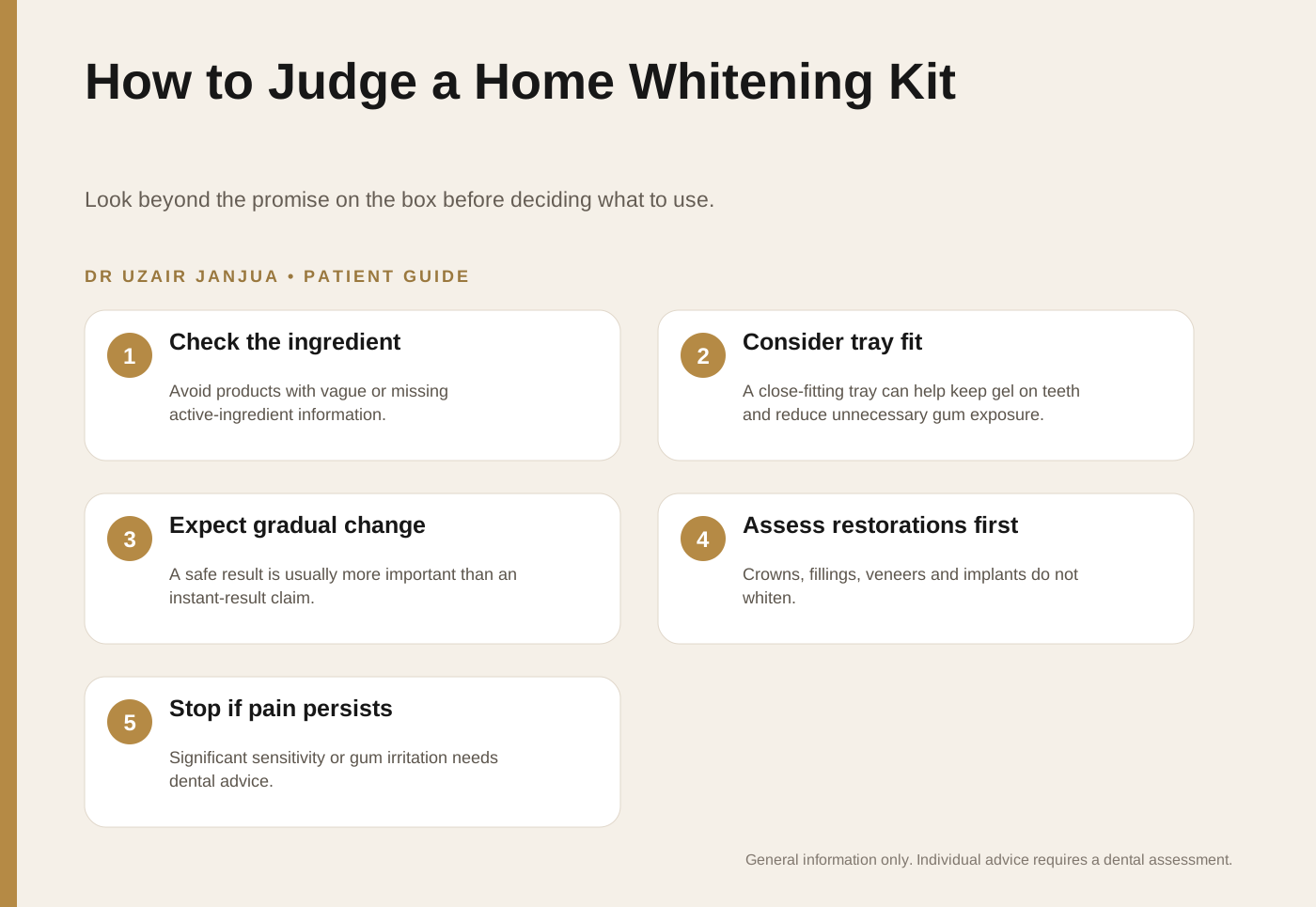
- Unclear peroxide information. Be cautious if a seller makes strong whitening claims but does not clearly explain the active ingredient or how the product should be used.
- Very strong or instant-result claims. More gel, longer wear or a stronger concentration does not automatically mean a better result. It can increase the chance of sensitivity and gum irritation.
- Ill-fitting generic trays. A bulky tray can allow gel to spread onto the gums, which may cause soreness or whitening of the gum tissue.
- Sodium perborate or chlorine dioxide-based products. I would avoid these ingredients for cosmetic tooth whitening.
- Abrasive powders and forceful brushing. Trying to scrub teeth whiter can irritate gums and worsen sensitivity without changing the natural tooth shade.
- Whitening treatment provided outside dental care. The provision of tooth-whitening treatment is the practice of dentistry. I would only consider treatment supplied and provided through an appropriately registered dental professional, rather than a beauty setting offering to whiten someone else's teeth.
“Peroxide-free” is not automatically a reassurance. It does not tell you whether a product is effective, suitable for your mouth or being supplied appropriately. I would always want to know what the alternative ingredient actually is.
Are shop-bought and online whitening kits safe in the UK?
Some low-strength cosmetic products are sold legally in the UK, but I would not assume that every online kit is safe, legal or suitable simply because it is easy to order. Its legal status depends on the formulation, concentration, supplier and how whitening treatment is being provided.
In the UK, products containing or releasing more than 0.1% and up to 6% hydrogen peroxide can only be supplied through a registered dental professional. An appropriate clinical examination is required before use, and the first use must be carried out by, or under the direct supervision of, a registered dental professional. Products containing or releasing more than 6% hydrogen peroxide are not permitted for cosmetic tooth whitening.
This does not mean every product sold online is automatically illegal. It does mean I would be wary of kits claiming professional-strength peroxide without a dental assessment or identifiable professional supplier. I would also be cautious about imported products, misleading concentration claims and sellers offering whitening treatment without examining your teeth.
For a fuller comparison of the practical differences, you may find my guide to why teeth whitening should start with a dentist rather than a kit helpful.
Dentist-supervised trays, strips or in-practice whitening?
The right choice depends on the level of change you want, your starting shade, your time frame and how likely you are to experience sensitivity. I would not assume that the fastest option is automatically the best one for you.
| Consideration | Dentist-supervised home trays | Shop-bought strips or kits | In-practice whitening |
|---|---|---|---|
| Expected change | Often a more controlled and potentially more visible change, depending on the gel, starting shade and discolouration | Often modest, especially for deeper colour change | May offer a quicker initial change where appropriate after assessment |
| Fit and gel placement | Custom trays designed for your teeth | Generic fit or direct application | Applied with professional supervision |
| Sensitivity support | Schedule and gel use can be adjusted | Limited individual guidance | Can be discussed and managed as part of treatment |
| Convenience | Whiten at home over a planned period | Easy to buy and use | Requires an appointment |
| Cost considerations | Assessment, trays, gel, fitting and review may be included | Lower upfront cost, but variable value | Usually higher upfront cost due to clinical appointment time |
Custom trays can have a higher initial cost, but they may be retained for future top-up whitening if I confirm it remains appropriate. When comparing fees, I suggest asking what is included: examination, tray manufacture, fitting, whitening gel, review appointments and support if sensitivity develops.
What results should I realistically expect?
I would expect a gradual lightening of natural teeth rather than an identical, brilliant-white result for everyone. Some teeth respond more than others, and deeper age-related, trauma-related or medication-related discolouration may not react in the same way as everyday surface staining.
Whitening does not change the shade of crowns, veneers, fillings, bridges, dentures or implants. If you have a visible restoration, I would discuss whether a mismatch is likely before treatment starts, particularly if you are whitening before a wedding, holiday or another important event.
Results are not permanent. Tea, coffee, red wine, smoking and natural changes over time can gradually reintroduce staining. Good oral hygiene and appropriate top-up treatment can help maintain the result, but I would not recommend repeatedly using leftover gel without checking that it is still suitable for your teeth and gums.
How I would reduce the chance of sensitivity or gum irritation
Sensitivity and gum irritation can occur with whitening, even when it is professionally planned. They are more likely when gel is used too often, left on too long, placed in excessive amounts or allowed to touch the gums.
I would give clear instructions on how much gel to use, when to wear the trays and what to do if your teeth become sensitive. Using more gel does not whiten teeth faster. A small amount in the correct place is usually more controlled than overfilling a tray.
If you develop significant pain, persistent sensitivity, gum burning or visible irritation, stop using the product and seek dental advice rather than trying to push through the course. I may recommend altering the schedule, reviewing tray fit or addressing another dental issue before whitening continues.
When another treatment may make more sense
Whitening is a conservative option because it does not require removing tooth structure, but it cannot solve every colour concern. If the main issue is plaque, calculus or external staining, a hygiene appointment and professional cleaning may be a more sensible first step.
If one tooth is distinctly darker, I would assess why before suggesting general whitening. A non-vital tooth, meaning a tooth whose nerve is no longer alive, may need a different approach such as internal whitening after appropriate assessment.
For chips, shape concerns or a localised colour difference that whitening cannot disguise, composite bonding treatment may be worth discussing. Veneers can be an option in carefully selected cases, but they are a more irreversible restorative decision and should not be chosen simply because an online whitening kit has disappointed you.
My practical buying checklist before you spend money
Before buying a home whitening kit, I would encourage you to ask a few direct questions. The answers usually tell you more than before-and-after advertising.
- What is the active whitening ingredient, and is the concentration clearly stated?
- Who is supplying the product, and are they identifiable and appropriately registered where required?
- Has anyone assessed my teeth, gums, sensitivity, age and existing restorations?
- How will the product stay on my teeth and away from my gums?
- What should I do if my teeth become sensitive or my gums feel sore?
- Does the quoted cost include trays, gel, fitting, review and future top-up advice?
- Will whitening create a noticeable mismatch with my crowns, fillings, veneers or bonding?
If you are travelling into Birmingham from Solihull, Sutton Coldfield, Dudley, Wolverhampton, Coventry or elsewhere in the West Midlands, it is worth asking how many appointments are needed and what happens if trays need adjustment. A safe, custom approach should be planned around your teeth, not rushed around an event date.
The best at-home teeth whitening kit is usually the one that is suitable for your mouth, has clear ingredients and instructions, and gives you a realistic route to a result you are comfortable maintaining. If you want to compare dentist-supervised home whitening with in-practice treatment or a shop-bought option, I would be happy to assess your teeth and talk you through the most appropriate next step.