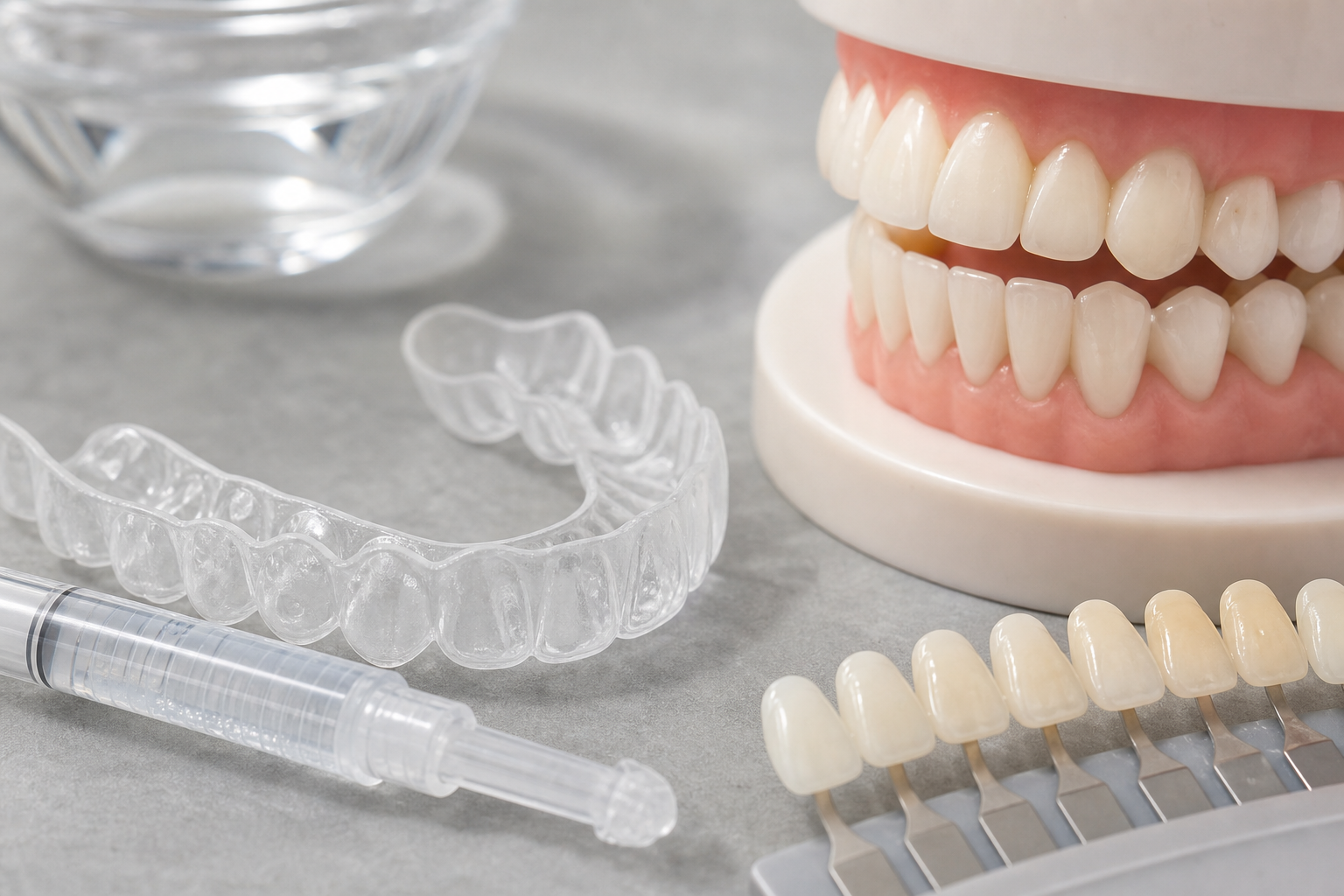
If you are deciding between a teeth whitening dentist and a pharmacy or online kit, I would start with an examination rather than the product. The important difference is not simply whitening at home versus whitening in a dental practice. Dentist-prescribed home whitening is still done at home, but it follows an assessment and uses prescribed gel, closely fitting trays and clear instructions.
I would check that your teeth and gums are healthy enough for whitening, look at existing fillings or crowns, assess sensitivity and explain what level of change is realistic. A cheaper kit may remove some surface staining or create a limited colour change, but it cannot tell you why your teeth look darker or whether whitening is the most sensible option.
Why should teeth whitening start with a dentist?
In the UK, tooth whitening is regarded as dentistry, whether it takes place in a surgery or at home using a prescribed kit. I would always assess your mouth before recommending it because whitening gel can aggravate problems such as active decay, gum inflammation, exposed tooth roots, cracks or poorly sealed fillings.
There is also an important legal distinction. Products containing or releasing between 0.1% and 6% hydrogen peroxide can only be supplied through dental professionals after an appropriate clinical examination. Products sold directly to consumers in the UK are limited to much lower levels, but legal availability does not automatically mean that a product is suitable, effective or comfortable for your teeth and gums.
One thing I usually explain to patients is that an assessment is not just a formality before a cosmetic treatment. It is how I work out whether your concern is mainly surface staining, the natural shade of the teeth, one darker tooth, old restorations or something that needs treatment before any whitening begins.
What is the difference between a dentist’s whitening kit and a shop-bought kit?
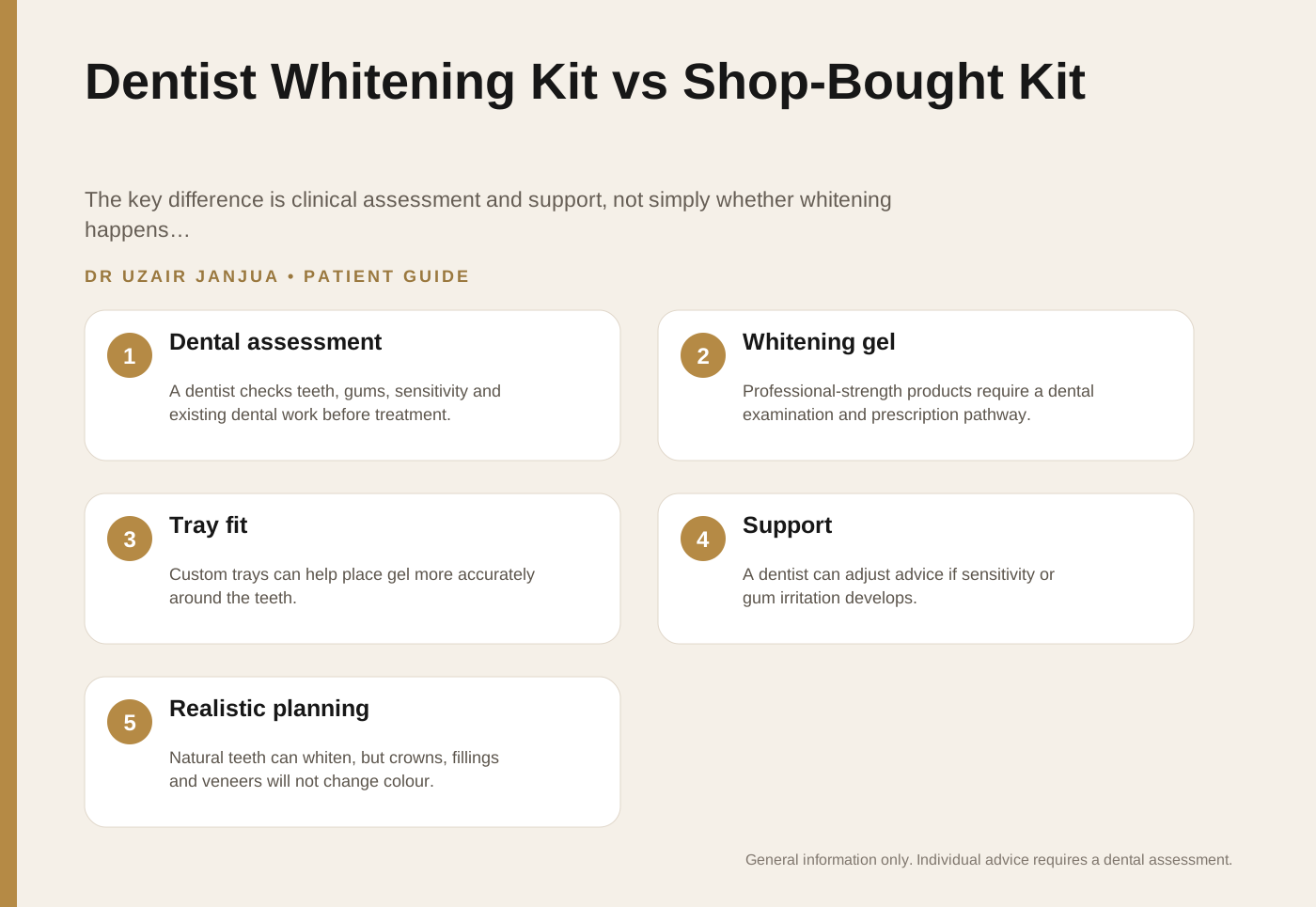
A dentist-prescribed kit is not simply a more expensive version of a shop-bought product. I would tailor the approach around your teeth, gum health, level of sensitivity and the shade change you are hoping to achieve. It also gives you a route back for advice if treatment becomes uncomfortable or the trays do not fit as expected.
| Feature | Dentist-prescribed home whitening | Shop-bought or online kit |
|---|---|---|
| Assessment | Clinical examination before treatment | Usually no individual dental assessment |
| Whitening gel | Prescribed through a dental professional after assessment | Consumer product, usually at lower permitted levels in the UK, or of uncertain origin when bought online |
| Suitability | Planned around your teeth, gums, sensitivity and dental work | Legal availability does not confirm that it is suitable for your mouth |
| Fit | Custom trays can be made to fit your teeth closely | Generic strips, trays or paint-on products |
| Instructions | Wear time and gel quantity can be tailored | General instructions only |
| Support | Advice is available if sensitivity or irritation develops | Limited or no clinical follow-up |
| Expected role | Gradual whitening of natural teeth under professional guidance | May help with some surface staining or limited colour change |
Custom trays matter because they help keep gel where it is intended to be. They do not remove every risk, but a good fit, the right amount of gel and sensible wear times can reduce avoidable gum contact and discomfort.
What I would assess before recommending whitening
When I assess someone for teeth whitening in Birmingham, I first look at the health and condition of the teeth and gums. Whitening is usually something to consider once the mouth is stable, not a way to cover up an untreated dental problem.
- Teeth and gums: I would check for decay, gum inflammation, loose or leaking restorations, cracks and worn areas.
- Sensitivity: Existing sensitivity to cold, sweet foods or brushing may change the plan, the wear time or whether whitening should be delayed.
- Existing dental work: Fillings, crowns, bridges, veneers, dentures and implants do not whiten. I would discuss whether these may look different once your natural teeth become lighter.
- The type of discolouration: Tea, coffee, red wine and smoking can create surface staining, while trauma, medication, tooth development or a root-treated tooth can cause deeper colour changes.
- Your expectations: I would discuss a natural-looking target rather than promise a particular shade or a perfectly even change.
I would also be cautious where someone is under 18, pregnant or breastfeeding, or where there is active dental disease. An individual assessment is needed before deciding whether cosmetic whitening is appropriate in those circumstances.
Are home whitening kits always ineffective?
No. Some shop-bought products, particularly strips and products intended to lift surface stains, may create a limited short-term change for some people. The problem is that their effect varies, they are not tailored to your teeth and gums, and a result from one person does not predict what will happen for another.
This is where people sometimes get confused. Professional teeth whitening at home is a different category from buying a kit yourself. I can prescribe a home whitening plan after examining you, provide trays made for your teeth and explain how to use the gel over a planned period, often over a number of weeks.
Online products need particular caution. A product sold through a marketplace or overseas website may not meet UK requirements, and the stated ingredients or concentration may not be reliable. I would not choose a whitening product based on its advertised strength alone.
The risks people underestimate with unsupervised whitening
Professional whitening is not risk-free, and I would explain the possible side effects before treatment. Temporary sensitivity can occur, particularly with cold drinks or sweet foods, although the likelihood and severity vary between people and treatment plans. Gum irritation, sore areas in the mouth and temporary white patches on the gums can also happen when gel contacts soft tissues.
With an unsupervised kit, common problems include using too much gel, wearing it for too long, poorly fitting trays pressing gel onto the gums, or continuing despite significant sensitivity. A generic tray may fit loosely, and a strip may not sit evenly over every tooth.
There is another risk that is less obvious. If a tooth has decay, a crack, an exposed root or a failing filling, whitening may be uncomfortable without addressing the actual cause. I would rather identify that first than have someone assume whitening itself is the only issue.
If you want a recommendation based on your teeth rather than an online product review, a teeth whitening consultation in Birmingham is the practical first step. I can assess suitability, talk through the options and explain what treatment would involve before you commit.
Which professional whitening option might suit you?
The most suitable professional whitening option depends on how quickly you want to see a change, how sensitive your teeth are, the type of staining present and how comfortably you can follow a home routine. I would not assume that one method is automatically better for everyone.
Dentist-prescribed take-home whitening
This approach uses custom-made trays and prescribed gel at home. It is often a gradual process, which can be helpful when I want to manage sensitivity carefully or give you more control over when you wear the trays. It does require you to follow the instructions consistently.
In-surgery whitening
In-surgery whitening is carried out in a clinical appointment and may appeal if you want a faster visible change. It can still cause temporary sensitivity, and it does not make dentist-prescribed home whitening inferior. In some cases, I may discuss one approach, the other, or a combination depending on your needs.
Whichever route is considered, I would explain the likely appointment sequence, aftercare and whether future top-up gel may be useful. If you are travelling into Birmingham from Solihull, Coventry, Wolverhampton, Sutton Coldfield, Walsall or elsewhere in the West Midlands, it is sensible to ask how many visits may be needed and what follow-up support is available.
What whitening will not change, and when another option may make more sense
Whitening changes the colour of natural tooth tissue. It does not lighten fillings, crowns, veneers, bridges, dentures or implants. If you have visible front-tooth restorations, I would discuss colour planning before treatment so that you understand they may appear darker afterwards.
Whitening also cannot straighten teeth, repair chips, close gaps or alter tooth shape. If the main concern is a localised mark, a damaged edge or uneven shape, composite bonding may be worth discussing instead. If tooth position is the main issue, whitening may be better considered after alignment rather than before it.
I may advise against whitening as the first step where there is untreated decay, gum disease, severe sensitivity, a single dark root-treated tooth, significant enamel marks or a restoration that is the true source of the colour concern. Cleaning and stain removal, internal bleaching for one non-vital tooth, restorative treatment or another cosmetic option can sometimes be more predictable.
For a clearer sense of why individual teeth can respond differently, you can also read about what affects teeth whitening before-and-after changes. It is useful preparation if you are comparing your own teeth with highly edited or selectively photographed images online.
What changes the cost of dentist teeth whitening?
I would be wary of comparing whitening options by headline price alone. A lower initial cost may not include an examination, custom trays, enough gel, follow-up or support if you develop sensitivity. Cosmetic whitening is generally private treatment, so a written plan should make clear what is included.
| Cost factor | Why it matters |
|---|---|
| Initial examination | Confirms whether whitening is suitable and identifies treatment needed first. |
| Custom trays | Upper and lower trays are made for your teeth. They may sometimes be suitable for future top-ups, subject to their condition, fit and my advice. |
| Whitening plan | Take-home, in-surgery or combined treatment involve different materials and appointment time. |
| Preliminary dental care | Decay, gum problems, broken fillings or sensitivity may need attention before whitening. |
| Restoration planning | Visible crowns, fillings or veneers may require discussion about shade matching after whitening. |
| Follow-up and top-ups | Ask whether reviews, extra gel and future maintenance are included or charged separately. |
For a fuller buyer guide without relying on a generic price range, I have explained what affects the cost of teeth whitening in the UK.
Questions I would encourage you to ask a whitening provider in Birmingham
A legitimate provider should be comfortable answering direct questions. If an offer is unusually cheap, sold through social media or being provided in a salon or mobile setting, I would be especially careful to establish who is clinically responsible for your treatment.
- Are you registered with the General Dental Council, and who is prescribing the whitening?
- Does the price include a dental examination before treatment?
- Will I have custom-made trays, and how will you check their fit?
- What should I do if I develop sensitivity, gum irritation or problems with the trays?
- How will my crowns, veneers or front fillings look after whitening?
- Does the plan include follow-up, enough gel and information about future top-ups?
- Are there any dental problems that should be treated before I whiten my teeth?
The sensible starting point is not choosing the strongest-looking kit or the lowest advertised offer. It is finding out whether whitening is appropriate for your teeth, what outcome is realistic and how treatment can be managed safely.
If you are considering a teeth whitening dentist in Birmingham or the West Midlands, I can assess your teeth and gums, explain the options without pressure and help you decide whether whitening, another cosmetic treatment or no treatment is the right next step.