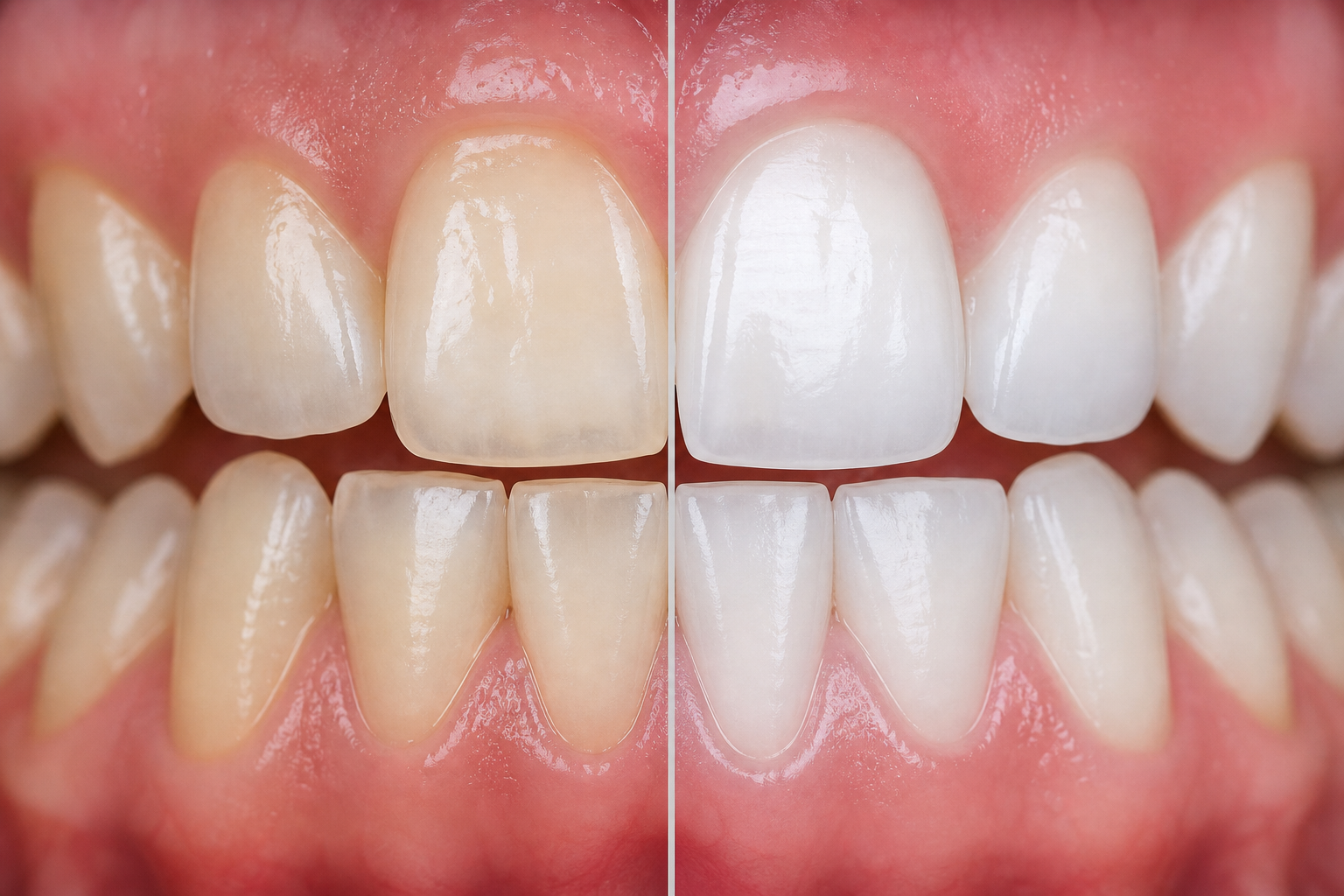
Teeth whitening before and after results can look very different from one person to another because teeth do not all start at the same shade or respond in the same way. When I assess someone for whitening, I look at the type of staining, the natural colour of each tooth, any fillings or crowns, and whether there is a darker tooth that needs separate investigation. Professional whitening can lighten natural tooth structure without removing it, but it cannot guarantee one identical shade across every tooth or recreate the result in somebody else's photograph.
Yellow or surface-stained teeth often respond more predictably than deeply discoloured, grey or developmentally marked teeth. Existing bonding, fillings, crowns and veneers will not whiten at all, which is one of the main reasons a smile can look uneven after treatment.
What should you realistically expect from teeth whitening before and after?
I usually explain that whitening should make your natural teeth lighter, not necessarily uniformly white. The aim is often a fresher, brighter version of your own smile rather than an artificial-looking shade that may not be achievable or suitable for your teeth.
A before-and-after image is useful as an illustration of what can be possible for one person, but it is not a prediction of your result. The starting shade, lighting, camera settings, timing of the photographs and temporary changes in how hydrated the teeth are can all affect how dramatic a change appears in an image.
Some teeth are naturally slightly darker, warmer or more translucent than others. This variation can remain after whitening, even where treatment has worked well. I would assess the overall smile rather than judge success solely by whether every tooth looks identical.
Why do some teeth whiten more than others?
Natural teeth vary in their structure and colour. The outer enamel layer is partly translucent, so the underlying dentine, which is naturally more yellow in colour, contributes significantly to the shade you see. Enamel can also look different near the gumline and at the biting edge of a tooth.
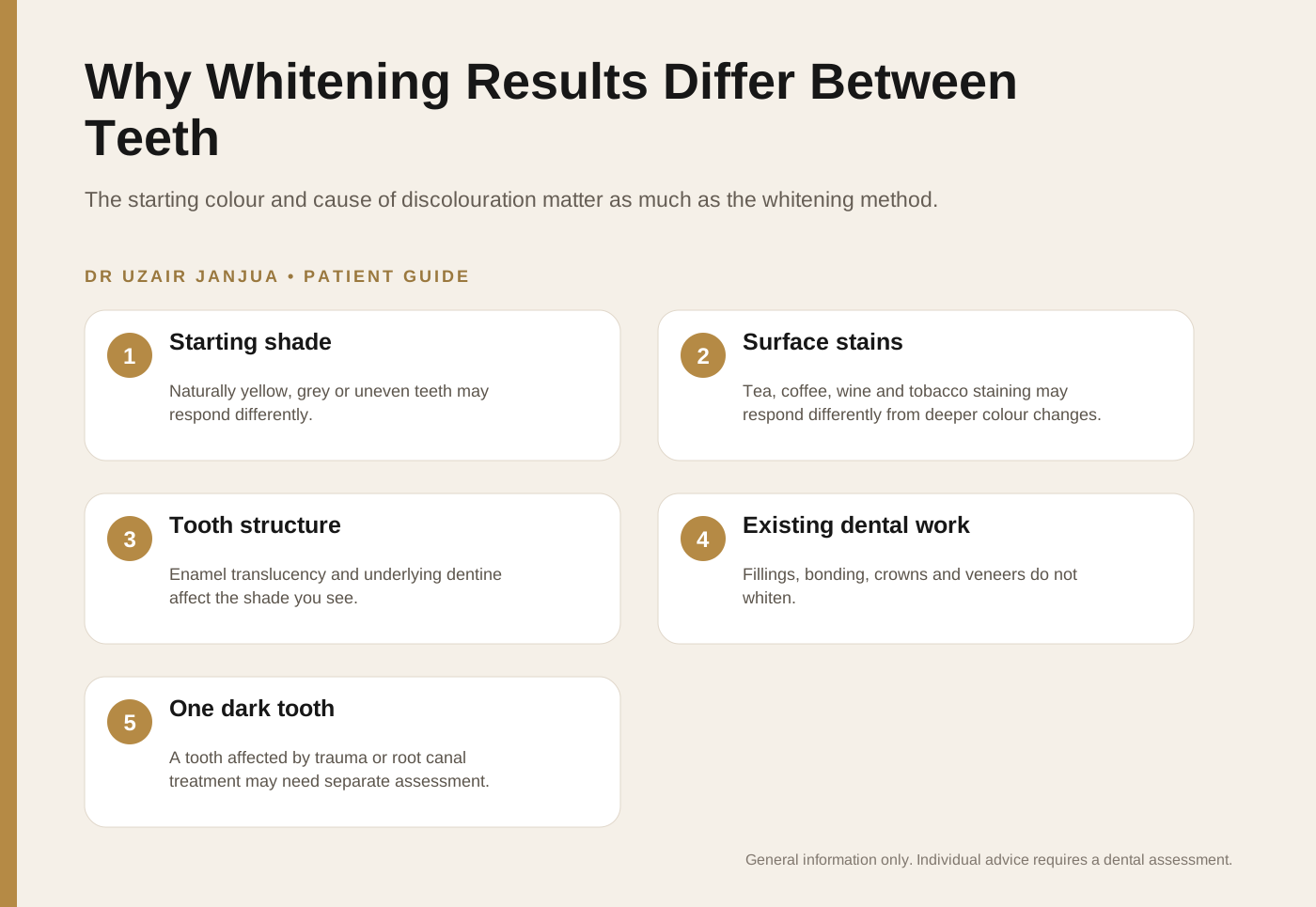
Different teeth may have been exposed to different amounts of staining over time. Front teeth and teeth with previous dental work can therefore begin at noticeably different shades. It is not unusual for some teeth to remain slightly warmer or darker than others after whitening.
What I would look at first is whether the difference is a normal variation in natural colour, a surface stain, an old restoration, or a sign that one tooth needs a more focused assessment. That distinction matters far more than trying to make every tooth match an online shade guide.
Surface stains and deeper discolouration are not the same
Surface staining from tea, coffee, red wine, tobacco and strongly coloured foods can sit on or close to the tooth surface. A professional clean may help remove some of this staining, while whitening can address the natural tooth colour beneath it.
Deeper discolouration develops within the enamel or dentine. It can be related to ageing, a tooth's development, certain medicines, trauma or changes inside a tooth. These causes can still sometimes improve with whitening, but the response is usually less predictable and may take longer.
| Type of colour change | What I would consider | Likely treatment approach |
|---|---|---|
| Tea, coffee, wine or tobacco staining | How much is surface stain and how healthy the teeth and gums are | Cleaning, followed by whitening where appropriate |
| Age-related yellowing | Starting shade, sensitivity and expectations | Dentist-prescribed whitening may be a conservative option |
| Grey, striped or patchy discolouration | Whether the cause is developmental, medication-related or trauma-related | Whitening may help, but another treatment may also be needed |
| One noticeably dark tooth | Whether the tooth is healthy and still alive, any trauma history, root canal treatment and X-ray findings where needed | Assessment for targeted treatment, including possible internal bleaching |
I would not assume that every brown, white or grey mark has the same cause from a photograph alone. An examination is important because the best option depends on the depth and nature of the colour change.
Which stains are more difficult to whiten?
Tetracycline staining, fluorosis, enamel-development changes and trauma-related darkening can be more challenging than general yellowing. Whitening may still provide improvement in selected cases, but I would discuss realistic expectations carefully rather than promise a dramatic or perfectly even change.
Tetracycline staining can create grey, brown or banded discolouration within the tooth. It may need a longer, carefully supervised whitening approach and can still require restorative treatment if the remaining colour is distracting. Whitening can be worth considering before more invasive options because it may reduce the amount of masking needed.
White spots are another area where people can be disappointed if they expect whitening to remove them. These marks can be caused by fluorosis, early demineralisation or enamel defects. As the surrounding tooth becomes lighter, some white areas can initially look more obvious. Depending on the diagnosis, I may discuss observation, whitening, microabrasion, bonding or another approach.
If one tooth has become darker than the rest, particularly after an injury or root canal treatment, repeated whole-smile whitening is not always the answer. I would assess that tooth separately and may need an X-ray before advising whether internal bleaching or restorative treatment is appropriate.
What happens if I have fillings, crowns, veneers or bonding?
Fillings, composite bonding, crowns, veneers, implants and dentures do not whiten. Whitening changes natural tooth structure only, so existing dental work stays at its original shade while the surrounding teeth become lighter.
This does not mean whitening is unsuitable if you have restorations. It means I need to identify which restorations show when you smile and whether a shade difference is likely to become noticeable. A small filling hidden at the back may not matter, whereas bonding on a front tooth or a visible crown can become a clear mismatch.
If you are considering new visible bonding, veneers or replacement fillings, I would usually establish your preferred natural tooth shade first. New restorations can then be matched to the whitened teeth. Existing visible restorations that no longer match may need review, repair, replacement or planned remaking, depending on their condition and the appearance you want to achieve. For concerns involving colour as well as small chips, shape or spaces, composite bonding treatment may be part of the discussion after whitening has settled.
What I assess before recommending whitening in Birmingham
Before I recommend whitening, I would examine the teeth and gums rather than rely on a photograph or an online shade description. Whitening is a cosmetic treatment, but it still needs to be planned around your oral health and the reason your teeth look darker.
- I check for decay, cracks, leaking fillings and gum problems that may need attention first.
- I ask about existing sensitivity, gum recession and any discomfort from cold or sweet foods.
- I identify crowns, veneers, bonding and fillings that will not change shade.
- I assess whether the colour is generalised or limited to one tooth.
- I assess whether a darker individual tooth appears healthy and still alive, or needs further investigation.
- I consider whether the staining is likely to be surface-based, age-related or deeper within the teeth.
- I discuss the shade you hope to achieve and whether it is realistic for your starting point.
Short-term sensitivity and gum irritation can occur with whitening, particularly if whitening gel contacts the gums or teeth are already sensitive. These effects are often temporary, but I would take them seriously when deciding the method, pace and suitability of treatment.
For patients in Birmingham and across the West Midlands, an assessment is especially worthwhile before booking whitening around a wedding, holiday or graduation. If you are travelling from Solihull, Coventry, Wolverhampton, Sutton Coldfield, Dudley or Walsall, allow time for an examination, tray fitting where relevant and any review appointments rather than choosing treatment only on speed.
If you want a personal view of how your teeth may respond, including whether visible dental work could look mismatched afterwards, I can assess this during a teeth whitening consultation in Birmingham.
Why online before-and-after photographs can be difficult to compare
I would treat whitening photographs as a conversation starter, not a shade promise. The same teeth can appear lighter or darker depending on room lighting, camera settings, lip colour, image exposure and the timing of the image. Teeth can also look temporarily different immediately after treatment, so the point at which a photograph is taken matters.
A useful image should show a clear starting point and a comparable final image. Even then, it cannot show how your enamel, dentine, restorations or stain type will react. The clinically useful comparison is your own starting shade, recorded before treatment, followed by a review of the change you have achieved.
When comparing examples, I suggest asking whether the teeth shown had crowns, bonding or veneers, whether the colour change was general or limited to certain teeth, and whether the result required further restorative work. Those details often explain why one smile changes more dramatically than another.
What should you do if whitening looks patchy or uneven?
If your teeth look uneven after whitening, I would not advise simply using more product or extending treatment without review. Some temporary variation can settle as advised after treatment, but persistent patchiness needs an explanation before deciding what to do next.
I would first check whether the difference is caused by fillings, crowns, bonding or veneers that have stayed the same shade. I would also assess whether white spots, enamel changes, a darker tooth that needs separate treatment or natural variation between teeth are contributing to the appearance.
The next step may be further supervised whitening, a targeted approach for one dark tooth, microabrasion for a suitable superficial enamel change, or restorative treatment to mask a persistent colour difference. The right answer depends on preserving as much healthy tooth structure as possible while addressing the feature that concerns you.
Whitening versus bonding or veneers
Whitening is often the most conservative option where the main concern is the colour of healthy natural teeth. It can brighten the smile without changing tooth shape or removing tooth structure, but it cannot correct chips, gaps, uneven edges, significant enamel defects or persistent deep discolouration in every case.
I would consider bonding where colour needs masking but there is also a small shape, edge or spacing concern. Composite can be carefully colour-matched, although it needs maintenance over time and may require polishing, repair or replacement. Veneers can provide more comprehensive masking and shape change for selected teeth, but they are a more significant commitment and often involve irreversible preparation.
For persistent intrinsic staining or combined concerns about colour and tooth shape, I can explain whether porcelain veneers are relevant, or whether a less invasive route makes more sense first. I would not recommend veneers simply because whitening is gradual or because a photograph shows an unusually bright result.
How long do whitening results last and how can you maintain them?
Whitening is not permanent. Over time, new surface staining can develop and natural teeth can gradually darken again. How long the result remains noticeable varies with diet, smoking, oral hygiene, the original tooth colour and the shade achieved.
I usually advise patients to maintain regular hygiene appointments, limit frequent exposure to strong staining products where practical, and use any top-up whitening only as professionally advised. A bright result should be maintained sensibly, not chased repeatedly in pursuit of a shade that is unnatural or difficult for your teeth to sustain.
The most useful teeth whitening before-and-after comparison is not somebody else's image. It is your own assessed starting shade, the likely response of your natural teeth and a plan for any restorations that will remain unchanged. If you are considering whitening in Birmingham or the West Midlands, or you already have an uneven result, arrange an examination so I can advise whether whitening, targeted treatment or a restorative option is the most appropriate next step.