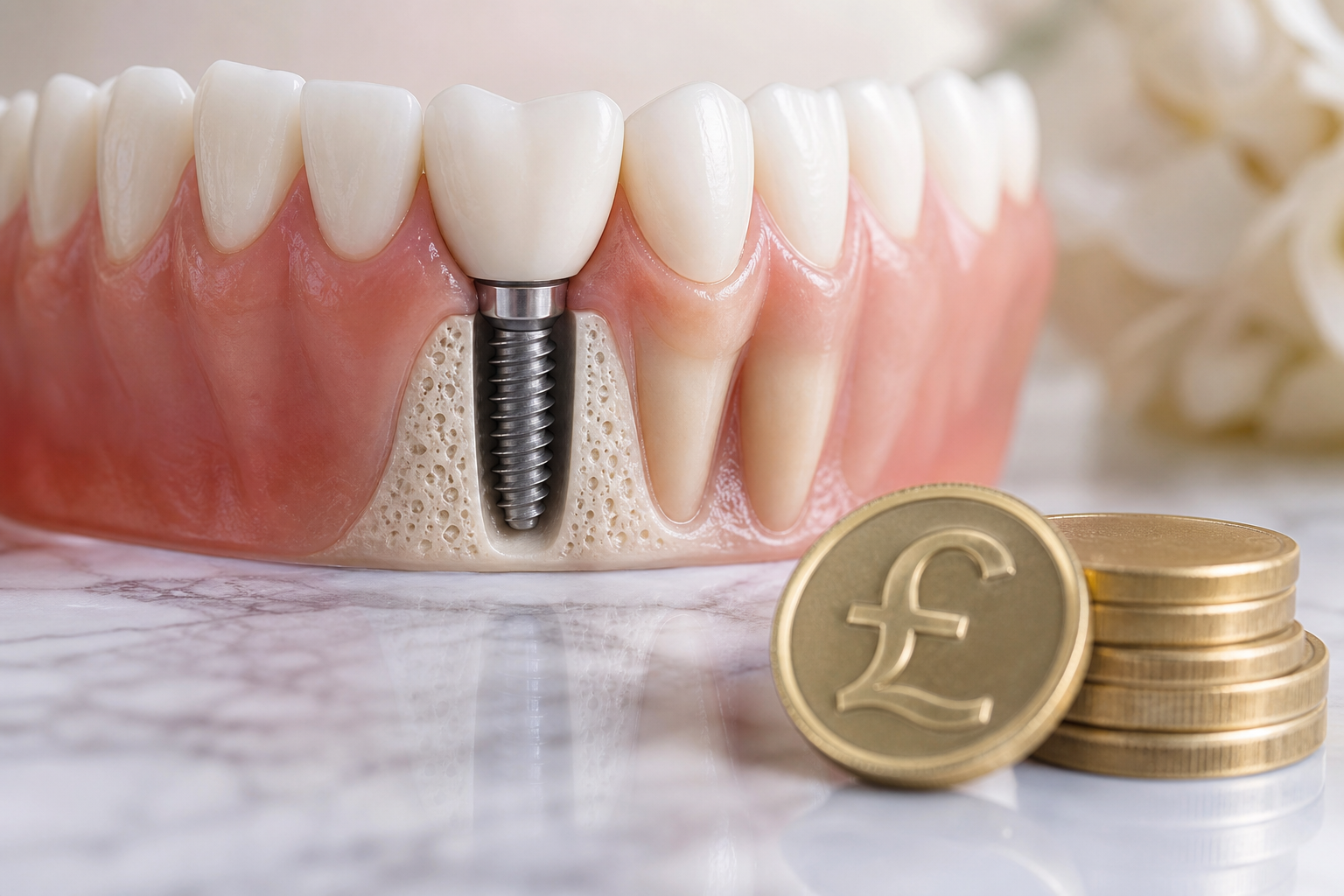
Age alone does not prevent you from having dental implants. When I assess people in their 60s, 70s, 80s and beyond, I focus on gum health, available bone, general health, medicines, cleaning ability and whether the treatment suits their priorities. The cost of dental implants for seniors in the UK is not based on age. It depends on the amount and complexity of treatment required.
If you have worn dentures for years, have been told you have bone loss or take several medicines, implants may still be possible. Equally, I would not recommend rushing into surgery if gum disease, unstable medical conditions or practical difficulties with cleaning need attention first. An examination and appropriate imaging are the only reliable way to decide.
For an overview of the treatment journey, you can also read about dental implants in Birmingham.
How much do dental implants cost for seniors in the UK?
There is no separate senior tariff for dental implants in the UK. I usually explain that the final fee reflects what is needed to create and maintain a safe, functional replacement tooth or denture, rather than a patient’s age.
A single missing tooth may need one implant, an abutment which connects the implant to the visible tooth, and a crown. Replacing several teeth may involve individual implants, an implant-supported bridge or an implant-retained denture. Each option has different surgical, laboratory and maintenance requirements.
The most useful comparison is not a headline implant price. I would ask to see an itemised plan showing whether it includes the consultation, scans, extraction, implant, abutment, temporary tooth, final crown or denture, grafting, reviews and future maintenance. A lower starting figure can be misleading if essential components are added later.
It is also worth separating the initial treatment fee from the longer-term ownership cost. Crowns, bridges, dentures and retaining components can need maintenance, repair or replacement over time, so I would encourage you to ask what future care is likely to involve as well as what treatment costs at the outset.
For a wider explanation of UK pricing, I have covered the factors behind dental implant costs in the UK in more detail.
| Cost element | Why it may be needed |
|---|---|
| Assessment and imaging | To assess teeth, gums, bite and bone, sometimes using a CBCT scan, which is a detailed 3D scan. |
| Preparatory care | Gum treatment, fillings, extractions or a temporary denture may be needed before implant surgery. |
| Bone treatment | Bone grafting, ridge augmentation or a sinus lift can add treatment stages where anatomy requires it. |
| Final restoration | A crown, bridge or implant-retained denture has different laboratory and design requirements. |
| Long-term care | Hygiene visits, reviews, denture clips, screws and restorations may need repair or replacement over time. |
Am I too old for dental implants?
No, there is no fixed upper age limit for implants. What I would look at first is whether your mouth and general health are in a position to support healing, whether the proposed design can be kept clean and whether the treatment journey is practical for you.
Someone who is otherwise well and independent may be suitable at an advanced age. In another person, frailty, a serious uncontrolled medical condition, active dental infection, cognitive impairment, limited ability to attend appointments or difficulty cleaning around restorations may make a simpler option more sensible.
Where a person relies on a carer or family member, I would also discuss what practical support is available for cleaning, attending reviews and recognising any concerns early. This is not about making assumptions. It is about choosing a restoration that remains realistic to look after.
I also discuss what you want the treatment to achieve. For some people, replacing one visible tooth matters most. For others, the priority is stopping a lower denture from lifting while eating or speaking. It is not always necessary, or beneficial, to replace every missing tooth with an individual implant.
What I would assess before recommending implants
When I assess an older adult for implants, I start with the whole picture rather than just the gap. I need to understand your dental history, medical history, medication list, expectations and day-to-day routine.
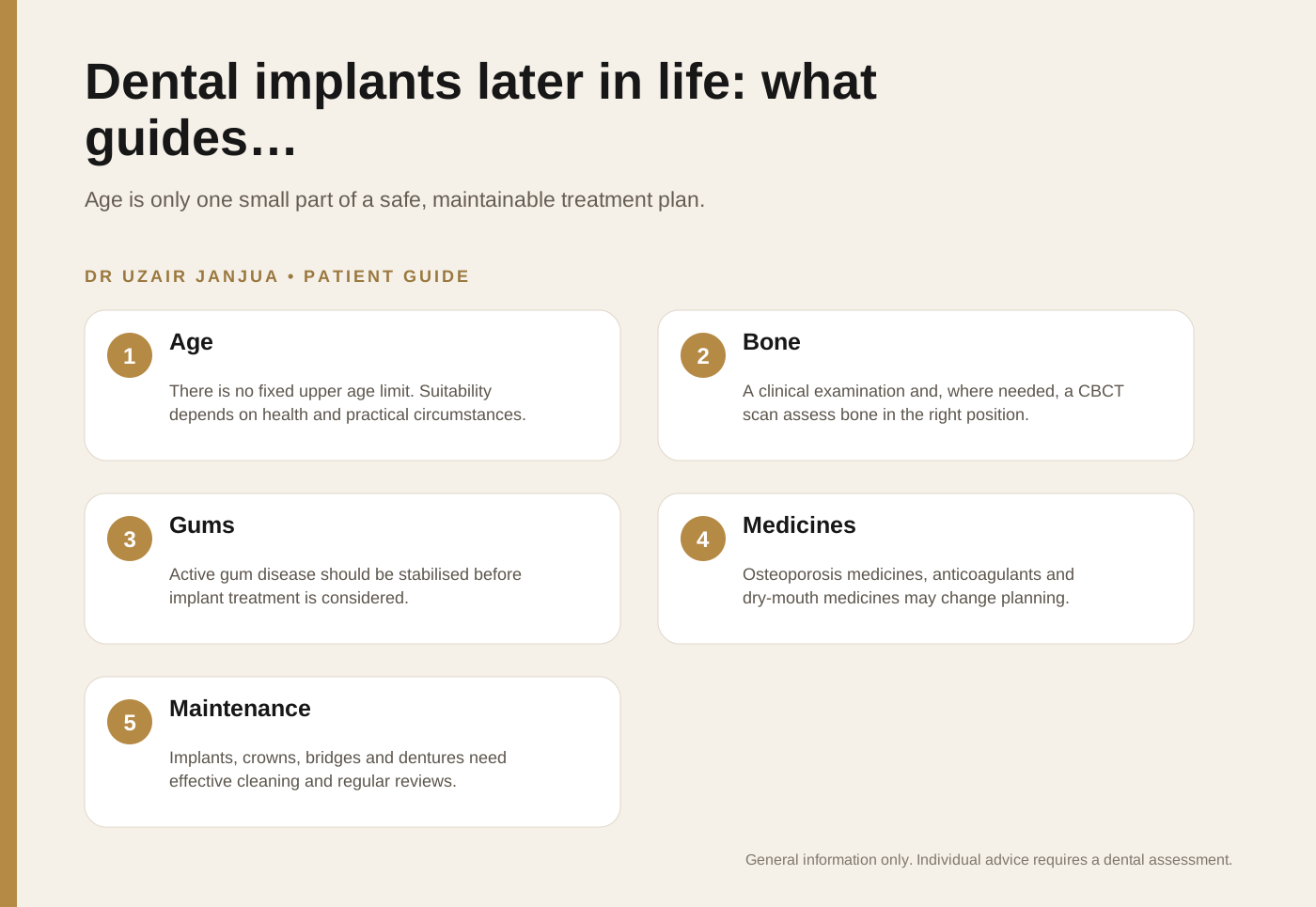
- Gums and remaining teeth: Active gum disease and untreated decay should be stabilised first. A past history of gum disease does not automatically rule out implants, but it makes careful cleaning and regular review especially important.
- Bone and bite: I assess the amount and position of bone, the space available and how your teeth or dentures meet together.
- Medical health: Conditions such as diabetes need to be considered in context. Well-managed diabetes is different from poorly controlled diabetes, which may affect healing and infection risk.
- Smoking: Smoking can increase the risk of complications. Reducing or stopping smoking may improve the overall risk profile, although it does not remove every risk.
- Cleaning and dexterity: Arthritis, tremor, poor eyesight, dry mouth or reduced mobility can make cleaning around an implant bridge or denture more difficult. I would favour a design you can realistically maintain.
- Practicalities: Implant treatment often involves several visits over months. Transport, caring responsibilities and the ability to attend reviews matter, particularly for patients travelling across Birmingham and the West Midlands.
This assessment is also where I explain the alternatives. An implant is not automatically the best choice simply because it is a fixed option.
Does bone loss mean I cannot have dental implants?
Bone loss does not automatically rule out dental implants. After a tooth is removed, the jawbone in that area can gradually reduce in width and height. This can happen after years of wearing dentures too, although the amount and pattern of change vary considerably between individuals.
I would assess the available bone clinically and, where needed, with a CBCT scan. The scan helps me see whether there is enough bone in the right position for an implant and whether important structures, such as the sinus or nerves, affect planning.
Some people can have implants placed using the bone already available. Others may need bone grafting or another form of augmentation before placement. Grafting can broaden the options, but it also adds cost, surgery, healing time and uncertainty. It is not something I would recommend automatically.
Sometimes a different design is the more proportionate answer. For example, an implant-retained denture may improve stability with fewer implants than a plan to replace every missing tooth individually. In more complex cases, I would explain whether a fixed bridge, overdenture or conventional denture is the more maintainable option.
Medical conditions and medicines that can change the plan
One thing I usually explain to patients is that a medication list can be as important as an X-ray. I need an up-to-date list of prescribed medicines, over-the-counter products and relevant medical conditions before planning any implant surgery.
Osteoporosis medicines
Bisphosphonates and denosumab are antiresorptive medicines commonly prescribed for osteoporosis and other bone conditions. They need specific consideration because, in some circumstances, they are associated with a risk of medication-related osteonecrosis of the jaw, where jawbone healing is affected.
Taking these medicines does not automatically mean implants are impossible. I would consider the type of medicine, dose, duration, reason it was prescribed and your wider risk factors, and may need to liaise with your GP, osteoporosis team or prescribing clinician. You should never stop or change prescribed medication without their advice.
Diabetes, anticoagulants and dry mouth
Diabetes may affect healing if it is poorly controlled, but its presence alone does not decide suitability. Anticoagulants, sometimes called blood-thinning medicines, can affect surgical planning and bleeding management. They should not be stopped independently.
Medicines that contribute to dry mouth can also matter. A dry mouth may increase discomfort, plaque retention and the risk of decay in remaining teeth. I would plan around these issues rather than treating them as an afterthought.
Implant, bridge, denture or implant-retained denture?
The better option depends on the number and position of missing teeth, the condition of neighbouring teeth, your bone, budget, cleaning ability and how much surgery you are comfortable with. I would not describe one option as best for every older person.
| Option | Potential advantage | Trade-off to understand |
|---|---|---|
| Single implant and crown | Can replace one tooth without preparing adjacent teeth. | Requires surgery, adequate bone and ongoing cleaning around the implant. |
| Conventional bridge | Usually avoids implant surgery and can be completed more quickly. | Normally relies on adjacent teeth, which may need preparation. |
| Conventional denture | Less invasive and often has a lower initial cost. | May move, needs removal for cleaning and can become less stable if the supporting jaw changes over time. |
| Implant-retained denture | Can improve denture stability without an implant for every tooth. | Still needs surgery, removal for cleaning and periodic maintenance of clips or components. |
| Fixed implant bridge | Offers a fixed replacement for several teeth or an arch in selected cases. | Can be more costly and demanding to clean and repair. |
If you are weighing up the main choices, my guide to implants, bridges and dentures for missing teeth may help you prepare for a consultation.
What can change the final price?
The complexity of the starting point usually has the greatest effect on the final cost. A plan involving healthy gums, good bone and one straightforward space is very different from a plan involving failing teeth, long-term denture wear, bone loss and a full-arch restoration.
I would encourage Birmingham and West Midlands patients to ask for a written plan that separates the initial treatment cost from likely ongoing care. It should clarify who provides long-term reviews and what happens if a temporary tooth, denture or final restoration needs repair, servicing or replacement.
- The number of teeth being replaced and the chosen implant-supported design.
- Scans, photographs and diagnostic planning.
- Gum treatment, extractions or treatment needed for remaining teeth.
- Bone grafting, sinus lifting or other preparatory surgery.
- The type of crown, bridge or denture, including laboratory work and materials.
- Temporary teeth or dentures during healing.
- Sedation or additional clinical support where appropriate.
- Follow-up appointments, hygiene care and future replacement parts.
- Travel costs and the practical burden of attending several appointments.
If you would like an individual view of your bone, medical considerations and likely treatment stages, an implant assessment is the sensible next step. I can discuss whether implants, an implant-retained denture or a non-implant alternative is the more appropriate route for you.
Questions I would suggest asking before you agree to treatment
A good consultation should leave you clear about the plan, not simply impressed by a price. I would be comfortable answering these questions in detail before you commit.
- What exactly is included in the written fee, and what could be an additional cost?
- Does the quote include the implant, abutment, crown or denture, scan, temporary tooth and aftercare?
- Do I need gum treatment, extractions or bone grafting first?
- What are the realistic alternatives, including a bridge or a conventional denture?
- How many appointments and how much healing time might my case involve?
- How will I clean the final restoration, and can I manage that routine with my current dexterity?
- What maintenance, repair or replacement costs could arise over the coming years?
- Who will provide maintenance, repairs and urgent care in future?
- What implant system and components are being used, and can they be serviced locally in years to come?
These questions matter if you are considering treatment abroad as well. A lower initial quote may not account for repeat travel, local maintenance, record transfer, emergency care or the practical difficulty of managing a complication once you are back in the UK.
The realistic long-term commitment
Implants are not maintenance-free, and I would never present them as permanent teeth that can be ignored. The implant itself, the connecting components and the visible crown, bridge or denture are different parts with different maintenance needs.
Daily cleaning and regular professional review are important because plaque can cause inflammation around implants. Early inflammation around the gums is often referred to as peri-implant mucositis. More advanced disease involving bone loss is called peri-implantitis. The risk is one reason why I pay close attention to cleaning access before selecting a design.
Over time, a crown can wear, a bridge may need repair, and an implant-retained denture may need relining, new retaining clips or eventual replacement. Your health and dexterity can change too. A simpler restoration that remains cleanable may be a better long-term investment than a more elaborate option that becomes difficult to look after.
If you are considering dental implants later in life, I would focus less on whether you are “too old” and more on whether the treatment is safe, maintainable and worthwhile for your particular circumstances. A detailed assessment in Birmingham can establish what your bone, gums, medications and goals mean for the options available, then allow you to make a decision with a clear plan rather than a headline price.