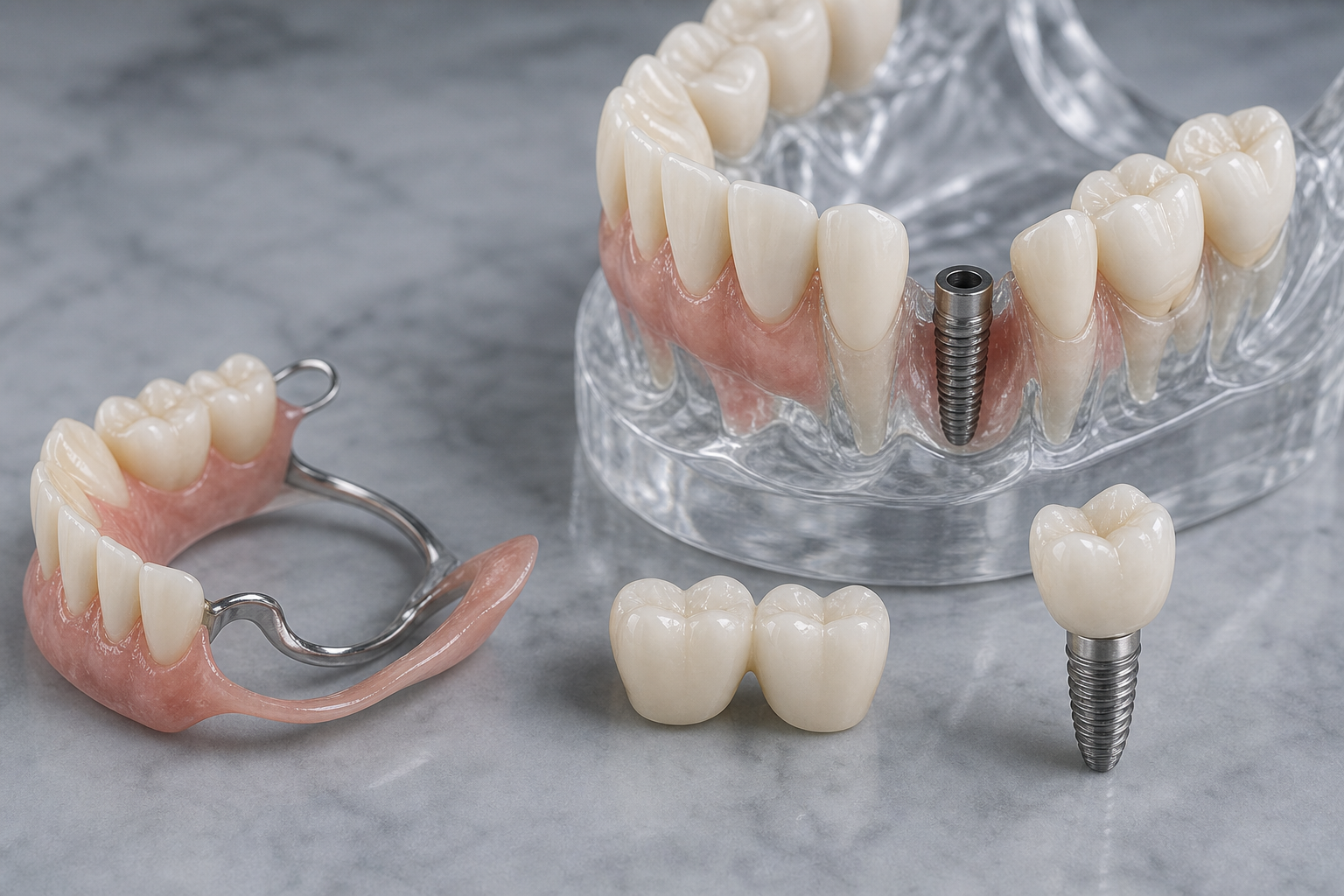
There is no single best missing tooth replacement for everyone. I would usually compare a dental implant, a fixed bridge and a removable denture, then look at the position of the gap, the health of your gums and remaining teeth, your bite, available bone, timescale and budget. In some situations, particularly at the back of the mouth, monitoring the gap may also be reasonable.
An implant can replace the missing root as well as the visible tooth, without usually preparing neighbouring teeth. A bridge can be a quicker fixed option where the teeth next to the gap are suitable. A denture avoids implant surgery and can replace one or several teeth, but it is removable. The right choice should come after an examination, rather than from an online ranking alone.
Which missing tooth replacement is best?
The best option is the one that gives you a sensible balance of function, appearance, long-term reliability and invasiveness for your particular mouth. I would not automatically recommend an implant simply because it is a more technically involved option, and I would not choose a bridge or denture purely because it has a lower starting cost.
For one missing tooth with healthy neighbouring teeth, an implant-supported crown or an adhesive bridge may be worth discussing. If the adjacent teeth already need crowns, a conventional bridge can sometimes make more sense. For several missing teeth, a partial denture, implant-supported bridge or implant-retained denture may be more practical than replacing every tooth individually.
One thing I usually explain is that a good replacement plan starts with the teeth you are keeping. If those teeth have active decay, unstable gum disease or an uncertain long-term outlook, I would address that first rather than build a new restoration around a problem.
What I would assess before recommending an option
When I assess someone for missing tooth replacement, I look beyond the gap itself. A front tooth and a back tooth create different priorities. A visible front gap may make appearance or speech an important individual concern, while a back tooth replacement is often more about chewing, available space and the forces placed on it.
- The missing tooth position and number of spaces, including whether the teeth have moved since the tooth was lost.
- The neighbouring and opposing teeth, including fillings, crowns, root canal treatment, strength and their likely long-term prognosis.
- Gum health and cleaning, because untreated gum disease can undermine any replacement option.
- Bone at the missing tooth site, particularly if you are considering an implant.
- Your bite and any grinding or clenching, which can affect bridge design, denture stability and implant loading.
- Medical history, smoking and healing factors, which may alter implant planning and risk.
- Your priorities, such as avoiding surgery, having a fixed tooth, limiting appointments, managing cost or replacing a tooth quickly for work or social reasons.
I would normally use examination findings and appropriate X-rays before confirming a recommendation. In more complex implant cases, three-dimensional imaging may be needed to assess bone and important nearby structures.
Dental implant, bridge or denture: the practical comparison
This is where people sometimes get confused. All three options can replace the visible gap, but they work in different ways and ask different things of your mouth.
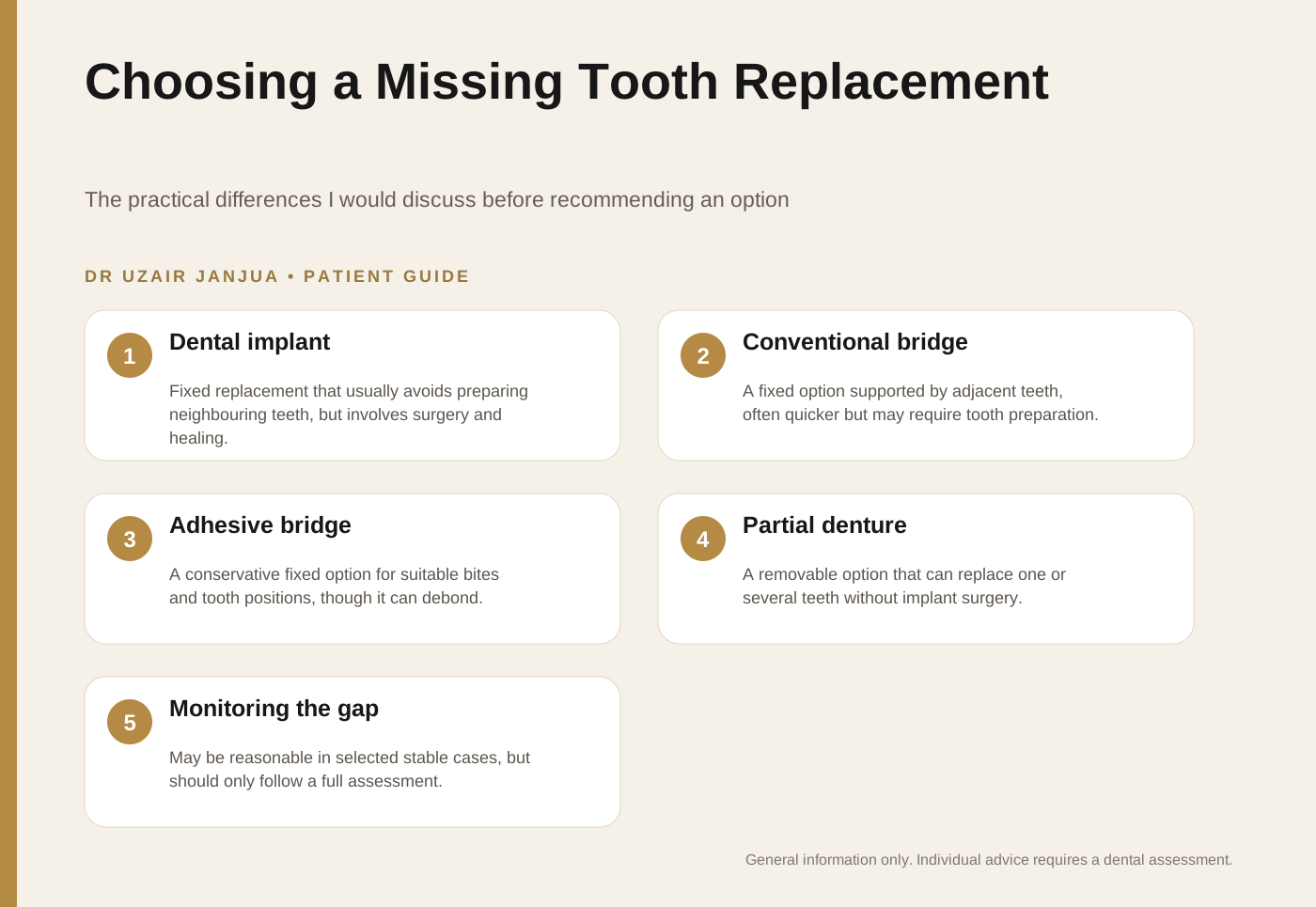
| Option | Fixed or removable? | What it relies on | Typical advantage | Main trade-off |
|---|---|---|---|---|
| Implant-supported crown | Fixed | An implant placed in the jawbone | Usually avoids preparing adjacent natural teeth | Surgery, healing time, suitability checks and ongoing maintenance |
| Conventional bridge | Fixed | One or more neighbouring teeth | Often quicker than implant treatment | May involve irreversible preparation of supporting teeth |
| Adhesive bridge | Fixed | Bonding to a neighbouring tooth, often on the back surface | Usually a more conservative option for suitable cases | Can debond and is not suitable for every position or bite |
| Partial denture | Removable | The gums, remaining teeth and denture design | No implant surgery and can replace several teeth | Needs removal, cleaning and an adjustment period |
The option that appears cheapest at the start is not always the lowest-cost option over many years. For example, a denture may need adjustments, relining, repair or replacement as the mouth changes, while an implant crown or bridge may need future attention to its crown, screw or other components. I would encourage you to compare likely maintenance, repairs and replacement, as well as the first quotation.
When a dental implant may make sense
An implant may be a strong option when you want a fixed replacement and the neighbouring teeth are healthy enough that it would be preferable not to prepare them. The implant is placed in the jawbone and can support a crown for one missing tooth, a bridge for several spaces or, in selected cases, help retain a denture.
Because an implant replaces the root as well as the visible part of the tooth, it may help maintain bone at the extraction site. That does not mean the area is protected from all future bone or gum changes. Inflammation around implants can still occur, particularly where cleaning is difficult or gum health is not stable.
I would assess whether there is enough healthy bone, whether the gums are stable and whether your bite can be managed safely. Bone loss does not automatically rule out an implant, but it can mean that grafting or a different treatment plan is needed. That can increase both the number of stages and the overall treatment time.
Implant treatment involves a surgical phase followed by a restorative phase. Healing can take several months, especially where an extraction, infection, bone graft or gum treatment is part of the journey. Some people can have a temporary tooth while the site heals, but this depends on the position and stability of the case.
I also make clear that an implant is not a fit-and-forget treatment. The crown, screw or other components may need attention over time, and the gums around the implant need careful home cleaning and professional review. You can read more about the planning involved with dental implants in Birmingham if this is the option you are considering.
When a bridge or denture may be the more sensible choice
A bridge can be a good fixed alternative
A conventional bridge uses teeth on either side, or occasionally one side, to support the replacement tooth. I may consider this where neighbouring teeth are already heavily restored or crowned and are strong enough to support a bridge. It can provide a fixed result without implant surgery and may be completed sooner than a staged implant plan.
The important trade-off is tooth preparation. To make room for a conventional bridge, the supporting teeth are usually shaped. This is irreversible, and in some cases can affect the nerve inside a tooth and lead to further treatment later. I would not advise preparing healthy teeth casually when a more conservative alternative is realistic.
An adhesive bridge, sometimes called a resin-bonded bridge, is bonded to enamel and often needs little or no tooth reduction. It can be particularly useful for selected front-tooth gaps. However, it can come loose, and whether it is appropriate depends on the bite, enamel quality, space and how heavily that area is loaded.
A denture can be the right practical solution
A removable partial denture can replace just one tooth or several teeth. I may recommend one where surgery is not wanted, where several gaps need replacing, where the remaining teeth cannot reliably support a fixed bridge, or as an interim solution while a longer-term plan is developed.
Dentures can be made in different materials and designs. A smaller one-tooth denture may be useful for appearance while a site heals, while a more robust partial denture may be considered for multiple missing teeth. I would discuss realistic expectations around movement, speech, chewing and appearance rather than suggesting a denture will feel exactly like natural teeth.
Dentures normally need to be removed for cleaning and are generally taken out overnight unless I have given you different advice. As gums and bone change over time, they may need adjustment, relining, repair or replacement.
If you are weighing up a bridge, denture or implant, a consultation is the sensible point to assess the gap alongside your gums, bite and the teeth you are relying on. For patients travelling into Birmingham from elsewhere in the West Midlands, I would also talk through likely visits and how aftercare can be arranged.
Do you always need to replace a missing tooth?
No. A missing tooth does not automatically need replacing. If a space is not affecting appearance, speech, chewing, cleaning or bite stability, and the remaining teeth are healthy, I may advise monitoring it rather than intervening immediately.
That said, I would not assume a gap is harmless without checking it. Nearby teeth can drift, the opposing tooth may move further into the space, and food packing or bite changes can become more difficult in some mouths. The likelihood and importance of these changes vary greatly depending on the tooth position and your existing bite.
With a front-tooth gap, appearance may be a priority for you. With a missing back tooth, the decision can be more nuanced. What I would look at first is whether you are functioning comfortably, whether there is enough space for a future replacement and whether the rest of your dentition is stable.
What changes the cost and timescale of missing tooth replacement?
I cannot safely give an individual fee or timetable without examining you, because the replacement itself is only part of the treatment. A written, itemised plan is more useful than a headline figure, particularly if there are preparatory stages.
| Factor | Why it matters |
|---|---|
| Number and position of missing teeth | A single crown, multi-tooth bridge and partial denture involve different designs and laboratory work. |
| Condition of remaining teeth and gums | Gum treatment, fillings, root canal treatment, crowns or extractions may be needed before a final replacement. |
| Imaging and planning | Standard X-rays, scans, photographs and diagnostic planning may be required, especially for implants. |
| Bone availability | An implant site with reduced bone may need grafting or a modified plan, adding stages and healing time. |
| Temporary replacement | A temporary denture or bridge may be needed while an extraction site or implant area heals. |
| Long-term maintenance | Adjustments, hygiene reviews, denture relines, repairs and replacement components should be considered from the start. |
A bridge or denture can sometimes be provided over a shorter period once the mouth is ready. Implant treatment commonly takes longer because healing and stability need to be respected. If you have recently lost a tooth, the timeline may also depend on whether the site needs to heal first and whether a temporary replacement is appropriate.
Before you accept a quotation, I suggest asking whether it includes the examination, imaging, any gum or preparatory treatment, a temporary replacement where needed, the final restoration and planned aftercare. Implant treatment is commonly arranged privately, so it is particularly important to confirm the full route, what is included and the likely future maintenance. For a closer explanation of why implant fees can vary, see my guide to dental implant cost factors in the UK.
Questions I suggest asking before you choose
A useful treatment discussion should be about more than which option looks best on a diagram. I would encourage you to ask questions that reveal the long-term plan.
- What is the outlook for the teeth next to and opposite the gap?
- Would a bridge require healthy teeth to be prepared, and is an adhesive bridge possible?
- Is there enough bone and gum health for an implant, or would preparatory treatment be needed?
- What temporary replacement is available while treatment is underway?
- What could need adjustment, repair or replacement in the future?
- How should I clean around this option, and how often should it be reviewed?
- Who will provide aftercare if I need help after the tooth is fitted?
- Can I have a written estimate separating examination, imaging, preparatory treatment, the final restoration and likely maintenance?
For someone based in Birmingham, Solihull, Sutton Coldfield, Wolverhampton, Coventry or elsewhere in the West Midlands, practical continuity matters. A replacement tooth can need review years later, so it is worth knowing where scans, surgical care, repairs and hygiene support will be provided.
Choosing the right replacement for your mouth
I usually summarise the decision this way. An implant may be worth considering if you want a fixed tooth and can accept surgery, healing time and long-term maintenance. A bridge may be a better fit if the supporting teeth are suitable and you want a fixed option without implant surgery. A denture may be the most practical route if you need to replace several teeth, prefer to avoid surgery or need an interim solution.
No option is automatically right simply because it is fixed, removable, faster or more expensive. I would assess the health and future of the whole mouth before advising which route offers the most sensible balance for you.
If you are considering missing tooth replacement in Birmingham or the West Midlands, arrange a consultation so I can assess the gap, your bite, gums, bone and remaining teeth, then talk you through the realistic options and their likely maintenance. That gives you a plan based on your mouth rather than a general comparison.