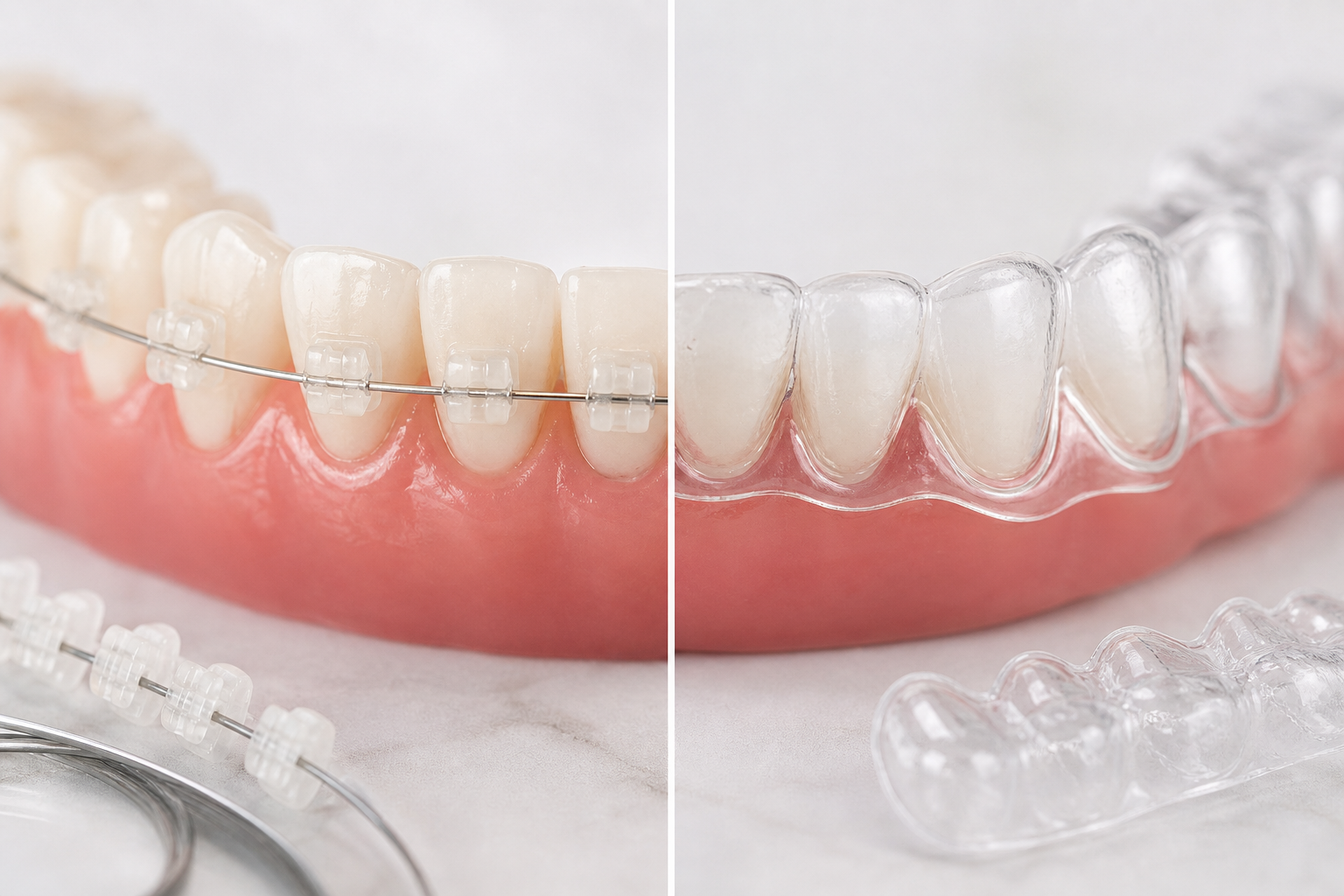
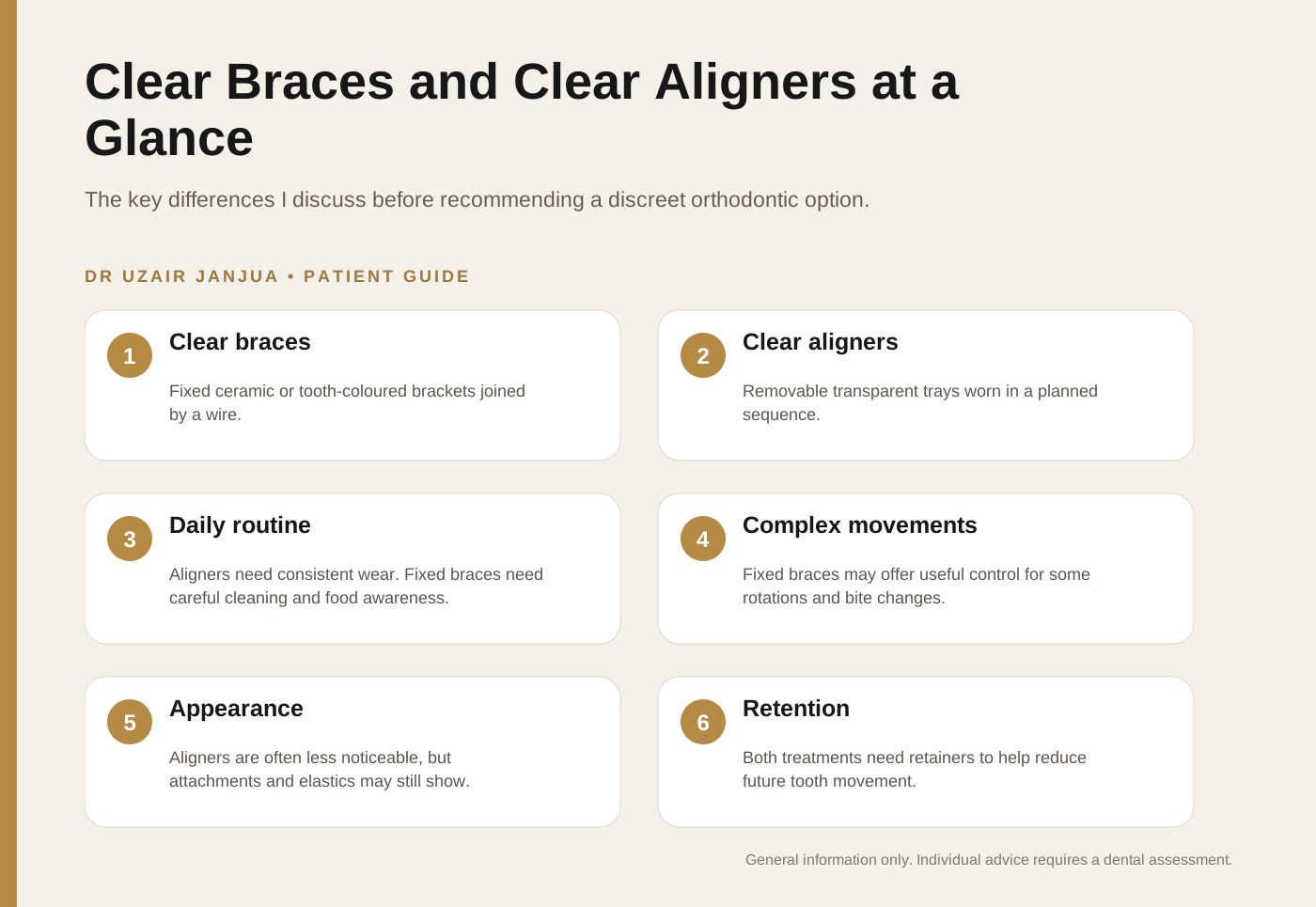
Clear braces and clear aligners are not the same treatment. When I assess someone considering discreet teeth straightening, I explain that clear braces usually mean fixed ceramic or tooth-coloured brackets attached to the teeth with a wire. Clear aligners are removable transparent trays worn in a planned sequence.
Both can straighten teeth, but they work differently, suit different routines and may offer different levels of control depending on the tooth movements and bite involved. The meaningful question is not simply which option is less visible. I would look at which appliance can safely and predictably address the movement you need while fitting your routine and your ability to attend reviews in Birmingham or the wider West Midlands.
What do dentists mean by clear braces?
Clear braces usually refer to fixed braces made with ceramic, translucent or tooth-coloured brackets. I bond the brackets to the front surfaces of the teeth and connect them with an archwire, much like conventional metal braces.
The brackets stay in place throughout active treatment. The brackets and wire apply planned forces throughout treatment, so success does not depend on remembering to put an appliance back in after meals. Ceramic brackets are usually less noticeable than metal brackets, although they are still visible at close range because there are brackets and a wire on the teeth.
This is where people sometimes get confused. Some marketing uses “clear braces” as a broad label for any discreet orthodontic option. Before making a comparison, I would ask whether the proposed treatment is fixed ceramic braces or removable aligners. They are very different appliances.
What are clear aligners?
Clear aligners are transparent plastic trays that fit closely over the teeth. Each set is designed to make planned, gradual changes before you move on to the next tray in the sequence. For a fuller explanation of the appliance itself, you can read about clear aligner treatment in Birmingham.
I usually explain that aligners are removable, but that does not mean they are occasional wear. They normally need to be worn for most of the day and night, commonly more than 22 hours daily, apart from eating, drinking anything other than plain water and cleaning your teeth. The exact instructions depend on the plan I prescribe.
Some aligner treatments also involve small tooth-coloured attachments bonded to selected teeth, elastics, or small amounts of enamel reduction between particular teeth to create space. Attachments and elastics can make aligners more noticeable than people expect. I would discuss why any of these steps are needed, the alternatives and the likely effect on appearance before treatment starts.
Clear braces vs clear aligners: the practical differences
Neither option is automatically better. I would compare them against the movements required, the health of your teeth and gums, and the practical realities of your routine rather than choosing solely on appearance.
| Point to compare | Clear ceramic braces | Clear aligners |
|---|---|---|
| How they work | Fixed brackets and an archwire apply planned forces throughout treatment. | Removable trays move teeth in planned stages. |
| Visibility | Discreet compared with metal, but brackets and wire remain visible. | Usually less noticeable, although attachments and elastics may show. |
| Eating | Remain in place. Hard, sticky and crunchy foods may need avoiding or modifying. | Removed for meals, then teeth and trays need cleaning before reinsertion. |
| Daily commitment | No need to remember to wear them, but cleaning takes more care. | Requires consistent wear and careful tray handling. |
| Cleaning | Brushing around brackets and wires takes time and good technique. | Brushing and interdental cleaning are easier with trays removed. |
| Treatment control | May offer useful control for some rotations, bite changes and more complex movements. | Can work very well in suitable cases, but some movements are less predictable. |
| Problems during treatment | A bracket or wire can break and may need a repair appointment. | A tray can be lost, damaged or stop fitting as intended. |
| After treatment | Retainers are still essential. | Retainers are still essential. |
Both options can cause short-term pressure or tenderness as teeth start moving. Fixed braces can rub against the cheeks or lips, while aligners can initially affect speech or irritate the gum edge. These issues are often manageable, but I would want you to understand them before committing.
Which treatment can correct more complicated problems?
Neither appliance is automatically best for a more complicated orthodontic problem. Fixed clear braces may be the more appropriate option in some cases because they can offer useful control of certain tooth movements. Clear aligners can also treat some complex cases, particularly where attachments, elastics and careful planning are used, but suitability is always individual.
What I would assess first is the whole bite, not just the front teeth in a photograph. Significant crowding, difficult rotations, prominent upper front teeth, extraction spaces, an overbite, underbite, crossbite or open bite can all affect the choice. Previous orthodontic treatment can matter too, particularly where teeth have relapsed or where fixed retainers are already present.
Aligner treatment may involve attachments, elastics, enamel reduction between selected teeth, additional refinement stages or, in selected cases, a switch to another appliance. These possibilities should be discussed in the treatment plan, rather than being treated as unexpected extras after you have started.
I would also be careful about promises based on a computer simulation. A simulation is a proposed plan, not a guarantee that every tooth will respond exactly as predicted. Sometimes treatment needs refinement, extra aligners, additional attachments or a change in approach to reach a safe and stable result.
If you are deciding between fixed clear braces and aligners, I can assess you in Birmingham and give you a personalised comparison based on your teeth, bite and routine. An examination is the sensible point to find out which option can realistically achieve the movement you want, rather than choosing from appearance alone.
What I would assess before recommending either option
I would not recommend orthodontic treatment from an online image alone. Before deciding whether clear braces or aligners are suitable, I need to understand the condition of the mouth as well as the appearance of the teeth.
- Teeth and gums: Teeth and gums need to be healthy enough for movement. Active decay, gum inflammation or gum disease may need treatment first.
- Your bite and tooth positions: I would check crowding, spacing, rotations, tooth prominence and how the upper and lower teeth meet.
- Roots and supporting structures: Where clinically indicated, X-rays may provide additional information about roots and supporting structures that cannot be assessed from photographs alone. They are only one part of the overall assessment.
- Existing dental work: Fillings, crowns, bridges, veneers and implants can affect how an appliance is planned. An implant cannot be moved orthodontically in the same way as a natural tooth.
- Space creation: I would discuss whether space can be made without extractions, whether enamel reduction is appropriate, or whether another approach should be considered.
- Your routine: I would ask honestly how realistic it is for you to wear aligners as instructed, clean around fixed braces and attend review appointments.
For adults travelling from Solihull, Sutton Coldfield, Wolverhampton, Coventry or elsewhere in the West Midlands, continuity of care matters. Orthodontic treatment involves repeat reviews, and an urgent issue such as a broken bracket or an aligner that no longer fits is easier to manage when appointments are practical.
The disadvantages people often miss
One thing I usually explain to patients is that discreet does not mean maintenance-free. Ceramic braces can be more prone to breakage than metal brackets. Depending on the bracket design, the way your teeth meet and the movements required, ceramic material may also need particular monitoring where it contacts opposing teeth.
Depending on the system used, clear elastic modules around brackets can pick up colour from strongly coloured foods and drinks. This does not mean every ceramic brace will stain, but it is worth asking what parts of the appliance are likely to be visible and how they are maintained.
Aligners avoid food restrictions while they are out, but they create a different discipline. Forgetting to wear them, repeatedly leaving them out for long meals, or putting them back over unclean teeth can affect treatment and oral health. Frequent sugary drinks while wearing aligners are not a good idea.
Both treatments require good oral hygiene. With fixed braces, plaque can gather around brackets and wires. With aligners, the teeth need to be clean before trays are replaced. Inadequate cleaning can contribute to decay and gum inflammation with either approach.
There are also orthodontic risks that apply to both systems, including temporary soreness, gum irritation, gum recession in some circumstances, root shortening and teeth moving again after treatment. These are not inevitable outcomes, but I would explain your individual risk factors and monitor treatment rather than presenting tooth movement as risk-free.
How much do clear braces or clear aligners cost in Birmingham?
I cannot give a reliable quote for clear braces or aligners without assessing the teeth and bite. The appliance is only one part of the overall treatment. A front-teeth-only plan is very different from treatment that needs both arches, bite correction, elastics, space creation or extended monitoring.
The final cost can be affected by the complexity of the case, treatment duration, the number of arches involved, the need for refinements, repairs or replacement aligners, and whether dental hygiene, fillings or gum treatment are needed first. Retainers, retention reviews and future replacement retainers should also be considered from the start.
I would encourage you to ask for a written plan that makes clear what is included. This should cover records and scans, planned review appointments, refinements where applicable, emergency repairs, retainers, retention checks and what happens if treatment takes longer than initially expected.
If you are comparing a lower advertised fee elsewhere, account for travel and the practicality of attending additional appointments. A lower starting price may not tell you whether both arches, refinements, retainers, repairs or follow-up care are included.
Which option fits your routine?
The best discreet braces for adults are not necessarily the most invisible option. I would help you weigh the clinical plan against how you actually live day to day.
- Discuss aligners if: removability for meals and brushing is important, you can reliably wear trays for the prescribed time, and your planned movements are suitable for aligner treatment.
- Consider fixed clear braces if: you struggle with routines, are likely to lose trays, or the treatment needs a level of control better delivered with a fixed appliance.
- Think carefully about contact sport: both options need individual advice. A mouthguard may be needed with fixed braces, while aligners may be removed in some circumstances only if that fits the prescribed plan.
- Plan around travel and work: aligners may have more spaced appointments in some cases, but this is not guaranteed. Fixed braces can need an additional visit if something breaks.
- Do not overlook public-facing work: aligners are often less obvious, but attachments, elastics and speech adjustment can still be relevant.
For a broader adult comparison, I have also explained how I weigh up Invisalign and fixed braces for adults. The same principle applies here, the treatment must suit both the clinical problem and the person wearing it.
What happens after clear braces or aligners?
Teeth can move after orthodontic treatment, whichever appliance has been used. I discuss retention before active treatment begins, not as an afterthought once the braces or aligners are finished.
Removable retainers are commonly worn according to an individual schedule and depend on you using them consistently. A fixed retainer is a fine wire bonded behind selected teeth. It is not visible from the front, but it needs careful cleaning and periodic checks because a broken bond can allow a tooth to drift.
Long-term, sometimes lifelong, retention is commonly advised. Retainers reduce the likelihood of unwanted tooth movement, but no retainer can guarantee that teeth will never change. Retainers can wear out, be lost or need repair, so I would make sure you understand the likely maintenance and replacement responsibilities before starting treatment.
Alternatives worth discussing before you decide
Clear braces and clear aligners are not the only options. Metal fixed braces can be a robust alternative and may be priced differently from ceramic braces depending on the practice and treatment plan. Lingual braces sit behind the teeth and can be less visible from the front, although they are technically demanding and may not suit every case.
In some situations, a combined orthodontic approach may be more sensible than relying on one appliance alone. For a very small cosmetic concern, limited treatment may be possible, but I would explain if it leaves the bite or root positions less fully corrected and potentially less stable.
Composite bonding, veneers and crowns can alter shape or mask selected cosmetic irregularities, but they do not move teeth or correct a bite. Where tooth position is the underlying concern, I would usually discuss orthodontics before irreversible restorative treatment. You can also compare the wider range of teeth straightening options for adults before deciding.
Clear braces versus clear aligners is ultimately a question of suitability, control and routine, not just appearance. If you are considering treatment in Birmingham or the West Midlands, the next step is an examination. I can assess your teeth, gums and bite, explain the realistic treatment scope and provide a clear written fee and plan before you decide whether to proceed.