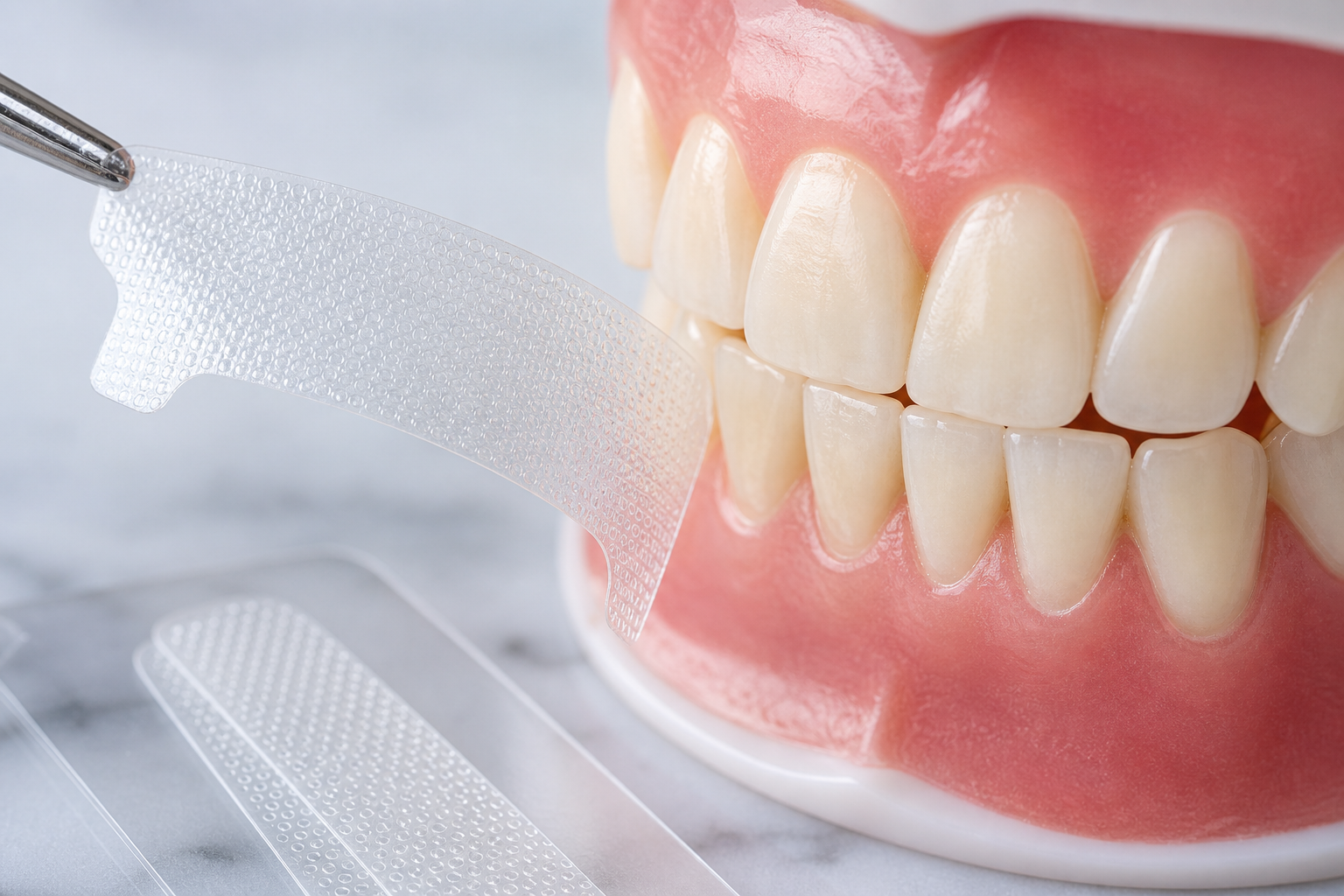
Teeth whitening strips are not automatically unsafe, but I would not regard every strip, every mouth or every online product as equally safe. The main issues I would watch for are tooth sensitivity, sore or affected gums, poorly fitting strips, overuse and whitening being used when there is untreated decay, gum disease or damage to a tooth. If your teeth and gums are healthy and the product is used exactly as directed, strips may offer a modest cosmetic change. They are not the right choice for everyone.
One thing I usually explain to patients is that whitening is cosmetic. It does not treat decay, gum disease, cracks, worn enamel or a single dark tooth. Those concerns need identifying first, because whitening may make an existing problem more uncomfortable and can delay the treatment that is actually needed.
Are teeth whitening strips safe?
The answer depends on the ingredients, product quality, how long the strips contact your teeth and gums, and the condition of your mouth before you start. When I assess someone for whitening, I would first check whether there are reasons that sensitivity, pain or irritation may be more likely.
Peroxide-based whitening products can lighten natural tooth colour, but temporary sensitivity and gum irritation can occur. A strip that overlaps the gums, is left on longer than instructed or is used repeatedly may increase soft-tissue contact with the whitening gel. A product described online as “professional strength” is not automatically suitable, accurately labelled or lawfully supplied for your circumstances.
Strips also have an important limitation. They only change the shade of natural teeth. They do not whiten fillings, composite bonding, crowns, veneers, bridges, dentures or implants. This can leave a visible colour mismatch, especially where restoration work is present on front teeth.
The problems I would watch for with whitening strips
People are often concerned that whitening strips are bad for their teeth. What I would look at first is whether there is sensitivity, gum discomfort or a symptom that was present before whitening started.
Tooth sensitivity
Whitening can cause a short, sharp reaction to cold air, cold drinks or brushing. This may settle after you stop using the product, but I would not advise simply pushing through significant discomfort. Sensitivity can be more likely where whitening exposure is stronger or more frequent, or where dentine is exposed. Dentine is the more sensitive layer beneath enamel.
Severe, worsening or persistent pain deserves an assessment, particularly if it seems to come from one tooth. That does not prove there is another problem, but it is a sensible reason to check rather than assume the strips are the only cause.
Gum irritation or chemical injury
Strips that overlap the gum line can cause burning, soreness or patches of gum that look temporarily white. This can indicate that the soft tissue has been irritated or affected by the product, particularly where there is soreness or burning. Excess gel, poor positioning and leaving strips on for too long can make this more likely.
I would advise stopping the product rather than trying to alter the strip and carry on. Do not compensate by using a shorter course more often. Give the tissues time to settle and seek dental advice if discomfort is marked, there is ulceration, swelling, or the gums do not return to normal.
Uneven colour and unrealistic expectations
Strips may whiten some surfaces more effectively than others. They may not sit evenly around crowded teeth, and they cannot reliably change every type of discolouration. My guide to what whitening strips can and cannot change may help if you are deciding whether another course is likely to be worthwhile.
Masking a dental problem
A dark tooth, a new sensitive area, bleeding gums or a rough filling should not be treated as a whitening problem until it has been checked. Whitening does not repair a leaking filling, strengthen enamel or treat gum disease. I would rather establish why the colour or symptom has changed before recommending repeated cosmetic treatment.
Can whitening strips damage enamel?
Whitening strips should not be assumed to damage enamel every time they are used, but they should not be treated as harmless in every circumstance either. Sensitivity alone does not prove permanent enamel damage. It does, however, tell me that the teeth are reacting to the treatment and that further exposure may not be sensible.
What I would look at first is whether there is existing enamel wear, acid erosion, exposed root surfaces, cracks or decay. These issues can make teeth more vulnerable to discomfort during whitening. An examination is the only reliable way to assess whether they are present and whether whitening is appropriate.
Using a product more often than instructed, extending the wear time, combining it with another whitening product or trying to get a faster result increases the chance of irritation and discomfort. More gel or longer exposure does not guarantee a whiter final shade.
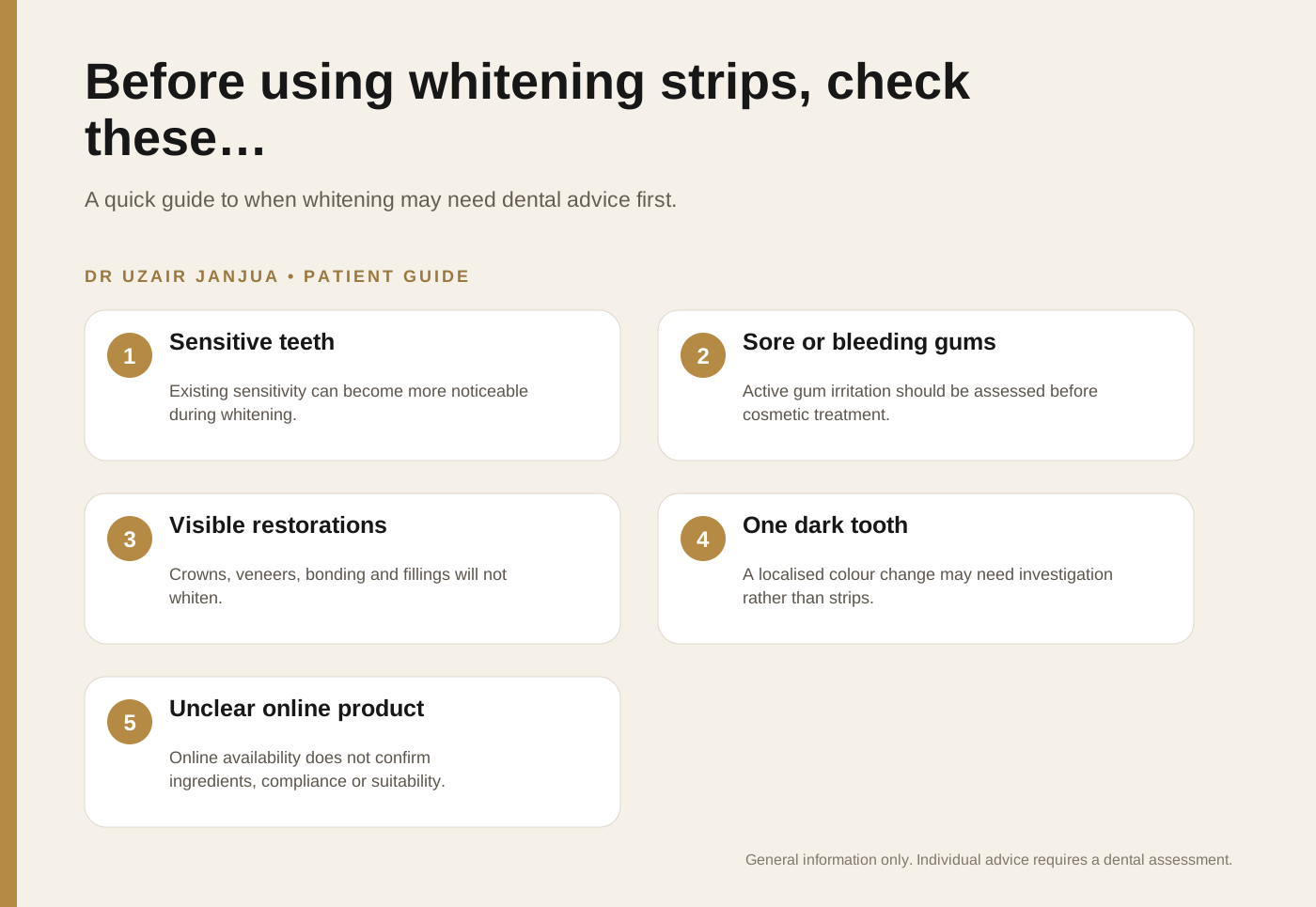
Who should avoid whitening strips or ask for advice first?
I would recommend an examination before whitening if you have symptoms, visible dental work or any uncertainty about the cause of tooth discolouration. An online article cannot confirm whether whitening is suitable for your individual teeth.
- Toothache, a cracked tooth, untreated decay or a loose, leaking or damaged filling.
- Significant tooth sensitivity, worn enamel, exposed roots or a history of pain after whitening.
- Bleeding, swollen or sore gums, or known active gum disease.
- A single tooth that has become noticeably darker than the others.
- Visible crowns, veneers, composite bonding, bridges or implants where a colour mismatch would matter.
- Pregnancy, breastfeeding or being under 18, where I would advise seeking individual dental guidance before whitening.
- Extensive staining or colour change that may not respond predictably to a generic strip.
For someone with front-tooth bonding, veneers or crowns, shade planning is particularly important. Whitening natural teeth first may be appropriate in some situations, but it can also reveal that restorations no longer blend in. If you are considering whitening around existing bonding, read my guide on whether composite bonding can be whitened before making decisions about the final shade.
Why the UK rules around whitening strips matter
In the UK, tooth whitening is regarded as the practice of dentistry. The rules around peroxide-containing whitening products are intended to ensure that stronger whitening treatment is considered following an appropriate dental examination and with dentist involvement.
Products containing or releasing between 0.1% and 6% hydrogen peroxide are subject to specific restrictions. Products above 6% hydrogen peroxide are not permitted for cosmetic use, except in limited circumstances related to disease treatment or prevention.
This is where people sometimes get confused. A product being available online does not establish that it is legal, accurately labelled, within the stated concentration, suitable for your teeth or supplied appropriately. I would be cautious about products with vague ingredients, missing instructions, unrealistic claims or sellers who cannot provide clear product information.
There is also a difference between buying a consumer product and receiving whitening treatment that has been planned or supervised by a dental professional. The latter starts with an assessment of your teeth, gums, symptoms and existing restorations, rather than relying only on generic packaging instructions.
What I would check before recommending whitening
When I assess someone for whitening, I am not only looking at how white they would like their teeth to be. I am checking whether whitening is likely to be comfortable, worthwhile and compatible with any existing dental work.
| What I would assess | Why it matters |
|---|---|
| Tooth and gum symptoms | Pain, bleeding or sensitivity may need treatment before cosmetic whitening. |
| Enamel wear and exposed dentine | These can increase the chance of sensitivity during whitening. |
| Fillings, bonding, crowns and veneers | They will not whiten and may require a final shade plan. |
| The type of discolouration | Surface staining, natural tooth shade and one dark tooth do not respond in the same way. |
| Your target shade | A realistic, natural-looking change is usually more predictable than chasing an arbitrary shade. |
| Your previous whitening experience | Past sensitivity or irritation helps guide whether and how whitening should proceed. |
If you live in Birmingham or elsewhere in the West Midlands and have already reacted to strips, bring the packaging or ingredient information to an appointment if possible. I can use that information alongside an examination to advise whether restarting is sensible, whether a different approach is appropriate, or whether whitening should wait.
Whitening strips versus dentist-supervised whitening
Strips are convenient and often have a lower upfront product cost, but there is less individual control over fit and where the whitening gel sits. Dentist-supervised whitening begins with an examination and may offer more controlled gel placement and exposure, but it is not risk-free and temporary sensitivity can still occur.
| Consideration | Generic whitening strips | Dentist-supervised whitening |
|---|---|---|
| Fit | Standard shape, which may overlap gums or miss uneven teeth. | Custom trays may allow more controlled gel placement. |
| Starting point | Usually self-selected without an examination. | Teeth, gums and existing restorations are assessed first. |
| Sensitivity management | Instructions are generic. | The approach may be adjusted where appropriate if sensitivity develops. |
| Colour planning | May reveal mismatches with visible restorations. | Allows discussion of bonding, crowns or veneers before treatment. |
| Cost considerations | Lower initial product cost, although repeated purchases may add up. | Includes professional planning and may involve treatment needed before whitening. |
| May suit | Healthy, unrestored teeth where someone wants a modest change and understands the limitations. | People with sensitivity, restorations, uncertainty or a preference for clinical guidance. |
If you are comparing the options, you can read more about dentist-supervised teeth whitening in Birmingham. I would always start by deciding whether whitening is appropriate, rather than assuming that a stronger or more expensive option is automatically better.
What to do if whitening strips cause sensitivity or sore gums
If strips make your teeth very sensitive or your gums burn, stop using them. Rinse your mouth gently with water, remove any remaining gel and do not extend the next application to make up for missed use.
- Do not restart until the sensitivity and gum irritation have settled.
- Do not use strips more frequently than the manufacturer directs.
- Do not combine strips with other whitening products while symptoms are present.
- Use a soft toothbrush and avoid aggressively brushing sore gum areas.
- Arrange a dental assessment if pain is severe, lasts, worsens, affects one tooth, or you have ulceration, swelling or other concerning symptoms.
I would be particularly careful where pain is focused around one tooth or a specific area. Rather than assuming it is a normal whitening reaction, I would want to assess whether there is an underlying issue before considering further whitening.
When strips are unlikely to give the result you want
Whitening strips are not a solution for every type of discolouration. A single dark tooth may have a cause that needs investigation. Crowns, veneers, bonding and fillings will keep their existing colour. Deep internal staining can respond differently from everyday tea, coffee or smoking stains.
If the concern appears to be mainly surface stain, professional cleaning or stain removal may be helpful, but I would need to examine your teeth first to confirm whether the change is surface staining or a change in the underlying tooth colour. If the concern is tooth shape, wear, chips or uneven edges, whitening may be only one part of a wider cosmetic plan.
Are teeth whitening strips safe? For some people, used carefully on healthy teeth, they can be a reasonable cosmetic option. They are not automatically a safe choice for sensitive teeth, unhealthy gums, damaged teeth or every product sold online. If you are unsure, have visible restorations or have already developed sensitivity, an examination is more sensible than repeated courses of strips.
If you would like an individual assessment in Birmingham or the West Midlands, I can check the health of your teeth and gums, explain whether whitening is likely to meet your expectations, and discuss a controlled option if that is appropriate for you.