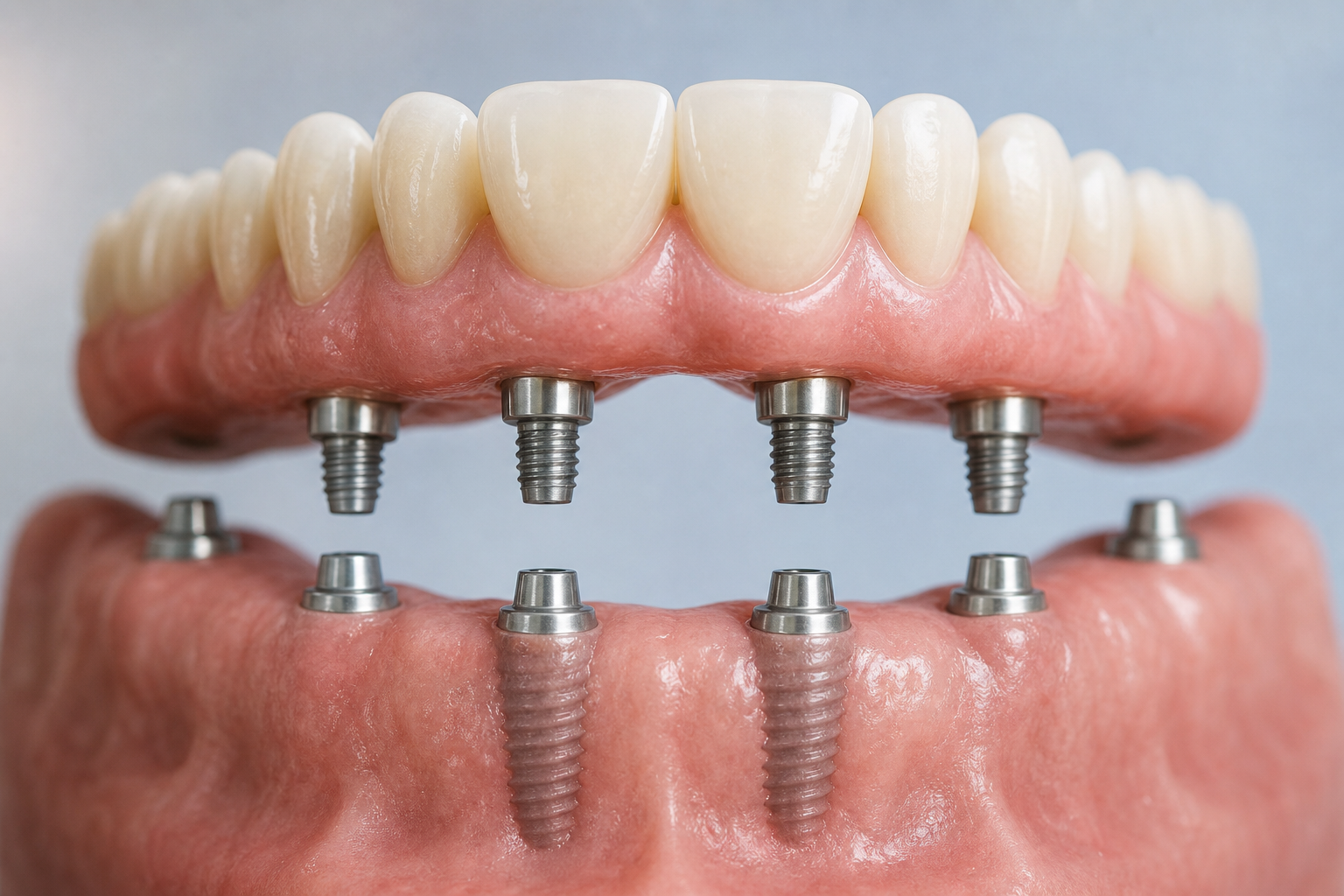
All-on-6 dental implants use six implants to support a fixed bridge across one jaw, while All-on-4 uses four. I would not describe either option as automatically better. Six implants can spread biting forces more widely and may provide additional support towards the back of the jaw, but All-on-4 can be a very sensible approach where bone is limited or the anatomy favours carefully angled implants. When I assess someone, I look beyond the number of implants at the quality and shape of the bone, gum health, bite forces, the opposing teeth, cleaning access and the design of the bridge itself.
The upper and lower jaws also need separate consideration. A plan that works well in the lower jaw may not be the best approach in the upper jaw, where bone can be softer and the sinus position may affect implant placement.
What are All-on-6 dental implants?
All-on-6 is a full-arch implant treatment concept in which six implants support one fixed bridge in either the upper or lower jaw. The six refers to the number of implants, not the number of visible replacement teeth. The final bridge may replace a full row of teeth, but its shape, tooth positions and materials are planned around your facial proportions, speech, lip support and bite.
I usually explain that the implants are the foundations beneath the gum, while the bridge is the part you see and use every day. Both matter. A well-positioned set of implants still needs a bridge that is comfortable, cleanable and designed to manage the forces created when you bite and chew.
All-on-6 is one form of full-arch dental implant treatment. It may be considered where most or all teeth in one jaw are missing, failing or no longer predictable to retain. However, removing teeth that could be maintained successfully is not automatically the right route, so I would assess the prognosis of each remaining tooth carefully.
All-on-6 vs All-on-4 at a glance
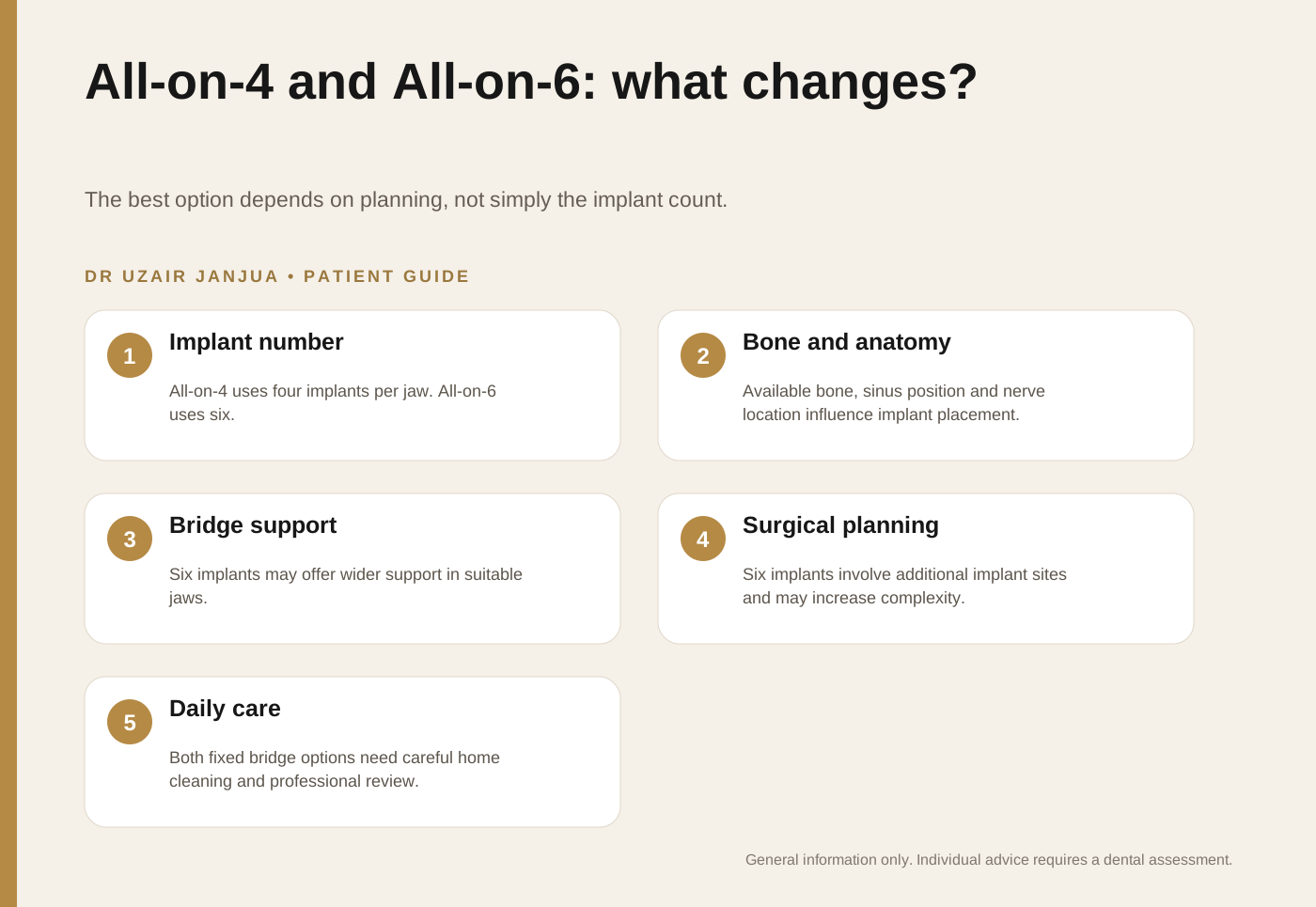
The practical difference is not simply two extra implants. It is how the available bone, implant positions and bridge design work together. In some cases, four well-placed implants are preferable to trying to place six implants in less suitable positions.
| Consideration | All-on-4 | All-on-6 |
|---|---|---|
| Implants per jaw | Four implants support one fixed arch bridge. | Six implants support one fixed arch bridge. |
| Typical planning approach | Posterior implants may be angled to make use of available bone. | May allow implant support to be distributed more widely across the arch. |
| Bone considerations | Can be useful where posterior bone is limited, depending on the scan and anatomy. | Needs suitable implant positions and sufficient bone across more of the jaw. |
| Support towards the back | May involve a bridge extension beyond the last implant, known as a cantilever. | May reduce reliance on a long posterior extension in selected cases. |
| Surgery | Fewer implant sites, though surgery can still be complex. | Two additional surgical sites and potentially more detailed planning. |
| Cost drivers | Depends on far more than implant number, including the bridge and any preparatory care. | Usually includes additional implant components and surgical work, alongside the same wider cost factors. |
| Maintenance | Requires daily cleaning and professional review. | Requires daily cleaning and professional review. |
For a fuller explanation of the four-implant approach, you may also find my guide to who All-on-4 dental implants may suit useful.
Is All-on-6 better than All-on-4?
No, not in every situation. All-on-6 may offer additional implant distribution, more support for the bridge and useful redundancy in selected cases, particularly where there is good bone available across the jaw and the bite places higher demands on the restoration. That does not mean it guarantees a better long-term result.
It would be too simplistic to regard six implants as a universal upgrade from four. The result can be influenced by the jaw being treated, implant positions, bridge material, hygiene, smoking, gum health, grinding habits and the maintenance provided over time.
This is where people sometimes get confused by marketing terms. More implants do not overcome uncontrolled gum disease, a poorly designed bite, inadequate home cleaning or a bridge that is difficult to maintain. Equally, All-on-4 is not automatically less stable because it uses fewer implants. What I would want is a design that makes clinical sense for your anatomy rather than a protocol selected from a brochure.
What I would assess before recommending either option
Before discussing whether four or six implants are appropriate, I would first establish whether a full-arch solution is needed at all. Some teeth may have a reasonable long-term outlook with periodontal care, root canal treatment, crowns or smaller implant bridges. In other situations, keeping severely compromised teeth can make a predictable full-arch plan more difficult.
I would assess the following areas as part of planning:
- Gum and bone health. Active gum disease needs to be controlled before implant treatment is considered. A previous history of gum disease does not necessarily rule implants out, but it makes long-term reviews and plaque control especially important.
- Bone volume and anatomy. A clinical examination and appropriate imaging help me assess bone quality, the maxillary sinuses in the upper jaw and the nerve canal in the lower jaw. A CBCT scan, which provides three-dimensional imaging, may be needed for safe detailed planning.
- Your bite and grinding habits. Strong bite forces, clenching or grinding can affect implant distribution, bridge material, tooth shape and whether I recommend a protective night guard.
- Restorative space. There needs to be enough room for a bridge that looks natural, is strong enough and does not make speech or cleaning unnecessarily difficult.
- Medical and lifestyle factors. Smoking, poorly controlled diabetes, certain medicines and other medical conditions can affect healing or future risk. These need individual discussion rather than assumptions.
- The opposing jaw. Natural teeth, a denture, an existing bridge or another implant restoration can all change the forces that the new bridge needs to manage.
- Cleaning ability and expectations. A fixed bridge feels secure, but it is not maintenance-free. I would make sure you understand how to clean beneath it and attend for professional monitoring.
If you are comparing all-on-6 dental implants in Birmingham or elsewhere in the West Midlands, I can assess your teeth, gums, bite and scan findings before you commit to four or six implants. An examination and properly planned scan review should give you a reasoned recommendation, rather than simply asking you to choose between package prices.
When All-on-6 may make more sense
All-on-6 may be worth considering when there is enough suitable bone to place implants across a broader area of the jaw and when that wider distribution would improve the bridge design. For example, I may consider it where additional posterior support could reduce the length of a bridge extension or where the bite is likely to place substantial functional demands on the restoration.
It can also be an attractive option where the jaw anatomy permits six implants to be placed in sound positions without creating unnecessary surgical compromise. The possible benefit is not just the total number of implants. It is the opportunity to support the bridge in the right places.
However, I would not recommend six implants simply because six sounds more secure. More surgical sites mean more healing considerations, more components and often a higher cost. The extra implants need a genuine role in the treatment plan.
When All-on-4 or another treatment may make more sense
All-on-4 may be appropriate where bone towards the back of the jaw is limited. The posterior implants can sometimes be angled to make effective use of available bone while avoiding structures such as the sinus or lower-jaw nerve. This is individual planning, not a promise that grafting will never be needed.
Another option may be better if the main priority is lower treatment complexity, easier removal for cleaning or a lower initial cost. An implant-retained overdenture, for example, can improve denture stability while still allowing the appliance to be taken out for cleaning. A staged implant plan, conventional dentures or treatment focused on preserving selected natural teeth may also be more sensible in some cases.
I would also be cautious about assuming the same treatment is right for both jaws. Someone may benefit from a fixed bridge in one jaw and a removable implant-retained solution in the other. The aim is to create a manageable, functional result, not to make both arches match on paper.
What changes the cost of All-on-6 dental implants in the UK?
The final cost is affected by much more than the two additional implants. I would encourage you to compare written plans carefully, especially if you are looking at quotes from different Birmingham clinics, elsewhere in the West Midlands or overseas providers.
Important cost factors include:
- Whether treatment is for one jaw or both jaws.
- Extractions and the condition of the remaining teeth.
- Gum treatment, scans, digital planning and surgical guides where needed.
- Bone grafting, sinus-related procedures or other augmentation.
- Whether temporary fixed teeth are appropriate during healing.
- The material and design of the final bridge.
- Sedation, laboratory work, bite adjustments and a night guard where indicated.
- Review appointments, hygiene care, bridge removal for inspection and future repairs.
Ask exactly what is included, what may be charged separately and who manages a complication if it arises. It is sensible to ask whether the temporary bridge and definitive bridge are both included, as they are not the same thing. I would also ask whether future bridge removal, emergency repairs, replacement teeth or components, hygiene reviews, implant-related complications and eventual bridge replacement are included, excluded or charged separately.
My guide to full-mouth dental implant costs in the UK explains more of the wider factors behind a full-arch quote.
For patients travelling into Birmingham from Solihull, Coventry, Wolverhampton, Dudley, Walsall or further afield, appointment access matters. Full-arch treatment involves planning, surgery, review visits and ongoing maintenance. A lower headline figure is less meaningful if aftercare is difficult to access when a bridge loosens, fractures or needs professional cleaning.
Treatment, recovery and long-term maintenance
Some people can have a temporary fixed bridge placed soon after implant surgery, but I would only consider immediate temporary teeth when the implants achieve enough initial stability and the wider plan supports it. It is not suitable for every jaw or every patient.
Healing continues after surgery, even if temporary teeth are fitted. I usually advise a carefully managed diet during the early healing phase, with follow-up appointments to monitor the tissues, bite and temporary bridge. The final bridge is normally planned once healing and stability allow, rather than being treated as an afterthought.
Day to day, a fixed bridge needs cleaning around the gumline and beneath the bridge using the methods recommended for your design. Interdental brushes, specialised floss or water irrigation may be helpful, but the right routine depends on the spaces and contours around your restoration. I would demonstrate the technique and tailor it to the final bridge, rather than expecting you to follow a generic cleaning routine.
Bleeding, swelling, bad taste, discomfort, looseness or a change in the bite should be checked promptly. Inflammation around implants may not always cause significant pain in its early stages, which is one reason routine hygiene and review appointments matter.
The bridge may need professional removal at intervals for inspection, cleaning or repair. Implants and bridges have different maintenance needs. An implant may remain stable while the bridge requires repair due to wear, staining, screw loosening or fracture.
What if an implant or bridge develops a problem?
A problem with one implant does not automatically mean the whole full-arch treatment has failed. The right response depends on which implant is affected, whether it has integrated with the bone, when the problem occurs, the health of the surrounding tissues and how the bridge is supported.
I would assess the cause before deciding whether the implant can be monitored, whether the bridge needs adjustment or removal, or whether an implant needs to be removed and the area allowed to heal. In some circumstances, the bridge design can be modified. In others, replacement treatment may be needed. This is why I place so much importance on a clear maintenance plan before treatment starts.
Questions I would encourage you to ask before choosing
A good consultation should leave you clear about why a particular plan has been suggested. I would encourage you to ask:
- Why are four or six implants recommended for my jaw?
- What does my scan show about bone, sinus position or the lower-jaw nerve?
- Are any natural teeth worth keeping, and what is their prognosis?
- Will I have temporary teeth, and what are the restrictions during healing?
- What material is proposed for the final bridge, and how repairable is it?
- How will I clean beneath the bridge, and how often will it need professional review?
- Who will provide aftercare and manage repairs, loosening or implant complications?
- Are future bridge removal, repairs, replacement components and eventual bridge replacement included in the quotation?
- What are the realistic alternatives, including overdentures, staged treatment or retaining selected teeth?
All-on-6 is a useful option for selected patients, particularly where six well-positioned implants can improve support for a fixed full-arch bridge. It is not automatically the right answer just because it uses more implants. If you are considering All-on-4 or All-on-6 in Birmingham or the West Midlands, I can assess your teeth, gums, bite and scan findings and provide a written plan that explains the reasoning, alternatives, likely stages and ongoing care requirements.