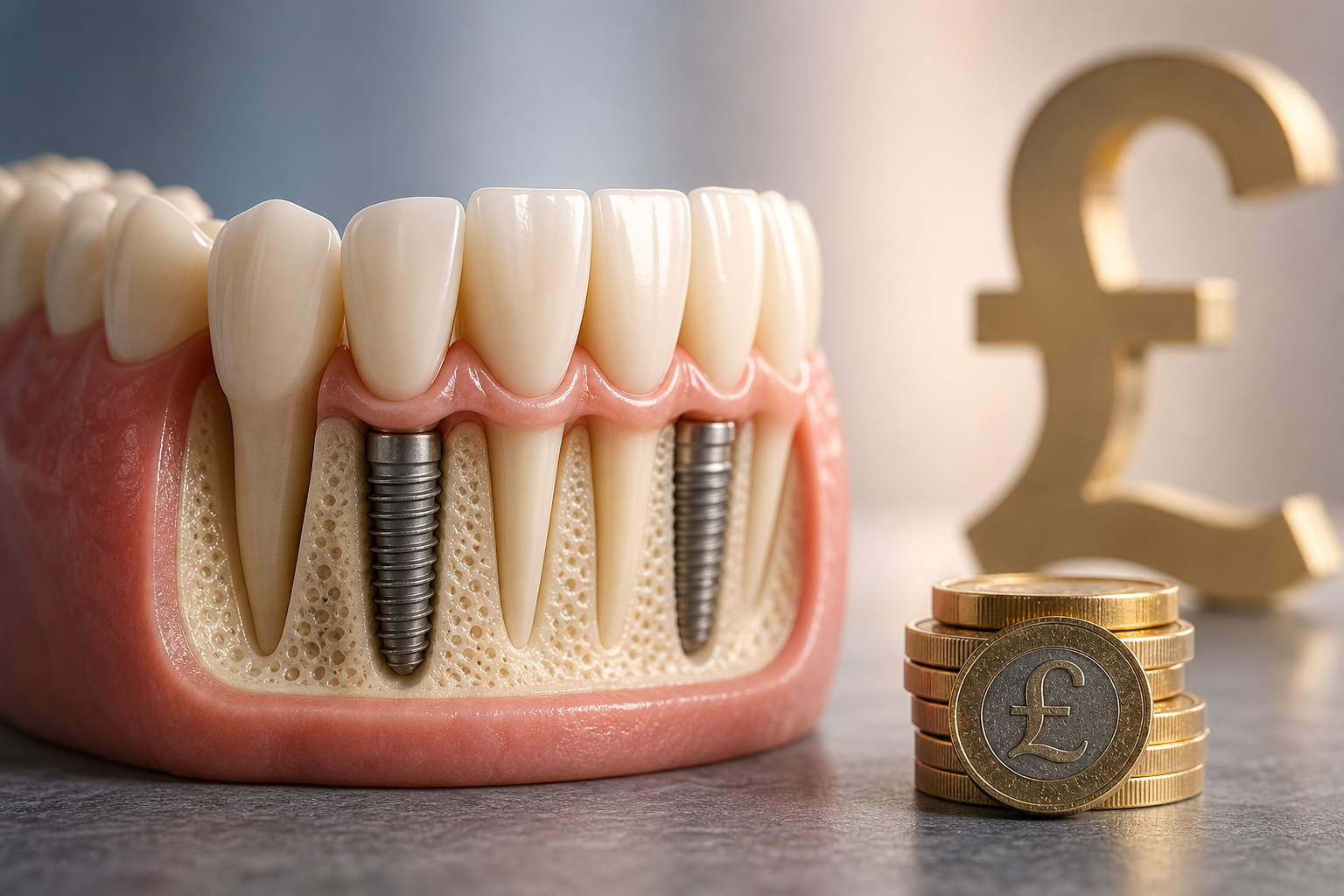
If you are asking how much is a full set of dental implants in the UK, a broad private-treatment guide for fixed teeth across both upper and lower jaws is often around £20,000 to £40,000 or more. However, I would be careful with any single figure because “full set”, “full mouth” and “full arch” are often used to describe quite different treatments. Many advertised prices apply to one jaw only, not both.
These figures are general guidance rather than my practice fees or a personal quotation, and treatment costs can change over time. When I assess someone considering full-mouth implants, the first question is not simply how many implants they need. I would establish whether they need fixed teeth, removable implant-retained dentures, treatment in one jaw or both, and whether any natural teeth can be predictably retained.
How much is a full set of dental implants in the UK?
For a fixed full-arch bridge supported by implants, a broad private UK guide is often around £10,000 to £18,000 or more per arch. That means either the upper jaw or the lower jaw. Fixed teeth across both jaws commonly fall around £20,000 to £40,000 or more, particularly where extractions, grafting, complex bite planning, sedation or higher-cost final materials are needed.
These are broad market guides, not a personal quotation. An implant-retained overdenture is generally less expensive than fixed full-arch teeth, but it is removable and has different maintenance needs. Replacing every missing tooth with separate implants and crowns is usually a more extensive and costly route than using a full-arch bridge.
| Treatment description | What it usually means | Broad private UK guide |
|---|---|---|
| Fixed full-arch implant bridge | One upper or lower jaw restored with a bridge supported by several implants | Often around £10,000 to £18,000 or more per arch |
| Fixed teeth in both jaws | Upper and lower full-arch restorations | Often around £20,000 to £40,000 or more overall |
| Implant-retained overdenture | A removable denture held more securely by implant attachments | Usually less than a fixed bridge, but depends on implant number and design |
| Individual implants and crowns | Separate implants replacing teeth individually or in small groups | Varies substantially and can exceed a full-arch approach |
One thing I usually explain is that a lower headline figure is not automatically poor value, and a higher figure is not automatically better. The useful comparison is whether two plans genuinely include the same clinical work, restoration design, materials and aftercare.
What does “full mouth” really mean?
“Full mouth” is not a precise dental term. It may mean replacing all teeth in both jaws, restoring one complete jaw, replacing only the teeth that are missing, or stabilising dentures with implants. I would always ask a practice to clarify exactly what is being restored before comparing a full-mouth dental implants cost.
Full arch
A full arch means one complete jaw, either upper or lower. In appropriately selected cases, four to six implants may support a fixed bridge that replaces all visible teeth in that jaw. The bridge may also include pink material to replace lost gum volume where needed.
Full mouth
Full mouth usually means both arches, but not every practice uses the phrase in the same way. This is where people sometimes get confused when comparing an apparent “full mouth” price in Birmingham with another quotation that is actually for one arch.
All-on-4 and All-on-6
These terms describe a full-arch concept where a fixed bridge is supported by four or six implants. Four implants are not automatically right for everyone, and six are not automatically better. I would consider bone volume, implant position, your bite, jaw relationship, cleaning access and the design of the final bridge before recommending either option.
Implant-retained dentures
An implant-retained overdenture is removable by you but attaches to implants for greater stability than a conventional denture. It can be a sensible option where a fixed bridge is not appropriate, not wanted or outside the available budget. It also allows the denture and attachments to be cleaned directly.
Why can one full-mouth implant quote be very different from another?
The difference is usually in the specification, not simply the postcode. When I review a treatment plan, I look beyond the number at the bottom and check what is included before deciding whether it is a fair comparison.
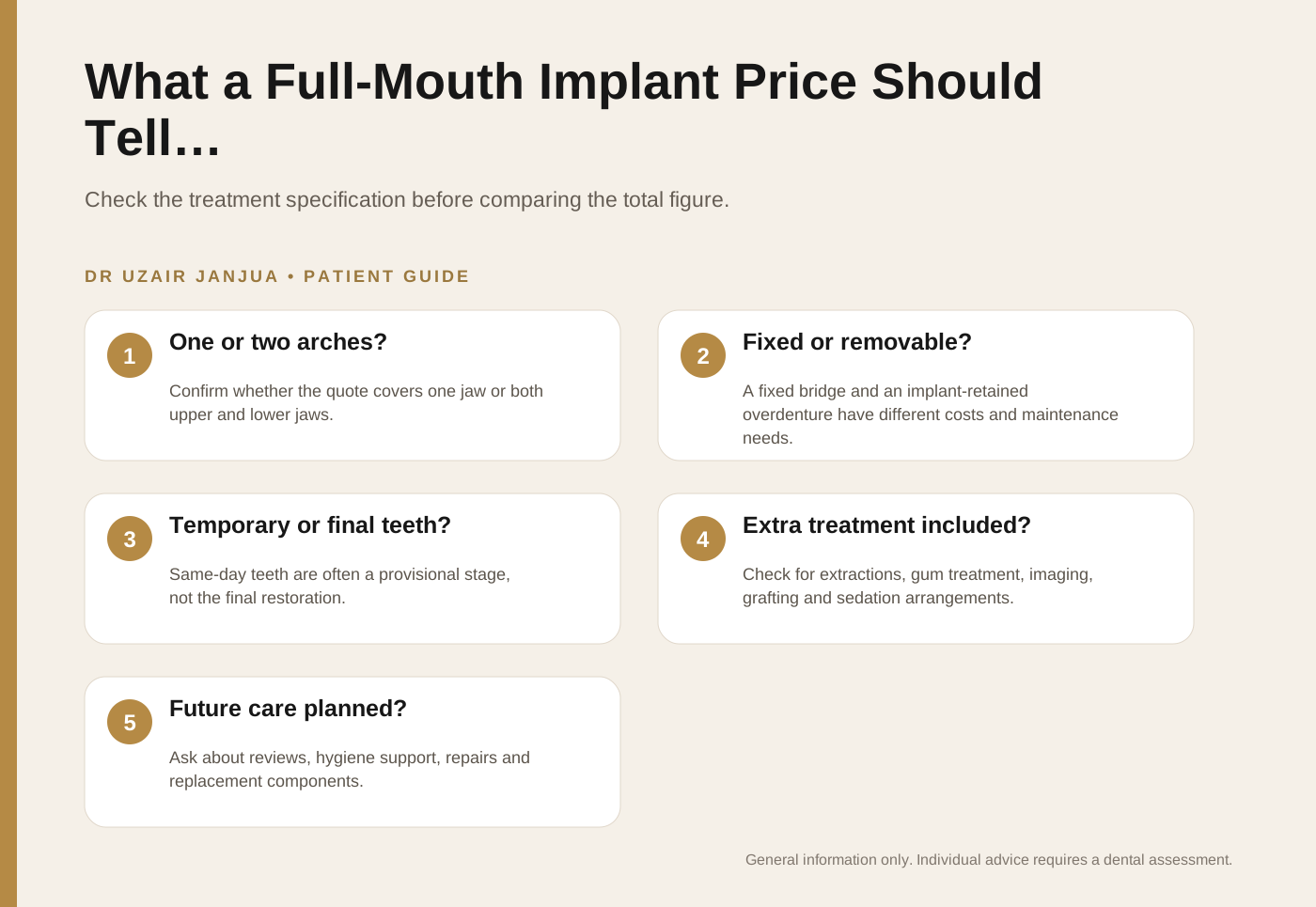
| Cost factor | Why it changes the quotation |
|---|---|
| One arch or two | A quoted fee may cover only the upper or lower jaw, rather than both. |
| Remaining teeth and extractions | Removing teeth, managing infection and providing temporary teeth can add stages and cost. |
| Gum and bone condition | Periodontal treatment, bone grafting or sinus procedures may be needed in selected cases. |
| Planning and imaging | Digital scans, records and clinically justified three-dimensional CBCT imaging help me assess bone and nearby anatomical structures when planning implant positions. |
| Temporary and final teeth | A temporary bridge is different from the final prosthesis, and materials vary in cost and repairability. |
| Bite and heavy loading | Grinding, clenching and a complex bite may require a more robust design and protective planning. |
| Aftercare and maintenance | Reviews, hygiene support, adjustments and future component care are important long after surgery. |
Final bridges may use acrylic, composite, ceramic, zirconia or another material. I would not describe one as universally best. The right choice depends on appearance, available space, bite forces, weight, repair options, maintenance and budget.
If you are comparing a full-arch plan with a smaller implant plan, my guide to what changes dental implant costs in the UK may help you understand why an individual implant price cannot simply be multiplied to estimate a full-mouth restoration.
What I would assess before recommending full-mouth implants
I would not start by assuming every remaining tooth needs to be removed. What I would look at first is whether any teeth have a realistic long-term prognosis, whether gum disease is active, and whether a less extensive approach could give you a sound result.
The assessment normally includes examination of the teeth and gums, photographs or digital records, appropriate X-rays and, where clinically indicated, CBCT imaging. A CBCT scan gives a three-dimensional view of bone and important anatomical structures, helping me assess the available bone and nearby structures when planning possible implant positions.
- Remaining teeth: whether they can be saved predictably with periodontal treatment, root canal treatment, crowns or another approach.
- Gum health: active gum disease should be stabilised where possible before implant surgery.
- Bone and anatomy: whether there is enough suitable bone for the planned implant positions.
- Your bite: how the upper and lower jaws meet, including clenching or grinding forces.
- Medical history: relevant health conditions and medicines may affect planning and healing.
- Smoking and cleaning: smoking can increase risks, while long-term cleaning access is essential.
- Your priorities: whether fixed teeth, removability, shorter treatment stages or lower initial cost matter most to you.
Previous gum disease does not automatically rule out implants, but it does make long-term gum and implant maintenance especially important. I would discuss the biological and mechanical risks honestly, including the possibility that implants may fail to integrate or that a bridge component may loosen, wear or fracture over time.
A consultation for dental implants in Birmingham should help you understand whether fixed full-arch treatment is genuinely appropriate, rather than committing you to replacing every tooth.
Fixed full-arch implants versus implant-retained dentures
The answer depends on how important a fixed restoration is to you, what your anatomy allows and what level of ongoing maintenance you are comfortable with. I often discuss both options because a removable implant-retained denture can be an excellent practical solution, not simply a compromise.
| Consideration | Fixed full-arch bridge | Implant-retained overdenture |
|---|---|---|
| How it feels | Stays in place and is not removed by the patient | More secure than a conventional denture, but removable |
| Cleaning | Requires cleaning around and underneath the bridge | Can be removed for direct cleaning of the denture and attachments |
| Initial cost | Usually higher | Usually lower than a fixed full-arch bridge |
| Maintenance | May need professional access for repairs, screw checks or adjustments | Attachment parts can wear and need periodic replacement |
| Surgery | Often requires more complex planning for a fixed restoration | May be a simpler route in suitable cases, but still needs careful planning |
Conventional complete dentures may also be a reasonable option. They avoid implant surgery and can be adjusted over time, although they may feel less secure. I would base the recommendation on your clinical situation and preferences, not on the idea that fixed implants are always the right answer.
What should be included in a full-mouth dental implant quote?
A thorough quote should make it clear what happens before, during and after surgery. I would encourage you to ask for the plan in writing, particularly if you are comparing several Birmingham or West Midlands providers.
- Is the price for one arch or for both upper and lower arches?
- Are extractions, gum treatment and temporary dentures or temporary fixed teeth included?
- Does it include clinical examination, scans, X-rays, CBCT imaging where indicated and surgical planning?
- Are bone grafting or sinus procedures included, excluded or only charged if required?
- Are same-day teeth proposed, and are they temporary or final teeth?
- What is the final bridge made from, and who provides the laboratory work?
- Are sedation arrangements included if they are clinically appropriate?
- How many reviews, adjustments and hygiene appointments are included?
- Who is responsible for repairs, replacement components and long-term maintenance?
Immediate fixed temporary teeth may be possible in selected cases, but they are not the final bridge and they do not mean unrestricted eating immediately after surgery. Whether temporary teeth can be fitted, how they are loaded and what you can eat during healing depend on implant stability and your individual treatment plan. I would explain the dietary guidance and review schedule before treatment begins.
Practical considerations for Birmingham and West Midlands patients
Full-arch treatment is usually a series of appointments rather than a one-day transaction. Patients travelling from Birmingham, Solihull, Sutton Coldfield, Coventry, Wolverhampton, Dudley, Walsall or elsewhere in the West Midlands should consider how easily they can attend planning, surgery, review and maintenance visits.
Local aftercare matters. A fixed bridge may need an adjustment, hygiene support, access to a screw channel, repair or eventual replacement of a component. Before accepting a quote from another area or country, I would ask who will manage those needs once you are back home, whether component details will be supplied and what follow-up is included.
Advertised treatment fees elsewhere may not include travel, temporary teeth, review visits, adjustments, records, replacement parts or arrangements if a complication develops. I would compare the complete treatment plan and the practical aftercare arrangements, rather than judging value from the surgical fee alone.
Are full-mouth dental implants always the best option?
No. If teeth can be saved with a realistic long-term outlook, I would not recommend extracting them simply to create a full-mouth implant case. In some situations, preserving selected teeth and treating only the most compromised areas is a more conservative and less costly plan.
Alternatives can include conventional dentures, implant-retained dentures, section bridges supported by implants, bridges supported by natural teeth, or staged treatment. A staged plan may focus first on painful, failing or highly visible teeth, allowing you to spread treatment over time while keeping the overall plan clinically sensible.
The important question is not whether full-mouth implants are “worth it” in general. It is whether the benefits, surgery, maintenance requirements, likely future repairs and cost make sense for your own teeth, gums, bite and priorities.
What happens after full-arch implant treatment?
Even where temporary fixed teeth are fitted soon after surgery, full-mouth implant treatment continues through healing, review and final restoration stages. I would plan these stages carefully, taking account of implant stability, the proposed bite and how the temporary restoration will be managed while healing takes place.
Once the final bridge is fitted, regular care remains essential. You will need a cleaning routine designed around your bridge, which may include specialist brushes or other cleaning aids. I would also recommend regular professional reviews so that the gums, bite, implants and restoration components can be monitored.
Implants do not get tooth decay, but the tissues around them can develop inflammation and disease. The bridge can also need maintenance over time. Planning for those future responsibilities is part of choosing treatment well, not an optional extra.
The sensible next step
If you are considering the cost of replacing all teeth with dental implants in the UK, I would begin with a proper assessment rather than an online headline price. That allows me to establish whether you need one arch, both arches, a removable overdenture, staged treatment or a plan that saves some natural teeth.
A detailed consultation should leave you with a written explanation of what is proposed, what is included, the likely stages, alternatives and the maintenance you should expect. If you would like an individual assessment in Birmingham, you can contact me, Dr Uzair Janjua, so we can discuss the most appropriate route for your situation.