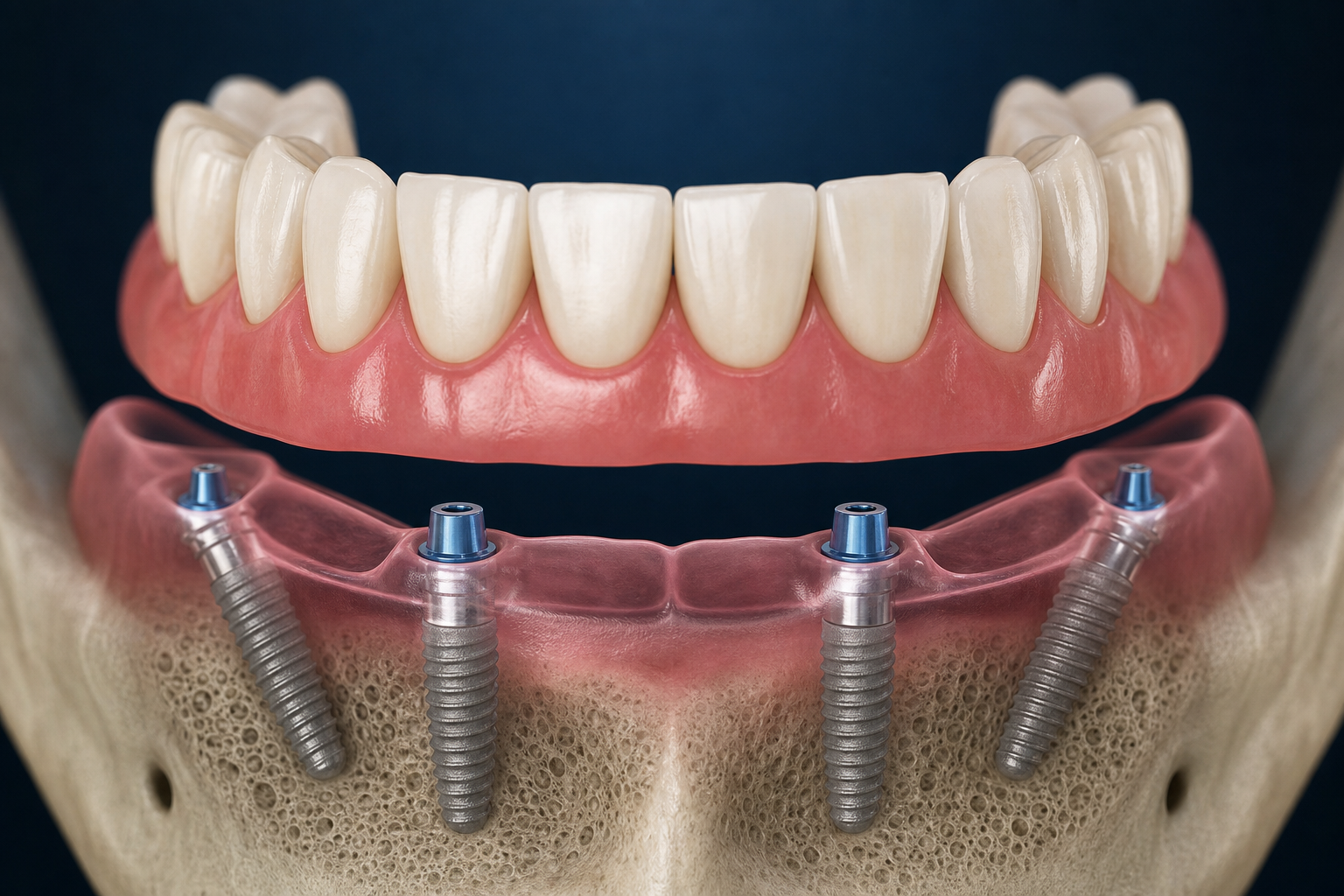
All-on-4 dental implants may suit someone who has lost most of their teeth in one jaw, has several failing teeth, or is struggling with loose full dentures and wants a fixed alternative. However, I would never recommend them simply because four implants sound quicker or because someone has been told they have bone loss. The right option depends on the condition of your remaining teeth and gums, your bone shape and volume, your bite, general health, cleaning ability and expectations for the long term.
In simple terms, All-on-4 is a full-arch treatment. Four carefully positioned implants support a fixed bridge that replaces most or all teeth in the upper or lower jaw. It can be a useful solution in selected cases, but it is not the same as having four individual replacement teeth, and it is not maintenance-free.
Who may suit All-on-4 dental implants?
I may consider All-on-4 dental implants for adults with a failing or largely toothless upper or lower arch who want teeth that are fixed in place rather than a conventional removable denture. The aim is to provide a full-arch bridge using a planned number and position of implants, often including angled implants towards the back of the jaw to make efficient use of available bone.
What I would look for first is whether there is a clear reason to replace a whole arch rather than restore individual teeth. This may include teeth affected by repeated breakdown, advanced mobility, an unreliable long-term prognosis, extensive tooth loss, or a denture that moves despite reasonable adjustments.
- You have lost most or all teeth in one jaw, or several remaining teeth are unlikely to be maintained predictably.
- You want a fixed restoration and understand that it will need daily cleaning beneath the bridge.
- Your gums and any existing infection can be stabilised before implant treatment.
- Your medical history and healing risks are appropriate for surgery following an individual assessment.
- You can attend reviews and commit to long-term implant maintenance.
- Your jawbone, bite and available space can support a stable full-arch design.
Having bone loss does not automatically prevent treatment. Angled implants can sometimes avoid certain anatomical areas and reduce the need for extensive grafting. That said, reduced bone is not, on its own, a reason to choose All-on-4. I would need to assess the scan, jaw relationship, soft tissues and the amount of support the final teeth will need before advising whether this is realistic.
When might All-on-4 not be the right choice yet?
I would not rush into full-arch implant treatment where active gum disease, untreated infection, poor cleaning habits or a medical issue is likely to compromise healing. These are not always permanent exclusions, but they may mean that treatment should be delayed, modified or approached in stages.
One thing I usually explain to patients is that implants can develop gum and bone problems too. Peri-implant mucositis means inflammation around an implant, while peri-implantitis is a more serious condition involving bone loss. A history of gum disease does not rule out implants, but it makes stabilisation and regular supportive care especially important.
Smoking, poorly controlled diabetes, teeth grinding, some medications and certain medical conditions can alter risk. I would discuss these in context rather than applying a blanket rule. In some cases, improving gum health, reducing smoking, addressing grinding or using a staged plan may make treatment safer and more predictable.
All-on-4 may also be the wrong starting point if healthy natural teeth can be retained with a reasonable long-term outlook. Removing maintainable teeth is irreversible. I would first consider whether periodontal care, root canal treatment, crowns, smaller bridges or individual implants could preserve more natural tooth structure.
What I would assess before recommending a full-arch bridge
A photograph, a quick video consultation or a headline price cannot establish whether All-on-4 is suitable. When I assess someone for fixed full-arch treatment, I need to understand not only how many teeth are missing, but why they have been lost and what needs to be replaced beyond the visible teeth.
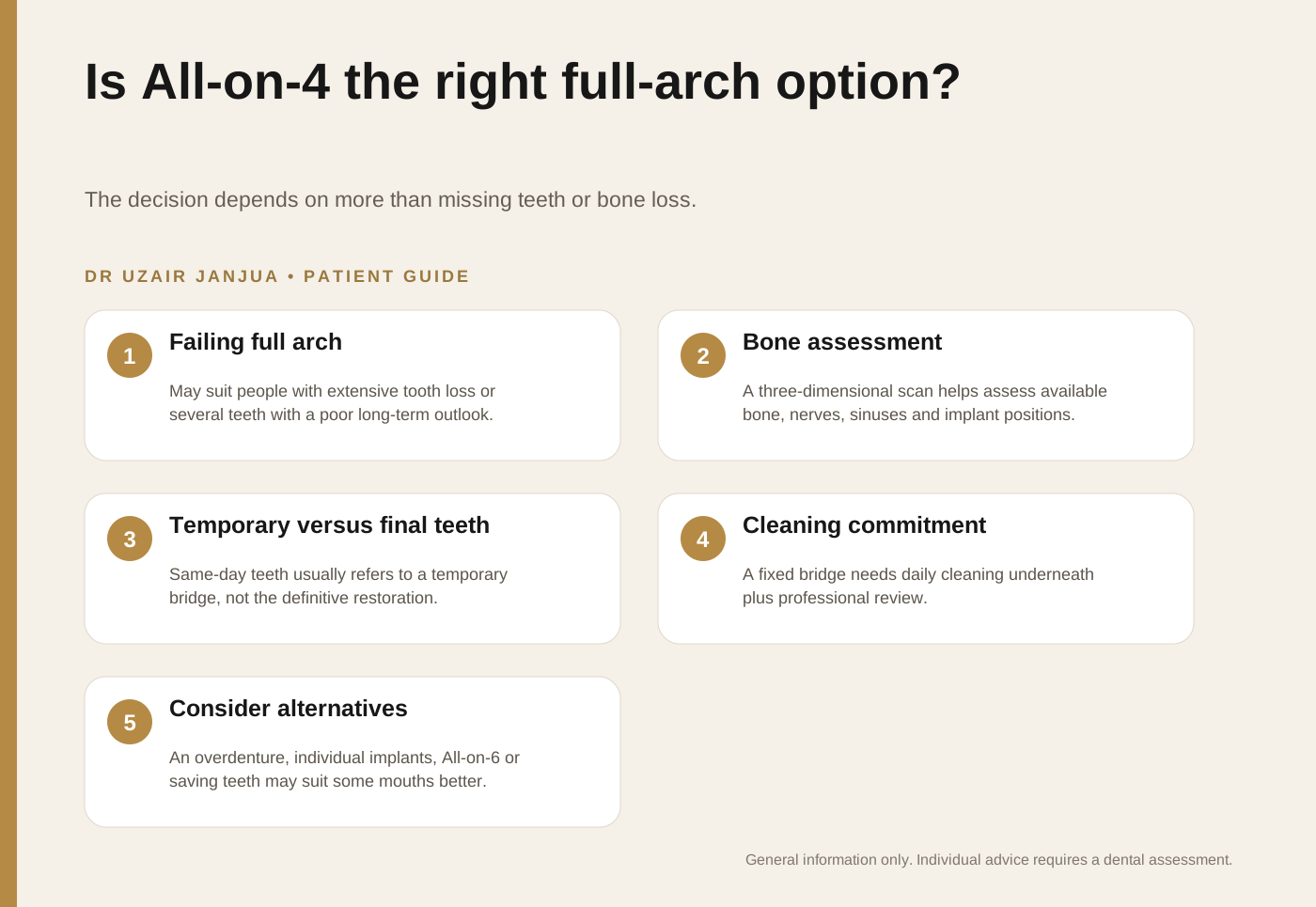
The assessment usually includes a medical and dental history, examination of the teeth and gums, records of the bite, photographs and appropriate imaging. A CBCT scan, which is a three-dimensional dental scan, may be clinically justified to assess bone, nerve pathways, sinuses and possible implant positions.
I would also assess:
- Remaining teeth: whether they can be saved reliably, and whether keeping them offers a more conservative plan.
- Gum health: whether periodontal disease or infection needs treatment before implants are considered.
- Bone and soft tissue: the amount of support available and whether grafting, a different implant arrangement or another solution may be needed.
- Bite and grinding forces: how your teeth meet, how much force the bridge will receive and whether a protective splint may be appropriate later.
- Restorative space: whether there is enough room to create teeth that are strong, cleanable and proportionate.
- Smile line and facial support: whether the bridge may need to replace lost gum tissue as well as teeth.
- Cleaning access: whether the planned bridge can be cleaned properly with your dexterity and daily routine.
For a broader explanation of implant assessment, surgery and healing, you may find my guide to dental implants in Birmingham helpful. The important point is that the treatment design should follow the assessment, rather than trying to make every mouth fit a pre-selected All-on-4 formula.
What does ‘teeth in a day’ really mean?
‘Teeth in a day’ usually means that a temporary fixed bridge may be attached soon after implant surgery in a carefully selected case. It does not normally mean that the final long-term bridge has been fitted on the same day, or that every person will leave with a fixed restoration.
Immediate loading, as it is called, depends on the implants achieving adequate initial stability, the quality of bone, the bite, the planned bridge and whether the surgical conditions are favourable. If these factors are not right, I may recommend a removable temporary denture or a delayed approach while healing takes place.
This is where people sometimes get confused. The four implants are the support structures beneath the gum. The visible teeth are one connected bridge or hybrid prosthesis, often replacing a full row of teeth. Where bone and gum have been lost, part of the bridge may include gum-coloured material to provide support and avoid making the teeth unrealistically long.
A fixed full-arch bridge does not recreate the sensation of natural teeth. Most people need time to adapt to its feel, speech, chewing and cleaning routine, particularly where the bridge also replaces lost gum volume.
The final bridge is usually planned after healing and review. Its material may include acrylic or composite teeth on a framework, or a ceramic or zirconia-based design. Material names alone do not determine quality. I would consider bite forces, appearance, hygiene access, repairability, laboratory work and the likely maintenance needs before recommending a material.
All-on-4, All-on-6, dentures or an implant-retained overdenture?
No option is automatically best. I would compare the choices against the condition of your teeth, bone, health, lifestyle, budget and ability to maintain the result. More implants are not always better, and a removable option is not necessarily a compromise if it suits your needs well.
| Option | How it is worn | Potential advantages | Important trade-offs |
|---|---|---|---|
| All-on-4 fixed bridge | Fixed in place, removed by the clinical team when needed | May offer a more stable alternative to a conventional full denture in suitable cases | Involves surgery, careful cleaning underneath and future repair or replacement planning |
| All-on-6 or another fixed full-arch design | Fixed in place | May provide a different distribution of support in suitable anatomy | Requires more implants and is not automatically safer or more appropriate |
| Implant-retained overdenture | Removable by you | May improve denture stability and is usually easier to remove for cleaning | Still removable, with attachments and denture components that need maintenance |
| Conventional complete denture | Removable by you | No implant surgery and may be appropriate where surgery is not wanted | Can move, affect confidence when eating and need adjustments over time |
| Individual implants or smaller bridges | Usually fixed | May preserve healthy teeth and replace only what is missing | May not suit a severely failing or extensively damaged arch |
For someone who wants improved denture stability but values being able to remove the teeth for cleaning, an implant-retained overdenture can be a very sensible option. If you have several healthy teeth worth retaining, individual implants or smaller bridges may make more sense than extracting everything.
If you are weighing up saving teeth, a denture, an overdenture or fixed full-arch dental implants in Birmingham, an examination is the most useful next step. I can assess the practical trade-offs rather than assuming that the most heavily advertised treatment is the right one for you.
The trade-offs I would want you to understand
All-on-4 can provide a fixed solution, but it is a major treatment commitment. I would make sure you understand the compromises before any teeth are removed or surgery is arranged.
First, fixed does not mean maintenance-free. You cannot usually remove the bridge yourself, so you need to clean beneath it using the techniques and aids suited to its shape. Depending on the design, this may involve specially shaped brushes, interdental cleaning aids, water devices or other tools. I would demonstrate what access is possible and review how effectively you are cleaning at follow-up visits.
Second, the bridge is not indestructible. Prosthetic teeth can wear, chip or fracture. Screws can loosen, and the bridge may need adjustment, repair or eventual replacement. This is particularly relevant if you grind your teeth or generate high bite forces.
Third, implant complications are possible. Gum inflammation and bone loss can occur around implants, and an implant can fail to integrate or fail later. If one implant fails, the outcome depends on when it happens, the bone and soft tissue available, the distribution of the remaining implants and whether the bridge can be adapted. It does not always mean that the entire treatment has failed, but it needs prompt professional assessment.
Finally, the visible treatment timeline can be shorter than a conventional staged approach, but healing and refinement still take time. A temporary bridge may require a softer diet and careful use while the implants integrate with bone. The exact dietary instructions depend on whether immediate loading has been used, the bridge design and the individual treatment plan. The final teeth should not be rushed simply to meet a marketing phrase.
How much do All-on-4 dental implants cost in Birmingham?
The cost of All-on-4 dental implants in Birmingham depends on the full treatment plan, not simply the number of implants. I would be cautious about comparing a headline figure unless it is clear what the quote includes and whether it covers the same level of planning, temporary teeth, final bridge, aftercare and future maintenance arrangements.
The fee can change according to whether one or both jaws are treated, the number and complexity of extractions, scans, gum treatment, bone or soft-tissue procedures, sedation, the temporary restoration, final bridge materials and laboratory work. The bite, smile line and amount of lost bone and gum that needs to be replaced can also make a significant difference.
I recommend asking for a written treatment plan that sets out inclusions, exclusions and likely future maintenance. It should make clear whether scans, extractions, temporary and definitive teeth, adjustments, aftercare, management of complications and possible future repairs are included or charged separately.
My guide to full-mouth dental implant costs in the UK explains why these plans vary and what is worth comparing. For patients travelling from Coventry, Solihull, Wolverhampton, Sutton Coldfield, Walsall, Dudley, Worcester or elsewhere in the West Midlands, I would also factor in the number of visits, transport after surgery and who will provide local support if you need an adjustment. This is particularly important if sedation is involved.
Looking after All-on-4 teeth after treatment
I would plan aftercare from the start, rather than treating it as an optional extra once the final bridge is fitted. Long-term function depends on daily plaque control, professional monitoring, bite management and dealing with small issues before they become larger problems.
During healing, I would give individual advice about diet, brushing and use of the temporary bridge. A softer diet is often advised where a temporary bridge has been immediately loaded, but the detail and duration depend on your surgical and restorative plan. Follow-up visits allow me to assess comfort, healing, bite contacts and whether the temporary restoration needs adjustment.
Once the definitive bridge is in place, I would recommend regular reviews and hygiene care appropriate to your gum health and risk factors. Supportive care intervals are individual and may need to be more frequent if you have previous periodontitis, smoke, have high plaque levels, grind your teeth or have other factors that increase risk.
These appointments may include checking the bridge, screws, bite and gums, as well as radiographs where clinically indicated. You should also expect that components may need maintenance over the years. Planning for this is more realistic than expecting a fixed bridge to last forever without attention.
Questions I recommend asking before you consent
A good consultation should leave you clear about what is being proposed, what is temporary and what responsibilities you will have afterwards. I encourage patients to ask direct questions, particularly if they are comparing providers across Birmingham and the West Midlands.
- Are my remaining teeth genuinely beyond predictable repair, or can some be retained?
- Why are four implants recommended in my case, rather than six, an overdenture or a staged plan?
- Will I have a fixed temporary bridge, a removable temporary denture or no teeth fitted immediately?
- What material is proposed for the final bridge, and how repairable is it?
- How will I clean underneath the bridge, and can I physically manage that routine?
- Who is responsible for surgery, bridge design, laboratory work, follow-up and urgent adjustments?
- What is included in the fee, and what future maintenance, repairs or replacement costs should I plan for?
- What happens if an implant does not integrate, a temporary bridge loosens or a component fractures?
All-on-4 dental implants can be a thoughtful option for the right person, especially where a whole arch is failing and a fixed solution is realistic. They are not a shortcut around gum disease, bone assessment, healing or maintenance.
If you are in Birmingham or the wider West Midlands and are deciding between saving teeth, dentures, an overdenture or fixed full-arch treatment, I can assess your mouth and talk you through the options before you commit to an irreversible plan.