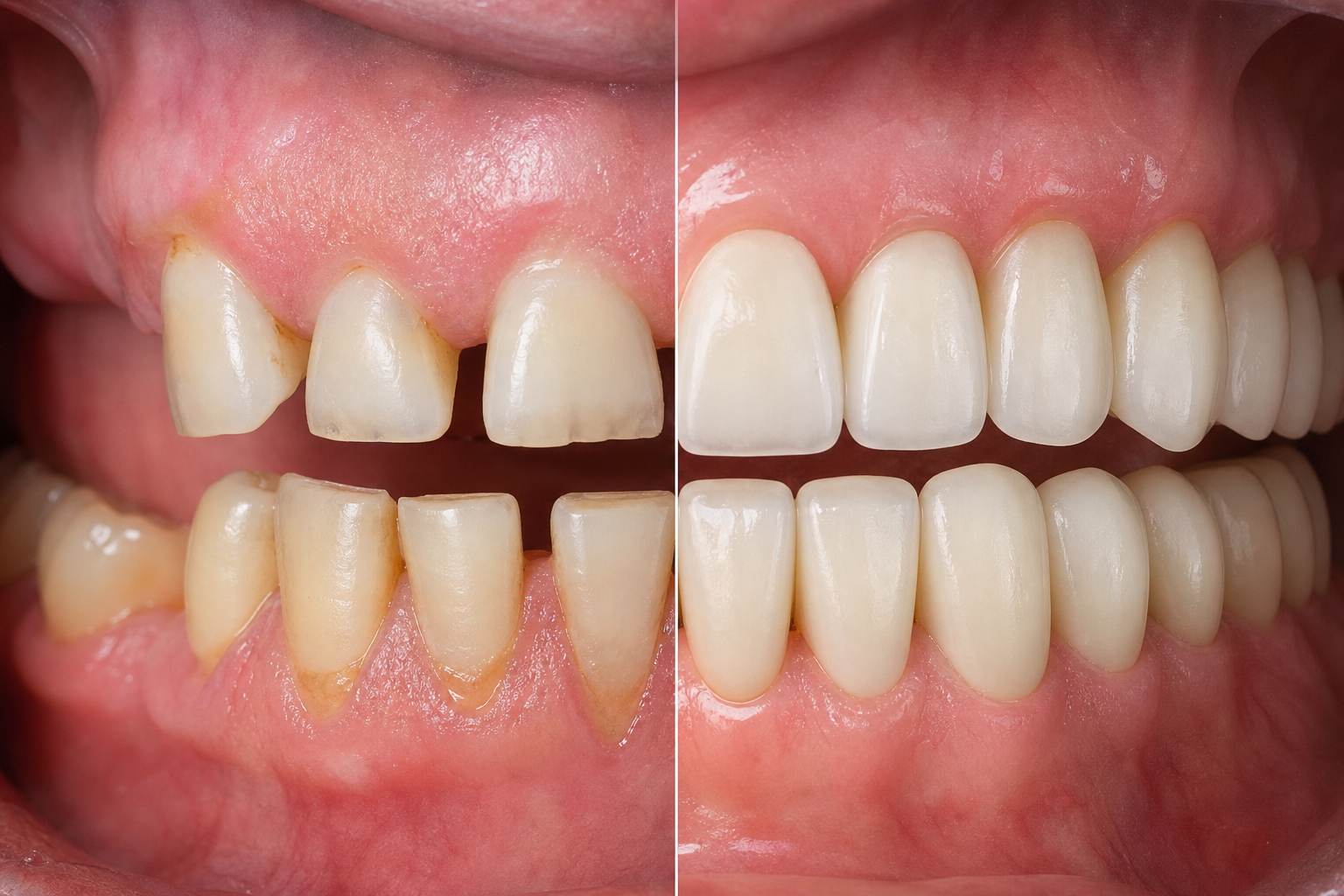
Before and after All-on-4 dental implants, the visible smile can change considerably, but that is only part of the result I would discuss. A fixed full-arch prosthesis may improve the appearance of failing or missing teeth, provide more stable chewing and restore some lost lip or facial support. However, the outcome depends on your bone, gums, bite, facial proportions, tooth position and healing. An online photograph cannot show whether the same result would be suitable, comfortable or maintainable for you.
I usually explain that the most successful All-on-4 result is not simply the brightest or most dramatic smile. It should look appropriate for your face, support your lips without excess bulk, allow clear speech, feel stable in function and be possible for you to clean properly over the years ahead.
What can change before and after All-on-4 dental implants?
All-on-4 can change the appearance of a full dental arch, the way replacement teeth support the lips, and the stability of eating and speaking compared with missing teeth or a loose denture. The degree of change is individual. I would assess the starting position carefully because someone with worn teeth, a collapsed bite and loose dentures has different needs from someone with a few failing teeth but reasonable facial support.
All-on-4 is a term commonly used for a fixed full-arch prosthesis supported by four implants. In many designs, two implants are placed towards the front of the jaw and two further back implants are angled. The number of implants alone does not tell you how the final teeth will look, what they are made from or whether the design is right for your mouth.
Changes people often notice
- Teeth and smile: replacement of missing, worn, broken or heavily restored teeth with a planned row of teeth.
- Lip support: where teeth and gum volume have been lost, the prosthesis may provide support that is no longer present.
- Chewing stability: fixed teeth can feel more secure than a removable denture, although they do not reproduce the sensation of natural teeth.
- Speech and confidence: some people find speaking easier with stable teeth, while others need time to adapt to the new tooth position and tongue space.
- Daily routine: eating, cleaning and maintenance all change. Fixed does not mean maintenance-free.
The smile is only one part of the result
When I assess someone for All-on-4 treatment, I do not plan the teeth by looking at a single smiling photograph. I would look at how much tooth shows when the lips are relaxed, how the lips move during speech and smiling, the shape of the face, the smile line, bite, gum display and the available space for the prosthesis.
A natural-looking result is usually about proportion rather than perfection. Very white, uniform teeth may suit some people, but they can look out of place if the tooth shape, shade, length or gum contours do not work with the face. I would discuss the appearance you like, while explaining what is realistic and safe for the bite and tissues.
This is where people sometimes get confused by All-on-4 dental implants before-and-after photos. A photograph may show an attractive smile, but it does not reveal whether the person can clean beneath the bridge, whether their speech was affected, how the teeth look at rest or whether the image shows temporary teeth rather than the final prosthesis.
What may change in your face and lips?
All-on-4 can alter facial support where lost teeth, gum tissue and bone have left the lips looking less supported. Replacing some of this lost volume may make the lower face appear more balanced in some cases. I would never promise that treatment will make someone look younger or create a particular facial shape, because the change depends on the amount and location of tissue loss and the way the prosthesis must be designed.
Artificial gum-coloured material can sometimes be incorporated into the bridge, particularly where there has been significant bone or gum loss. This is part of the prosthesis, not regenerated natural gum tissue. It can help support the lips and create more appropriate tooth proportions, but it also has trade-offs. Too little support may leave the teeth looking long or unsupported, while too much bulk can affect speech, tongue space, cleaning and the natural appearance of the smile.
What I would look at first is your facial profile, lip movement, tooth display, smile line and bite. Photographs, digital scans and appropriate radiographs or CBCT imaging help me plan the available bone and likely tooth position. These details matter far more than trying to copy a result from an online gallery.
What changes beyond appearance?
Beyond the smile, the main differences people are usually interested in are chewing, speech, comfort and confidence. Fixed implant teeth may feel more stable than a conventional denture, particularly if your denture moves while eating or speaking. That said, implant-supported teeth are still a prosthesis. They do not have the same nerve feedback as natural teeth, and there is normally a period of getting used to the new bite.
I would expect you to follow the dietary advice given during healing, which often means softer foods at first. As healing progresses and your treatment plan allows, function can be developed more confidently. Trying to test new teeth too early with hard or sticky foods can place unnecessary force on the implants and provisional bridge.
Speech may also feel different at first. Changing the position, thickness or length of the teeth can alter how the tongue meets them for certain sounds. Some people adapt quickly, while others need minor adjustments or more time. If speaking is central to your work or daily life, I would make this a specific part of the planning conversation rather than treating it as an afterthought.
Food can still collect around a fixed bridge, especially beneath the prosthesis. I would show you how to clean around the implants and underneath the bridge with suitable brushes, flossing aids or water-cleaning devices where appropriate. A fixed bridge is secure in daily use, but it needs deliberate home care.
Why the first All-on-4 photo may not show the final result
The teeth fitted shortly after surgery are often provisional, not the final prosthesis. In appropriately selected cases, a temporary fixed bridge may be fitted soon after implant placement, but this depends on implant stability and other clinical factors. I would explain clearly whether the teeth being fitted are provisional, how they should be used during healing and what is planned for the definitive bridge.
An immediate after photograph can be misleading if it is viewed as a finished result. There may be swelling, healing extraction sites, temporary gum contours and a smile that the person has not yet adapted to. The definitive bridge is planned in advance, then fitted or refined after healing and assessment of the bite, appearance, speech and soft tissues.
The final prosthesis may differ in tooth shape, shade, contour, strength and material from the temporary one. This is not necessarily a problem. It is often part of refining the result once the mouth has settled. I would encourage you to ask any provider whether their gallery shows immediate provisional teeth, a final bridge or both.
What I would assess before discussing your likely result
I would need an in-person assessment before saying whether All-on-4 is appropriate or predicting a likely before-and-after change. This normally involves examining your teeth and gums, discussing your medical history and lifestyle factors, reviewing your bite and taking the imaging needed for safe planning.
- The condition and long-term prognosis of your remaining teeth.
- Whether gum disease, decay or infection needs treatment and stabilisation first.
- Bone volume, nerve and sinus anatomy, and whether grafting or a different surgical approach may be needed.
- Your smile line, facial proportions, lip movement, tooth display and desired appearance.
- Your bite, jaw relationship and the space available for replacement teeth.
- Speech requirements, especially if you rely heavily on speaking at work.
- Smoking, medical conditions, medicines, healing factors and oral hygiene habits.
- Your ability to attend reviews and maintain a fixed bridge long term.
Natural teeth that can be predictably treated and maintained should not automatically be removed for a full-arch implant treatment. In some cases, preserving teeth with gum treatment, restorations or a staged plan may be the more conservative option. For a broader explanation of suitability, you can read my guide to who All-on-4 implants may suit.
If you are considering full-arch treatment in Birmingham or the West Midlands, a consultation should give you more than a smile simulation. I can assess the health, anatomy, function and maintenance requirements behind the proposed result, then discuss the alternatives in a written treatment plan.
When All-on-4 may not be the best choice
All-on-4 can be a valuable option for a failing or missing full arch, but I would not recommend it simply because it appears dramatic in before-and-after images. It may not be the right choice where natural teeth have a reasonable prognosis, gum disease is uncontrolled, cleaning is likely to be difficult or an alternative design would offer a better long-term plan.
Some people prefer a removable option, particularly if they want simpler access for cleaning or do not wish to undergo the same level of surgery. An implant-retained overdenture can be more stable than a conventional denture while remaining removable. In other cases, a fixed bridge supported by more than four implants may be considered. The question is not whether All-on-6 is automatically better, but whether the anatomy, bite and prosthetic design support one option over another. You can compare how All-on-6 differs from All-on-4 before deciding.
I would also be cautious where someone cannot commit to daily cleaning and regular maintenance, or where travel would make aftercare difficult. A full-arch bridge can need adjustments, repairs or professional removal for inspection over time. That is easier to manage when you have a clear local follow-up arrangement.
How to compare All-on-4 before-and-after photos properly
I would look beyond the obvious colour and straightness of the teeth. A useful gallery should help you understand the type of starting point and the stage of treatment shown, rather than encouraging you to expect the same result regardless of your own anatomy.
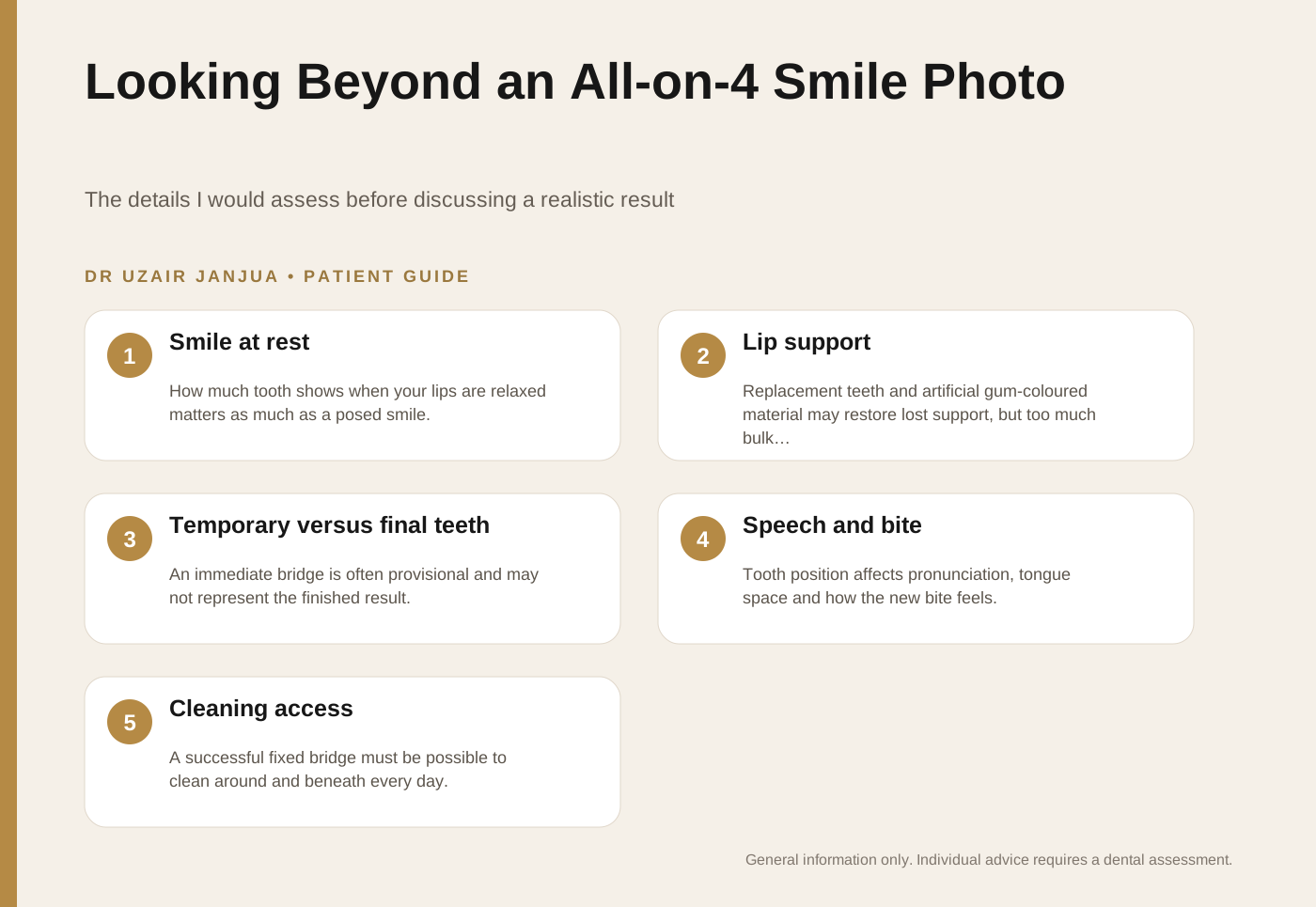
| What to check | Why it matters |
|---|---|
| Comparable views and lighting | Different angles, filters or lighting can make changes appear larger than they are. |
| Resting face as well as a broad smile | This helps show tooth display, lip support and whether the smile suits the face. |
| Temporary or final teeth | An immediate post-operative image may not represent the settled final result. |
| A starting point similar to yours | Severe tooth wear, missing teeth, bone loss and dentures each create different planning needs. |
| Gum contours and bridge bulk | The visible gum-coloured material and underside design affect support, cleaning and appearance. |
| More than one image | Profile, speech, function and cleaning access cannot be judged from a single smile photograph. |
For patients comparing providers in Birmingham, I would ask where surgery, temporary teeth, final fitting, adjustments and emergency care will take place. Travelling may be manageable for surgery, but it can become inconvenient if you need a bite adjustment, have swelling or pain, or require a repair. The lowest initial quote or most striking photograph does not necessarily represent the most complete long-term plan.
What the result involves long term
The implants and the visible teeth are separate parts of treatment. Implants may remain stable while the prosthetic teeth, screws, framework or outer material need repair, adjustment or eventual replacement. I would discuss this before treatment because describing All-on-4 as permanent can give the wrong impression. It is a long-term solution, but not one that is free from future care.
Daily plaque removal and regular professional maintenance are essential. Inflammation around implants can develop, and peri-implantitis means inflammation with bone loss around an implant. Bleeding, persistent swelling, a bad taste, pain, mobility or a loose bridge should not be dismissed as normal settling. I would want to assess these signs promptly.
Long-term cost is also more than the initial surgery and bridge. It can be affected by the number of arches treated, extractions, gum disease treatment, bone anatomy, scans, temporary teeth, final materials, laboratory work, sedation, reviews, maintenance and future repairs. My dental implant assessment in Birmingham is designed to clarify the clinical stages and practical responsibilities before you make an irreversible decision.
Is All-on-4 right for you in Birmingham or the West Midlands?
The right result is one that is attractive, functional, cleanable and maintainable for your individual mouth. If your teeth are failing, you struggle with a denture, or you are considering replacing a full arch, I would assess whether All-on-4, another implant design, an overdenture or preservation of your natural teeth makes the most sense.
Before committing, ask who will provide your hygiene support and reviews, whether temporary and final teeth are included in the plan, how repairs would be handled, and what happens if you need help outside normal appointment times. If you live in Birmingham or elsewhere in the West Midlands, convenient access to follow-up care can be as important as the surgical appointment itself.
A consultation is the sensible next step if you want to move beyond photographs and understand what a realistic All-on-4 before-and-after result could involve for you. I can assess your teeth, gums, bone, bite and facial support, then explain the options and trade-offs without assuming that a full-arch implant bridge is automatically the right answer.