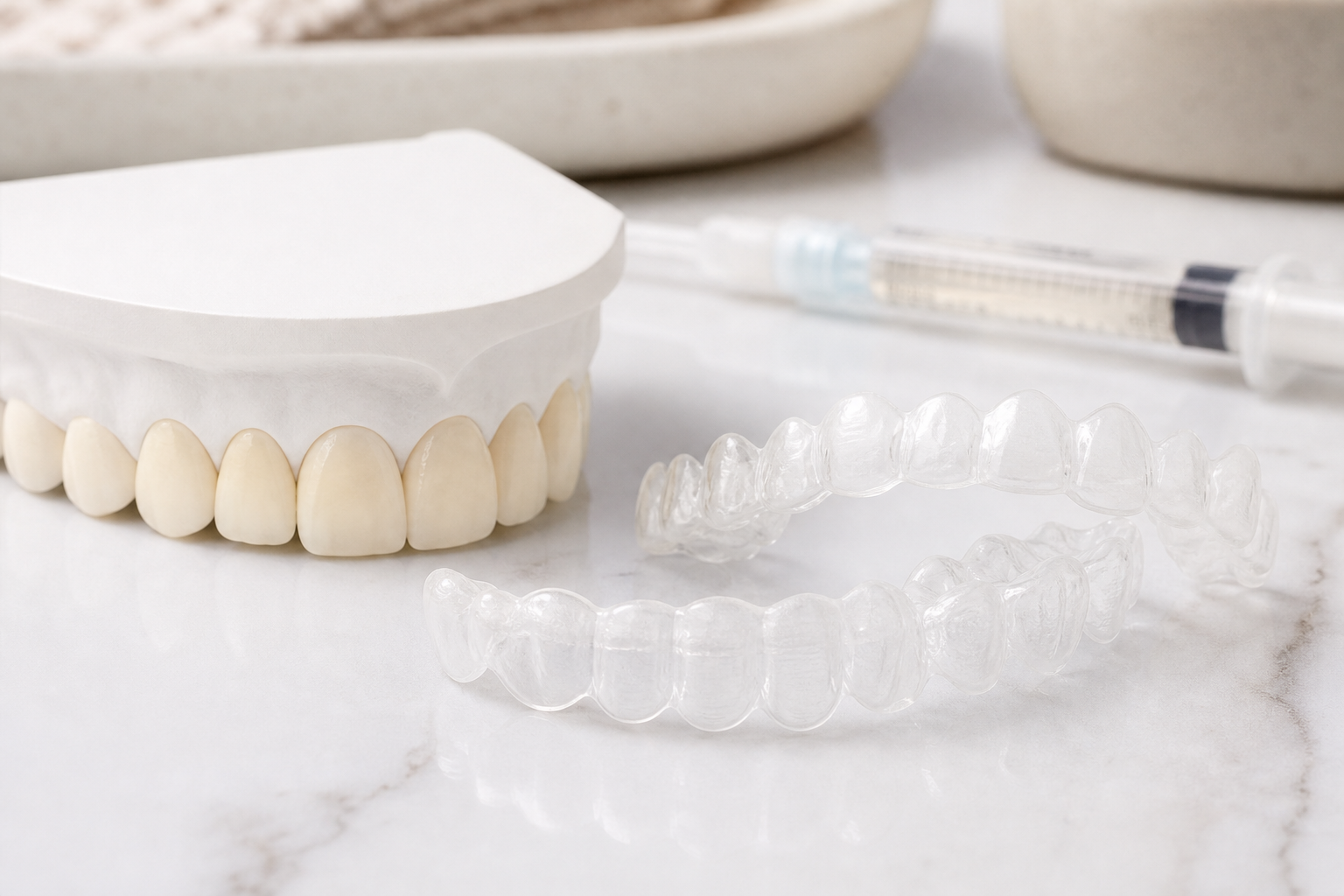
Professional teeth whitening should start with an examination and suitability discussion, not with whitening gel or trays. When I assess someone for whitening, I first check that the teeth and gums are healthy, look at existing crowns or fillings, discuss the type of discolouration involved and make sure whitening is likely to be a sensible option.
If it is suitable, I can then take records of your starting shade and arrange custom trays from an impression or digital scan. The purpose is not to make the process unnecessarily complicated. It is to give you a controlled, dentist-guided way to use prescribed whitening gel at home, with proper consideration of sensitivity, dental work and realistic expectations.
What happens before professional teeth whitening trays are made?
Before custom whitening trays are made, I would normally carry out a dental assessment, discuss the colour changes you want, check any visible restorations and record your current tooth shade. If your mouth is healthy and whitening is appropriate, I can take an impression or digital scan so closely fitting trays can be produced.
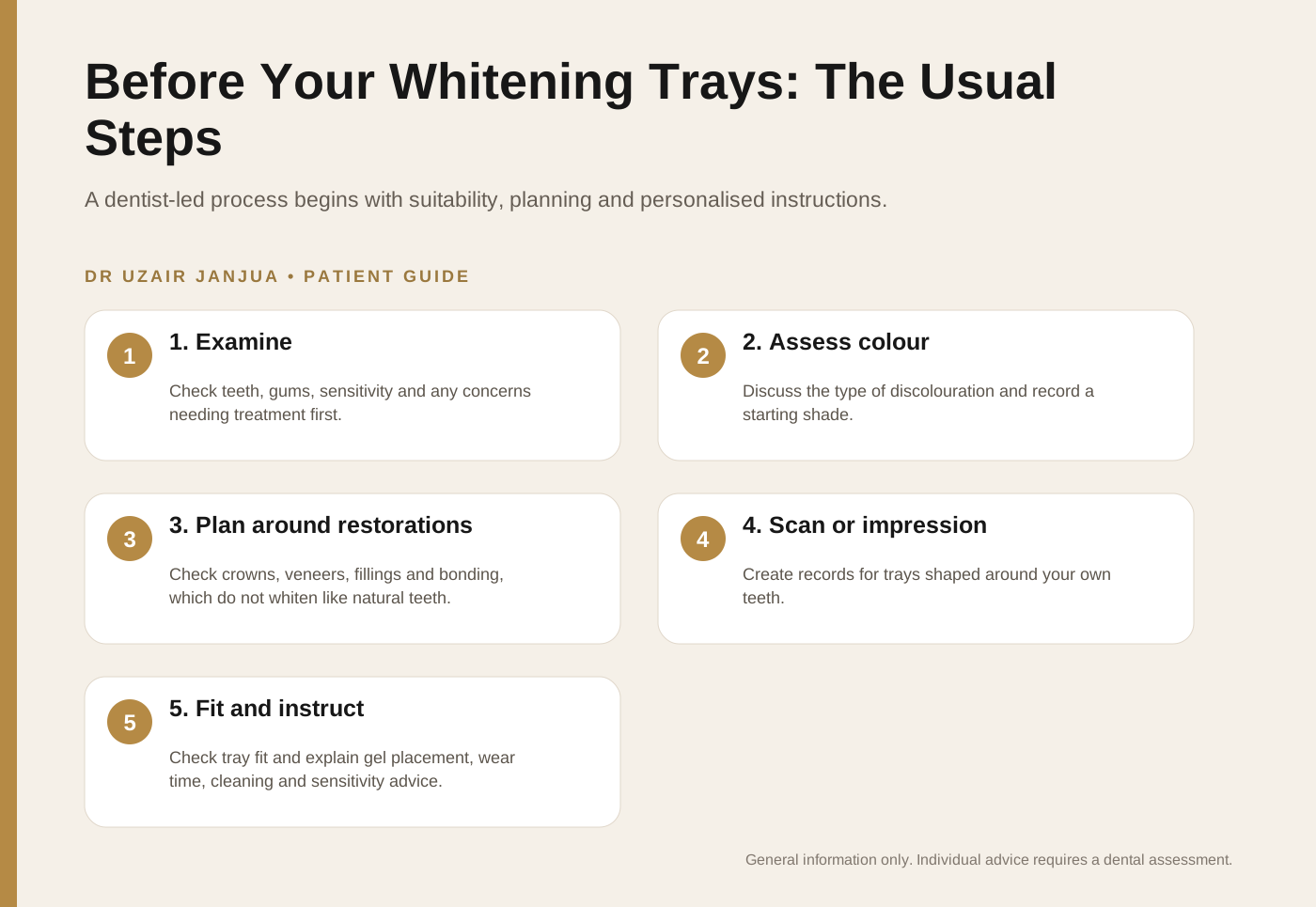
The exact sequence varies slightly between practices, but the preparation stage commonly includes:
- An examination of your teeth, gums and existing dental work.
- A conversation about staining, sensitivity and what whitening can realistically change.
- A starting shade record, sometimes with photographs.
- Digital scanning or impressions for your custom trays.
- A fitting appointment with personalised instructions for the gel and trays.
For patients in Birmingham and the West Midlands, I also recommend asking how many visits are likely to be needed and whether tray manufacture is completed in-house or through a laboratory. This matters if you are planning whitening before a holiday, wedding or other cosmetic dental treatment.
The first step is a dental examination, not the whitening gel
What I would look at first is whether there is anything that needs attention before whitening begins. This may include decay, cracked teeth, leaking or failing fillings, inflamed gums, gum recession, exposed root surfaces and existing sensitivity.
Whitening gel is designed for natural tooth structure, but it is not a substitute for dental treatment. If there is an untreated problem, whitening may cause more discomfort or distract from the issue that really needs addressing. I would not recommend simply covering a concern with cosmetic treatment.
An examination does not automatically mean X-rays are needed. I would only recommend further checks where they are clinically appropriate. The important point is that I need enough information to decide whether whitening is in your best interests.
A hygiene appointment may also be useful where plaque, calculus or surface staining is present. Cleaning can improve the appearance of teeth by removing deposits, but it does not replace the examination and it does not change the underlying colour of the tooth in the way whitening can.
I would also assess why your teeth look darker
Not all discolouration responds in the same way. I usually ask whether the change is general across the smile, mainly surface staining from drinks or smoking, or concentrated around one particular tooth. This helps me explain what professional teeth whitening is likely to improve and where it may have limitations.
General yellowing associated with ageing and some external staining can often respond differently from deep internal discolouration. A single dark tooth, for example, deserves a proper assessment rather than an assumption that tray whitening will solve it. If a tooth has been root-treated or has changed colour after trauma, another option such as internal whitening may sometimes be more appropriate.
Some developmental changes, fluorosis, medication-related staining or irregular patches may improve only partially or unevenly. I would rather explain that honestly at the outset than promise a uniform result that cannot be guaranteed. For a clearer sense of why results vary between teeth, you can read my guide to teeth whitening before and after results.
What if you already have fillings, crowns, veneers or composite bonding?
Whitening changes the shade of natural teeth, but it does not whiten crowns, veneers, bridges, fillings or composite bonding in the same way. I would check where these restorations sit in your smile and whether a change in your natural tooth shade could make them look darker or less well matched.
This does not mean every restoration needs replacing. Sometimes the difference is small and acceptable. In other situations, especially where a crown or bonded edge is visible near the front of the mouth, it is sensible to plan the order of treatment carefully.
One thing I usually explain to patients is that whitening often comes before new visible cosmetic work. Once the natural teeth have settled at their improved shade, I can assess whether future bonding, crowns or veneers should be matched to that colour. If your main concern is a chip, small gap, irregular edge or localised mark rather than overall tooth colour, composite bonding treatment may be the more relevant conversation.
Shade assessment is about expectations, not chasing an artificial colour
Before treatment, I would usually record a starting shade with a shade guide, photographs or another clinical record. This gives us a sensible reference point when reviewing progress and helps avoid relying on memory, lighting or a photograph taken in a different setting.
I do not promise a particular number of shades lighter. Teeth naturally vary in colour, and different areas of the same tooth can respond differently. The final result depends on the starting shade, the cause of the discolouration, the condition of the enamel and dentine, the prescribed product and how comfortably you can follow the treatment plan.
A brighter result is not necessarily the right result if it sits poorly alongside visible restorations or planned cosmetic work. I would discuss what looks natural for your smile and explain that a stronger or longer whitening course is not automatically better. More exposure can increase sensitivity without producing a proportionately better outcome.
How are professional whitening trays made?
If whitening is suitable, I can take an impression using conventional materials or use a digital intraoral scan. Both approaches can be used to create trays shaped around your own teeth, rather than relying on a generic tray bought online.
The trays are made to fit closely enough to hold the prescribed gel against the teeth in a controlled way. Good fit matters because it helps with accurate gel placement and comfort. It does not make whitening risk-free, and a small amount of gel can still escape if too much is used, which is why the fitting appointment and instructions are important.
There may be a laboratory stage before the trays are ready. I would explain the likely turnaround for your own plan rather than offering a universal timescale. If you are travelling from elsewhere in the West Midlands, it is worth planning for the fact that the consultation, scan or impression, tray fitting and review may take place on separate dates.
What happens at the tray-fitting appointment?
At the fitting appointment, I would check that the trays sit properly and show you exactly how to use them. This includes how much gel to place in each part of the tray, how to remove excess gel from the gum area, how to clean and store the trays, and how to follow your individual wear schedule.
Wear time is not the same for every product or prescription, so I would give instructions specific to the gel provided. I would also explain what to do if your teeth become sensitive, which can include pausing treatment or adjusting the plan after speaking with the practice.
Temporary sensitivity and mild gum irritation are recognised side effects of whitening. They should not simply be ignored. Persistent, severe or unusual pain needs dental advice, particularly if it affects one tooth more than the others or does not settle as expected.
If you would like an individual assessment of suitability, tray options and the likely appointment sequence, you can arrange a consultation for dentist-led teeth whitening in Birmingham. I can then explain what would be included for your teeth, rather than asking you to choose a kit without the information needed to do so safely.
When might I delay or advise against whitening?
I may recommend delaying whitening if there is active decay, gum disease, significant untreated sensitivity, exposed roots, a cracked tooth or another issue that needs treatment first. Addressing the underlying problem can feel like a delay, but it is usually the more comfortable and sensible route.
Professional whitening is not right for everyone. Cosmetic whitening is not suitable for under-18s, and people who are pregnant or breastfeeding are generally advised to postpone elective whitening. I would also be cautious where the main concern is a restoration that cannot change colour, a single dark tooth needing investigation, or staining unlikely to respond well to external tray whitening.
In the UK, tooth whitening is considered the practice of dentistry. Products containing or releasing between 0.1% and 6% hydrogen peroxide are subject to dental-professional restrictions. The first use in each cycle must be carried out by a dental professional or under appropriate direct supervision. This is an important distinction between a planned clinical treatment and an unassessed product bought online or whitening offered outside a dental setting.
What changes the cost of professional teeth whitening in Birmingham?
The headline price is only useful if you know what is included. When comparing professional teeth whitening in Birmingham, I would encourage you to ask whether the fee covers the assessment, custom trays, whitening gel, fitting instructions and a review appointment.
| Cost factor | Why it matters |
|---|---|
| Consultation and examination | This confirms whether whitening is appropriate before treatment starts. |
| Scan or impressions | These are used to make trays specific to your teeth. |
| Trays and prescribed gel | Plans may differ in the number of trays, gel syringes and product prescribed. |
| Review and aftercare | A review provides an opportunity to assess progress, comfort and sensitivity. |
| Preparation treatment | Hygiene care, fillings, gum treatment or sensitivity management may be needed first. |
| Future maintenance | Ask whether top-up gel or replacement trays would be charged separately. |
| Planned cosmetic dentistry | Whitening before bonding, crowns or veneers may affect the wider treatment plan. |
It is reasonable to compare fees, but compare like with like. A lower advertised figure may not include the examination, professional prescription, custom trays or review that make up a complete dentist-led process.
Professional trays versus online kits or salon whitening
The key difference is not simply whether a product is called “professional”. With dentist-led whitening, I can assess your teeth and gums beforehand, prescribe an appropriate product where suitable, arrange custom trays, show you how to use them and provide a route back for advice if sensitivity or tray-fit issues arise.
Some generic trays may not fit as closely to your teeth as custom-made trays. An online questionnaire or salon consultation also cannot replace an in-person dental assessment where this is needed. I would be particularly cautious if you have fillings, crowns, recession, sensitive teeth or one tooth that looks noticeably darker than the rest.
Custom tray whitening is usually a gradual process, which some people prefer because it allows controlled treatment at home. In some cases, trays may be used for future dentist-guided maintenance, but I would first need to review their fit and your oral health. This is particularly important after fillings, crowns, orthodontic tooth movement, tray damage or changes to the gums.
A practical timeline before you receive your trays
The process is usually straightforward, but it should not be rushed at the expense of the initial checks. I would outline your likely sequence at the consultation so you can plan around work, travel and any forthcoming event.
- Assessment: I examine your teeth and gums, discuss your concerns and decide whether whitening is appropriate.
- Planning: We record your starting shade and consider existing crowns, veneers, fillings or bonding.
- Records for trays: I take a scan or impression if we are proceeding.
- Tray manufacture: The trays are produced, with the timing explained for your particular arrangement.
- Fitting and instructions: I check the trays and provide your individual gel and wear guidance.
- Home course and review: You follow the plan at home and contact the practice if you have concerns or sensitivity.
The important decision is not simply which whitening gel to buy first. It is whether your teeth and gums are healthy, whether the discolouration is likely to respond, and whether whitening fits with any existing or planned dental work.
If you are considering professional teeth whitening in Birmingham or the West Midlands, I can assess whether whitening is appropriate, whether you need any preparation first, how many appointments are likely to be involved and exactly what is included in your treatment cost. That gives you a clear basis for deciding whether custom tray whitening is the right next step for you.