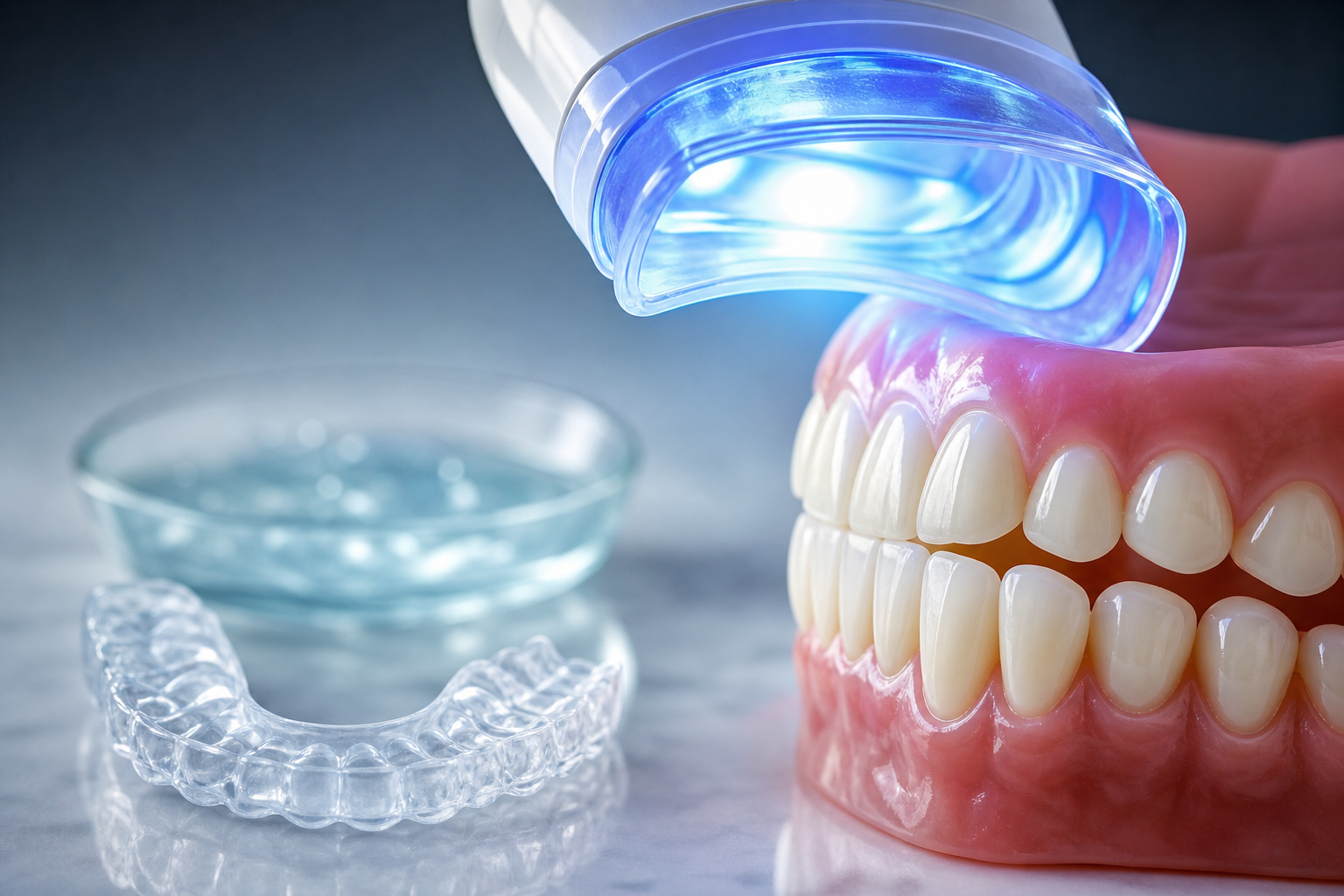
Laser teeth whitening can produce a visible change in a single appointment, often taking around one to two hours. That can be very appealing if you have a wedding, holiday, interview or other deadline. However, I usually explain that faster does not automatically mean whiter, longer-lasting, more comfortable or better value.
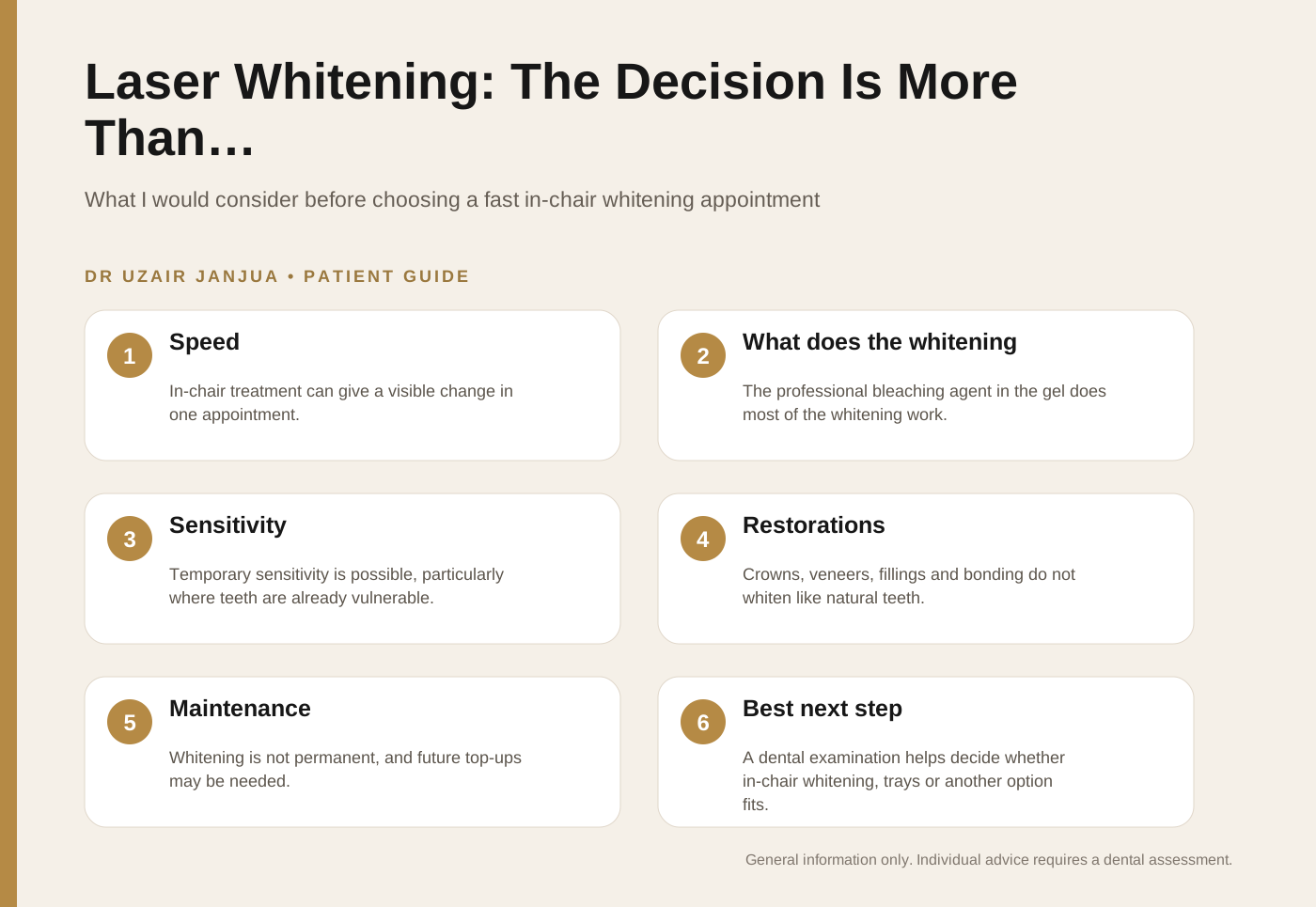
The bleaching agent in the gel does most of the whitening work. A laser or light may be used during an in-chair treatment to activate or support the process, but it does not guarantee a better final shade than other professional whitening methods. Before I recommend laser teeth whitening in Birmingham, I would assess your teeth and gums, any sensitivity, visible fillings or crowns, your timing and what you are hoping to change.
What is laser teeth whitening, and what does the laser actually do?
Laser teeth whitening is an in-chair professional whitening treatment. I would protect the gums and soft tissues, apply whitening gel to the natural teeth, then use the particular system's light or laser protocol where appropriate. The treatment is often described as power whitening, light-assisted whitening or laser whitening, although those terms do not always mean exactly the same thing.
This is where people sometimes get confused. The bleaching agent in the gel is the main part that lightens the tooth colour. The light source is intended to assist or accelerate the process during the appointment. It should not be presented as a magic ingredient that always produces a deeper or more durable result.
Different practices may use different products, light sources, gel strengths and appointment protocols. If you are comparing laser teeth whitening in the West Midlands, I would ask exactly what is included rather than relying on the word “laser” alone.
Is laser teeth whitening better than professional home whitening?
Laser teeth whitening is better for some people because it is quicker, not because it is automatically more effective. Dentist-supervised home whitening with custom trays takes longer, but it gives more gradual control and may be easier to maintain in future. The right choice depends on urgency, sensitivity, budget, existing dental work and how much flexibility you want over the process.
| Consideration | Laser or in-chair whitening | Dentist-supervised home trays |
|---|---|---|
| Speed | Visible change can be achieved in one appointment. | Usually develops gradually over days or weeks. |
| Control | Useful for a faster, professionally managed session. | Allows a more adjustable pace within the prescribed plan. |
| Sensitivity planning | May still cause temporary sensitivity despite the speed of treatment. | The routine can sometimes be modified if sensitivity develops. |
| Maintenance | May need future top-ups depending on staining and lifestyle. | Reusable trays may support future top-ups where I confirm that further whitening remains suitable. |
| Convenience | Helpful for people who prefer a single longer appointment. | Requires consistent use at home. |
| Cost structure | May include the appointment, light system, review and sometimes trays. | Usually includes custom trays, prescribed gel and instructions. |
Research has not consistently shown that light activation gives a better final colour change than in-office whitening without light activation. For that reason, I would focus less on whether a system sounds high-tech and more on whether the treatment plan is safe, realistic and suitable for your teeth.
If you would like to compare the wider range of professional teeth whitening options in Birmingham, the important distinction is usually between a rapid in-chair result, a gradual tray-based result, or a carefully planned combination of both.
What I would assess before recommending laser whitening
Whitening should start with an examination, not with choosing a shade on social media. What I would look at first is whether your teeth and gums are healthy enough for whitening and whether bleaching is likely to improve the concern you have.
The health of your teeth and gums
Decay, gum disease, leaking fillings, cracks, worn enamel and exposed dentine may need attention first. These problems can make whitening uncomfortable, and they can also mean that sensitivity is more likely. A fast appointment is never a substitute for identifying problems that need treatment.
Your starting shade and the type of discolouration
Surface staining from tea, coffee, red wine or smoking may respond differently from deeper discolouration within the tooth. A single dark tooth, particularly after trauma or root canal treatment, needs its own assessment. General laser whitening may not be the most appropriate solution for one unusually dark tooth.
Existing crowns, fillings, veneers and bonding
Whitening changes natural tooth colour. It does not whiten crowns, veneers, bridges, implants, fillings or composite bonding in the same way. If these are visible when you smile, I would discuss whether whitening could leave a mismatch and whether shade planning should happen before any replacement restoration is considered.
Sensitivity, timing and expectations
I would ask about sensitivity to cold drinks, previous whitening, gum recession and the result you have in mind. I would also ask about any fixed event date. Teeth can look especially bright immediately after treatment, and temporary sensitivity or gum irritation can occur, so I would not normally advise leaving treatment until the last possible day before an important occasion.
Age, pregnancy, breastfeeding and your wider medical and dental history also need to be considered individually. Tooth whitening is generally not provided for patients under 18, and I would usually advise discussing pregnancy or breastfeeding before making any cosmetic whitening plan. An examination is the only sensible way to decide whether whitening is appropriate for you.
Does laser whitening damage teeth or cause sensitivity?
Professional whitening should not be treated as risk-free, but it can be carried out carefully after a proper assessment. Temporary tooth sensitivity is a recognised side effect. Some people also notice short-lived gum soreness, throat irritation or white patches on the gums if whitening gel comes into contact with soft tissue.
I would use appropriate gum protection, controlled gel placement and careful removal of excess material to reduce the chance of irritation. However, no light source should be marketed as a guarantee that you will not experience sensitivity. If your teeth are already sensitive, have exposed root surfaces, cracks or significant wear, a slower approach may make more sense.
One thing I usually explain to patients is that pushing for the fastest or palest possible shade is not always the most comfortable or natural-looking plan. The aim is a healthy, even and realistic improvement, not an artificial endpoint that ignores your individual teeth.
Why laser whitening may not produce an even result
Laser teeth whitening can lighten natural enamel, but it cannot change the colour of restorations. This is particularly important if you have composite bonding on front teeth, a crown near the smile line, old fillings, veneers or an implant-supported crown.
For example, if your natural teeth become lighter but your existing composite bonding remains the same shade, the bonding may look darker by comparison. I would usually discuss whitening before planning new visible bonding, where clinically appropriate, so that any new material can be matched to your settled tooth shade. My guide to whitening around composite bonding explains this common shade-planning issue in more detail.
Whitening also may not solve a concern about tooth shape, chips, rough edges or a localised defect. In those situations, composite bonding treatment or another restorative option may be more relevant than bleaching alone. I would not recommend whitening as a substitute for treating a structural problem.
How much does laser teeth whitening cost in Birmingham?
There is no meaningful single price for laser teeth whitening in Birmingham because treatment plans are not always equivalent. A lower headline fee may not include the examination, gum protection, cleaning, review, take-home trays or support if sensitivity occurs. I would compare the full plan, not just the advertised appointment price.
I would also ask what the practice means by “laser whitening”. It may refer to a laser, an LED light-assisted system or another form of in-chair power whitening. The equipment name alone does not tell you the gel protocol, how long the appointment will take, or what aftercare is included.
| What can affect the final cost? | Why it matters |
|---|---|
| Examination and diagnostic checks | I may need to establish that whitening is safe and suitable before treatment begins. |
| Cleaning or stain removal | Removing surface deposits first can help reveal the true tooth colour. |
| The whitening protocol | Laser-assisted, LED-assisted and other power-whitening appointments vary considerably. |
| Number of in-chair applications | Appointment length and the number of gel cycles can differ between plans. |
| Custom trays and top-up gel | These can affect both the initial fee and future maintenance value. |
| Dental treatment needed first | Decay, gum problems, cracks or defective restorations may need treating before whitening. |
| Visible dental work | Shade mismatches may require separate planning or later replacement of restorations. |
If you are travelling from Solihull, Sutton Coldfield, Wolverhampton, Coventry, Dudley, Walsall or elsewhere in the West Midlands, I would also ask who will provide aftercare if you have questions following a single in-chair appointment. This matters more than it may appear when comparing quick whitening offers.
When does laser whitening make sense, and when would I suggest another option?
I may consider in-chair whitening where you want a professionally managed visible improvement within a relatively short timeframe, your teeth and gums are healthy, you understand the limits of treatment and you do not have visible restorations likely to create an obvious mismatch.
A fast result before an event
If you have a wedding, graduation, holiday or important professional event, an in-chair option may be convenient. I would still prefer to plan it with enough time for any sensitivity to settle and for us to review whether the result sits naturally with your existing restorations.
Teeth that are already sensitive
If cold drinks regularly cause discomfort, I would be cautious about choosing the fastest possible whitening protocol simply because of the name. Custom trays, a slower schedule or a combined approach may give us more control. The answer depends on what is causing the sensitivity and what I find at your examination.
Surface staining rather than a darker natural shade
Where the main issue is tea, coffee, smoking or other surface stain, professional cleaning or stain removal may be the more proportionate first step. Whitening can still be considered afterwards, but I would not assume it is necessary before seeing how much improvement cleaning achieves.
One dark tooth or visible restorations
A single dark tooth may need a more specific diagnosis and treatment plan. Likewise, multiple front crowns, veneers or bonded teeth can make general whitening less predictable. In either situation, I would discuss whether restorative planning is more likely to meet your expectations.
If you are unsure whether rapid in-chair whitening, home trays or another option fits your teeth, a consultation in Birmingham allows me to assess the cause of the colour change and explain the trade-offs before you commit to treatment.
How I would prepare you for treatment and aftercare
Before whitening, I would make sure you understand the intended shade direction rather than promise a particular result. Natural teeth vary in how they respond, and an immediate post-treatment shade is not always the final settled appearance.
- Allow time before a major event rather than booking at the last minute.
- Follow the specific aftercare advice and sensitivity plan provided with your treatment.
- Keep up normal brushing with a suitable toothpaste, but do not try to intensify the result with repeated unprescribed whitening products.
- Be realistic about staining foods, drinks and smoking, which can gradually affect the shade again.
- Arrange future top-ups only when I have confirmed that further whitening remains clinically appropriate, rather than whitening repeatedly without review.
Whitening is not permanent. How long the result remains noticeable depends on your starting shade, diet, smoking, oral hygiene, ageing and whether a suitable maintenance plan is available. Reusable trays can be a practical advantage for some people, provided future use is reviewed and remains appropriate for their teeth and gums.
Questions I would encourage you to ask before paying for laser teeth whitening
A clear conversation before treatment can prevent disappointment later. I would encourage you to ask:
- Is the person providing the treatment registered with the General Dental Council?
- Does “laser whitening” mean a laser, an LED light or another in-chair system?
- What examination and gum protection are included?
- How long is the appointment, and how many gel applications are planned?
- What result is realistic from my current tooth shade?
- How will sensitivity be managed if it occurs?
- Will my crowns, veneers, fillings or composite bonding look different afterwards?
- Are custom trays, top-up gel, a review appointment or aftercare included in the quoted fee?
In the UK, tooth whitening is the practice of dentistry and should be provided through a properly regulated dental route. I would always advise checking that your provider is registered with the General Dental Council, rather than assuming a beauty setting or a low-cost offer is an equivalent alternative.
Choosing the right whitening plan for your teeth
Laser teeth whitening can be a sensible option if speed genuinely matters and your teeth are suitable. But the quickest appointment is not automatically the best overall choice. The bleaching agent, your tooth condition, sensitivity risk, visible restorations and maintenance plan matter more than the marketing label attached to the light source.
When I assess someone for laser teeth whitening, I look beyond whether we can make the teeth lighter in one session. I look at whether the result is likely to be even, comfortable, appropriate for their smile and maintainable afterwards. If you are considering treatment in Birmingham or the West Midlands, a proper examination is the right next step to decide whether in-chair whitening, custom trays, a combined plan, cleaning or restorative treatment makes the most sense.