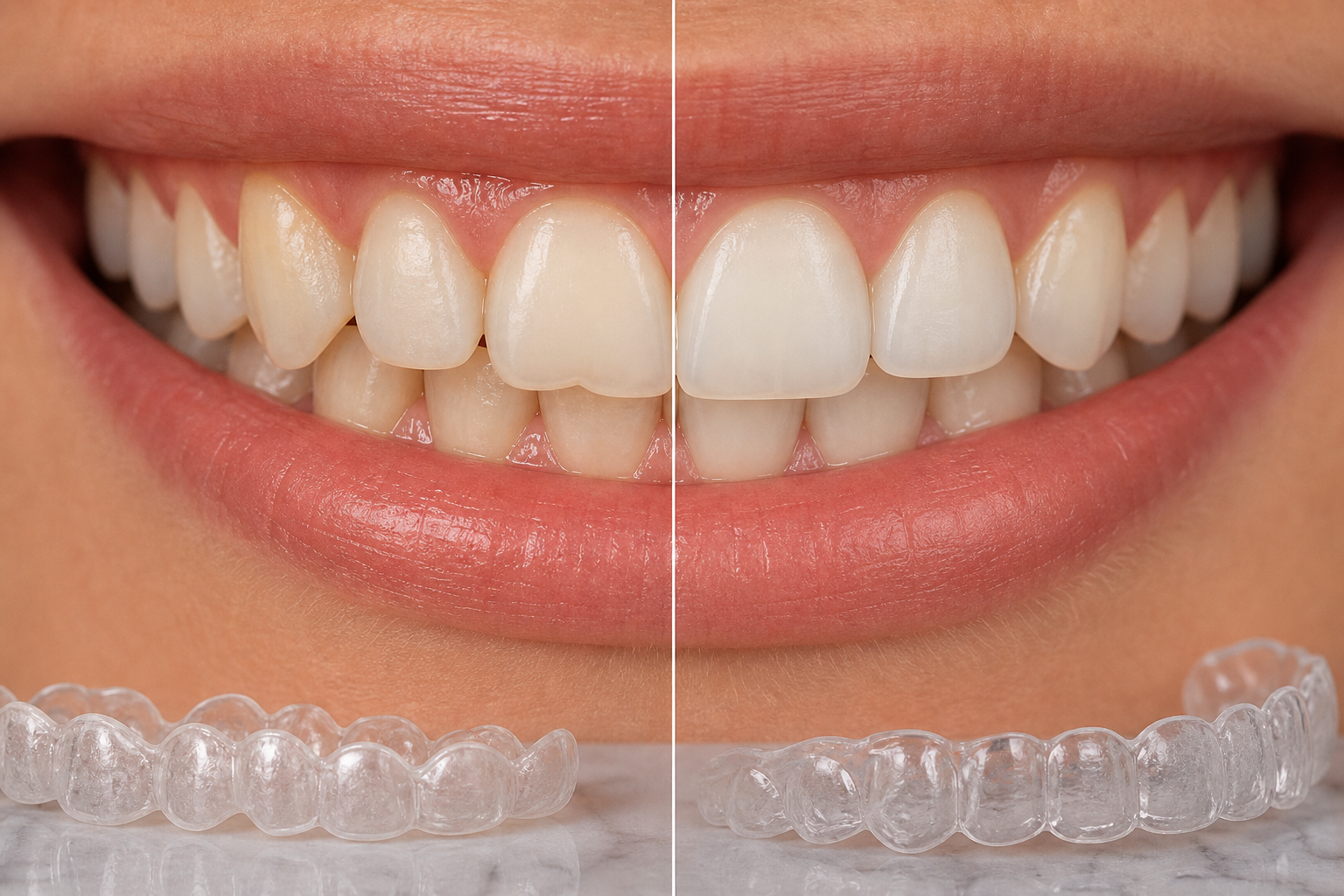
Clear aligners can produce convincing before-and-after changes, particularly for mild to moderate crowding, small gaps, teeth that have moved after previous braces and selected bite concerns. When I assess someone for clear aligners, though, I look beyond whether the front teeth can appear straighter. I need to establish whether the planned movement is safe, realistic and compatible with the bite, gums and supporting bone.
The most realistic clear aligners before and after results usually involve controlled alignment of teeth within the available space. Larger rotations, moving teeth up or down, major root movement, extraction cases and jaw-related bite problems can be more difficult. A digital simulation is useful for discussing the intended direction of treatment, but it is not a guarantee that every tooth, root and bite contact will follow the computer plan exactly.
What can clear aligners realistically change?
I can often use clear aligners to improve mild to moderate crowding, close small spaces, straighten front teeth and treat relapse after earlier orthodontic treatment. In the right case, aligners can also help with selected overbites, deep bites, crossbites and uneven tooth positions.
What matters is not simply how crooked the teeth look in a photograph. I would assess how much space is available, whether the teeth need to move bodily or merely tip into a better position, and whether the upper and lower teeth will still meet properly afterwards.
For example, a small gap between upper front teeth may be relatively straightforward to close if the bite and gum support are healthy. Severe crowding may need space to be created through carefully planned slenderising between selected teeth, tooth movement further back in the mouth, or occasionally a different orthodontic approach.
One thing I usually explain to patients is that a straighter-looking smile and a fully corrected bite are not always the same thing. Limited treatment focused only on the front teeth may be appropriate in some situations, but it should not be used to ignore an underlying bite issue.
Which movements are easier, and which need more control?
Clear aligners are generally most predictable for straightforward alignment and small, carefully staged changes. As movements become more three-dimensional, the need for additional control increases. Attachments, elastics and other features can help, but they do not make every movement equally predictable.
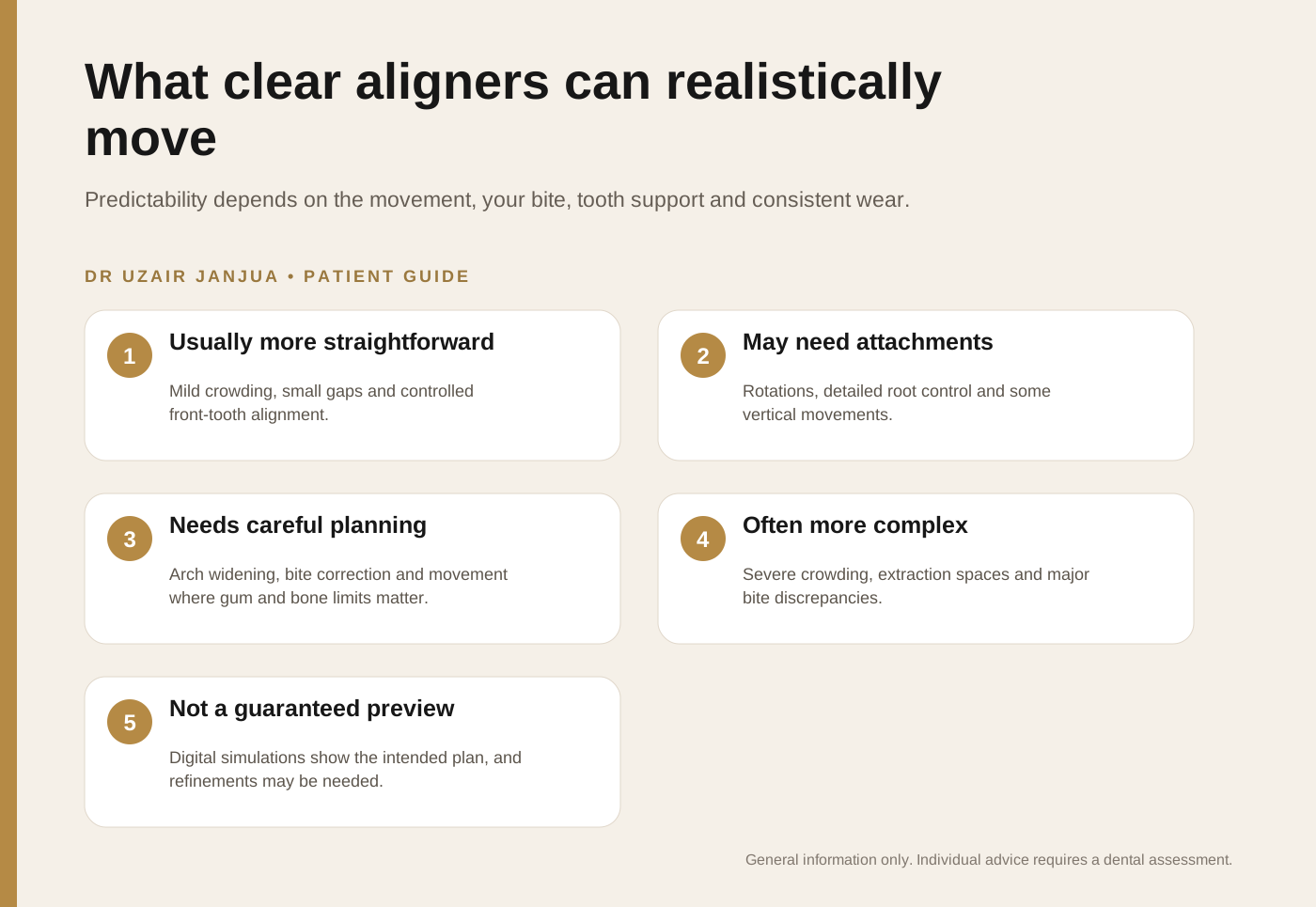
| Movement | What I would usually expect | Important consideration |
|---|---|---|
| Mild crowding or spacing | Often well suited to aligners when there is enough safe space. | The bite still needs checking, even when the concern is cosmetic. |
| Simple tipping | Usually more controllable than moving the whole root through the bone. | A tooth can look straight before its root position is fully ideal. |
| Rotation | Small rotations may be achievable, particularly with attachments. | Rounded teeth, including canines, can be harder to rotate accurately. |
| Moving a tooth up or down | Possible in selected cases, but often less predictable. | Vertical movement may need attachments, elastics or another technique. |
| Root torque | Can be planned, but requires careful control and monitoring. | This is more demanding than simply changing the visible angle of a tooth. |
| Arch widening | May create a broader-looking smile in suitable cases. | I would keep movement within the limits of the gums and supporting bone. |
| Extraction space closure | Sometimes possible, but often more complex. | Fixed braces or a combined approach may offer more control in some cases. |
Attachments are small tooth-coloured shapes temporarily bonded to selected teeth. They give an aligner more grip, rather like giving it a better handle on a tooth. They can make rotations, root control and certain vertical movements more achievable, but they are visible at close range and do not remove the possibility of refinements.
I may also discuss interproximal reduction, sometimes called slenderising. This involves removing a very small, planned amount of enamel between particular teeth to create space. It is not something that should be decided from a remote scan alone, because enamel condition, tooth shape, gum health and the overall bite all matter.
Why a digital before-and-after plan is not a guarantee
A digital simulation shows the intended sequence of tooth movement and the planned visible positions of the teeth. I find it useful for explaining what we are trying to achieve, but it is not a promise of the final clinical result.
A computer preview cannot guarantee exactly how each tooth root will respond within the supporting bone, how the gums will respond, or precisely where the final bite contacts will settle. Those details depend on the examination, the records taken where clinically indicated, the biology of your teeth and gums, and how treatment progresses over time.
For an aligner to work as planned, it needs to fit closely over the teeth throughout treatment. If a tooth does not move as expected, the aligner may stop tracking properly. This can happen because of the complexity of the movement, natural biological variation, an attachment coming off, or aligners not being worn as prescribed.
A refinement is an additional set of aligners used to improve positions that have not reached the planned result or to complete the fine detailing. Refinements are not necessarily a sign that treatment has failed. They are often part of responsible orthodontic finishing, especially where precise rotation, bite adjustment or root control is involved.
Before starting, I would make sure you understand what the quoted treatment includes. This should cover whether refinements are included, how reviews are arranged, what happens if an aligner is lost or stops fitting, and what retainers will be needed at the end.
What I would assess before recommending clear aligners
Before I recommend clear aligners, I would assess the teeth, gums and bite rather than relying on the appearance of the front teeth alone. A smile photograph can be helpful, but it cannot show whether there is gum disease, tooth wear, root issues, unstable fillings or a bite that may worsen if teeth are moved without proper planning.
I would look at crowding and spacing, the way the upper and lower teeth meet, gum and bone support, existing crowns or fillings, missing teeth, signs of grinding, tooth shape and any history of previous orthodontic treatment. X-rays or other records may be appropriate where clinically indicated, but not every person needs identical investigations.
This is particularly important if you have worn teeth, gum recession, implants, bridges, multiple crowns or teeth that have already moved following braces. Clear aligners may still be possible, but the plan needs to account for those factors rather than treating the teeth as though they are all the same.
Remote scans and direct-to-consumer previews can look convenient, but they may not provide enough information to assess gum health, active dental disease, root position, bone support or the way your teeth meet. I would not rely on a digital preview alone where those factors have not been examined and monitored appropriately during treatment.
If you are considering treatment in Birmingham or the wider West Midlands, I can assess whether your proposed changes are mainly cosmetic, whether they affect the bite and whether clear aligners are the sensible route before you commit to a simulated result. You can find more about my approach to clear aligner treatment in Birmingham.
When clear aligners may not be the best choice
I would not recommend clear aligners simply because they are discreet if the movements required are better controlled with another appliance. Clear aligners can treat a wide range of cases, but they are not automatically the best option for severe crowding, major rotations, extraction cases or complex bite correction.
Fixed braces may offer more control in some cases where teeth need substantial root movement, where spaces from removed teeth need closing, or where the bite needs detailed correction. Tooth-coloured fixed braces can be worth discussing if appearance is important but greater control is needed.
A prominent upper front tooth, a significant deep bite, a crossbite involving several teeth or a jaw-size discrepancy may need a more detailed orthodontic assessment. In some cases, I may discuss a hybrid plan, using aligners for suitable stages and fixed appliances or other aids for movements that need stronger control.
This is where people sometimes get confused by before-and-after images. A good-looking result in one person does not prove that the same method is appropriate for another person with apparently similar crowding. The underlying bite, tooth shape, gum support and amount of movement may be completely different. For a fuller comparison, read my guide to Invisalign or braces for adults.
How to judge clear aligner before-and-after photographs properly
I would treat before-and-after photographs as a conversation starter, not proof that you will achieve an identical result. Useful images should show more than a close-up of the upper front teeth. Ideally, I want to see the smile, the teeth together from the front and side, and views of the upper and lower arches.
Look for consistent camera angle, lighting and lip position. A photo can appear more dramatic simply because the after image is brighter, closer or taken at a more flattering angle. Whitening, composite bonding, enamel reshaping, gum contouring and different photography can all contribute to the final appearance.
It is also reasonable to ask whether the image shows alignment alone or a combination of treatments. Straightening may improve the position of teeth, but it does not change their natural colour, repair chips or alter the shape of a small tooth. In some cases, limited finishing with composite bonding may be discussed after alignment, but it should not be used as a substitute for moving teeth that are genuinely out of position.
What affects the final result and overall cost?
The final result depends on the diagnosis, the complexity of the movements, how consistently the aligners are worn and how the teeth respond during treatment. The original number of aligners is only one part of the picture. A shorter-looking initial plan can still need refinements before it is properly finished.
The overall cost can change depending on whether one or both arches are treated, the aligner system used, the number of stages, attachments, elastics, bite ramps, slenderising, monitoring appointments, refinements, retainers and any dental treatment required before orthodontics can begin.
I would also encourage patients travelling from Coventry, Solihull, Wolverhampton, Walsall, Sutton Coldfield or elsewhere in the West Midlands to consider appointment practicality. Regular review matters because attachments can come off, aligners can be damaged or lost, and a tooth that stops tracking may need attention before the next stage.
The key question is not just, “What is the starting price?” It is, “What level of planning, monitoring, refinement and retention is included for my case?”
Clear aligners, braces or a combined approach?
I usually compare these options by looking at the movement required rather than assuming one is universally better. Clear aligners are removable, discreet and can make brushing and flossing more straightforward for people who remove them and clean consistently. Their trade-off is that they rely on consistent wear and may have less control for some demanding movements.
Fixed braces are attached to the teeth, so they do not depend on being taken in and out correctly. In some complex cases, they may offer more control for rotations, detailed root positioning and involved bite correction. They are more visible and require careful cleaning around brackets and wires.
A combined approach can sometimes offer the most sensible balance. I may use aligners where they are efficient and consider fixed appliances or other aids only where they add meaningful control. The right plan should be based on the result we are trying to achieve safely, not on forcing every case into one system.
What happens after the aligners come out?
Active treatment is not the end of orthodontic care. Teeth can move over time after aligners or braces, which is why retention needs to be planned from the outset. I would give you an individual retainer plan and explain how to follow it, because long-term stability depends on wearing and looking after retainers as advised.
Retainers may be removable, fixed behind selected teeth, or a combination of both. The right arrangement depends on your teeth, bite and ability to look after them. Retainers can wear, break or stop fitting, so they may need review and replacement over time.
If you are comparing clear aligners before and after results, the useful question is not whether aligners work in general. It is whether your particular movements can be achieved safely and predictably, and whether you are comfortable with the commitment to wear, reviews, refinements and retention.
If you would like an individual assessment in Birmingham, I can talk through what clear aligners could realistically change, what may need a different approach and what the complete treatment plan would involve. I would only confirm suitability after an in-person examination, photographs and any other records that are clinically indicated for your teeth and bite.