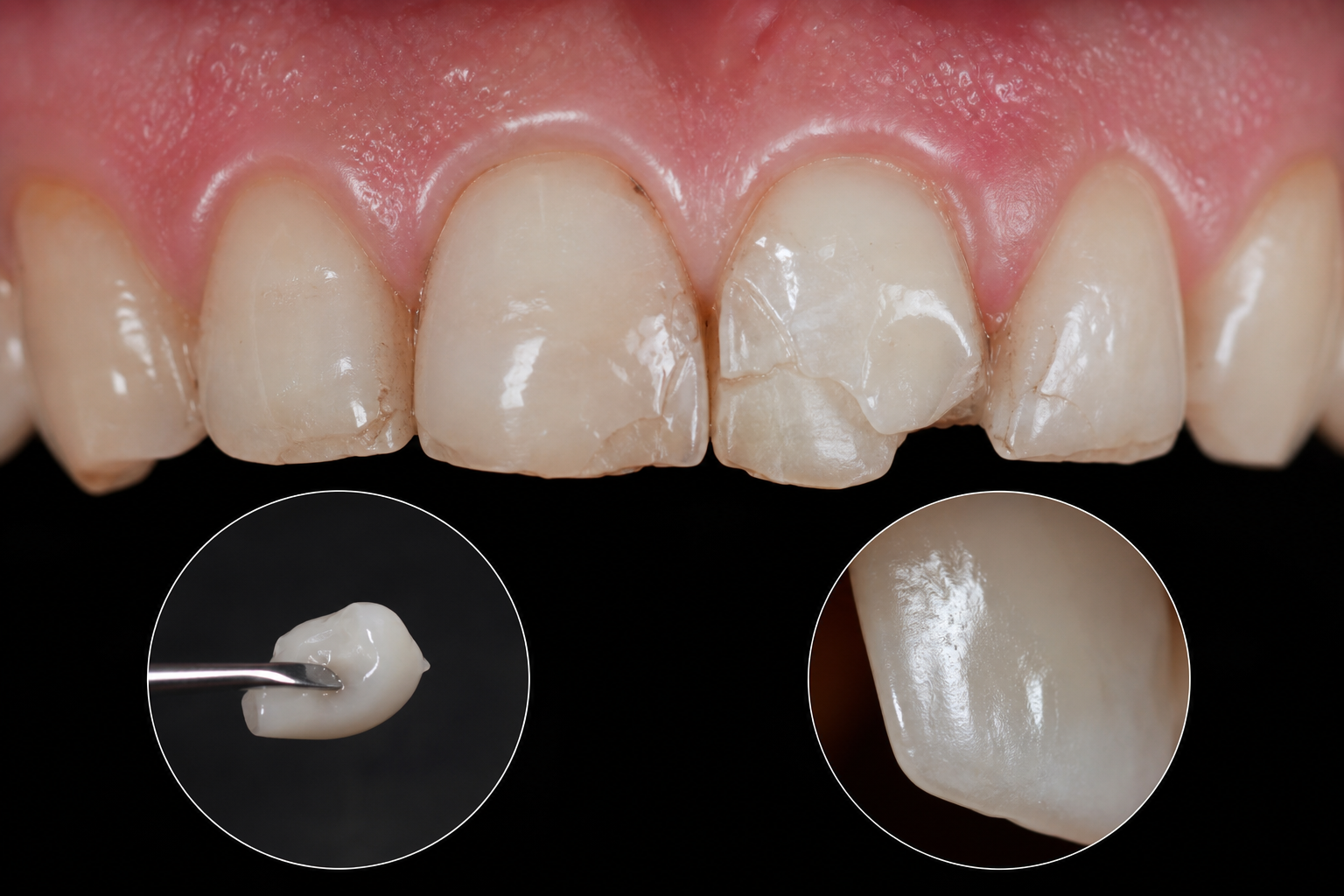
If you feel that composite bonding has ruined your teeth, I would first separate a disappointing cosmetic result from a problem affecting the tooth, gums or bite. Composite bonding should not normally damage healthy teeth when it is carefully planned and carried out conservatively, but genuine problems can arise if it is over-contoured, poorly finished, placed without addressing the bite, or involves unwanted tooth reduction.
Not every rough edge, stain or unfamiliar feeling means your natural teeth are permanently damaged. Many concerns can be improved with polishing, reshaping, repair or selective replacement. However, persistent pain, difficulty biting, bleeding gums, a bad taste, loose composite or concern that enamel has been removed all deserve a proper examination before anyone adds more material.
What people usually mean by “composite bonding ruined my teeth”
When I assess someone who is unhappy after bonding, the problem usually falls into one or more of four areas: appearance, comfort, function or the health of the underlying tooth. These need different solutions, which is why I would not assume that complete removal or a set of veneers is automatically the answer.
Appearance concerns
The bonding may look too white, opaque, grey, bulky, long or artificial compared with the surrounding teeth. It may also be asymmetrical, have visible joins, pick up stain at the edges, or close spaces in a way that makes the teeth look too wide.
A result can be clinically intact but still feel wrong for your face, smile or expectations. That does not mean the tooth is ruined, but it does mean any redo treatment needs more careful planning than simply covering the existing composite.
Comfort and function concerns
Composite bonding can feel unfamiliar initially, especially where the shape or length of front teeth has changed. Mild awareness that is improving over the first few days may settle, but persistent roughness, a sharp edge, a tooth that hits first, difficulty speaking clearly, food catching, or trouble passing floss between teeth should be checked rather than accepted as something you must live with.
Natural-tooth concerns
The more important question is whether the tooth underneath remains healthy. I would look for signs of previous enamel reduction, a defective edge where plaque can collect, decay, cracks, sensitivity, gum inflammation or a bite that is putting excessive force through the restoration.
What does bad composite bonding actually look like?
Bad composite bonding is not defined only by whether it looks natural in a photograph. I look at the shape, surface, edges, gum response, contact points between teeth and how the teeth meet when you bite. A restoration may be attractive at first glance but still be difficult to clean or uncomfortable in function.
- Too white, flat or opaque: composite can look chalky or block-like if its shade, translucency or surface finish does not blend with adjacent teeth.
- Bulky or over-long teeth: excessive material can make teeth appear thick, alter lip support or affect speech and chewing.
- Uneven shape or asymmetry: small differences may be intentional, but obvious inconsistencies in length, width or edge position can make a smile look unbalanced.
- Rough, sharp or dull surfaces: composite should be carefully finished and polished. Roughness can feel unpleasant, attract stain and make plaque removal harder.
- Visible margins and staining: a dark or stained line at the edge may be a surface issue, wear or a failing seal. It does not prove decay, but it merits assessment.
- Spaces closed too tightly: bonding between teeth should still allow cleaning. If floss shreds, will not pass through, or becomes trapped, the contact area needs reviewing.
- Material sitting into the gum area: poorly shaped edges can irritate the gum and make it harder to keep the area clean.
One thing I usually explain is that a slightly imperfect surface can often be refined conservatively. The aim is to preserve sound composite and natural tooth where possible, rather than assume every concern needs a full replacement.
Which symptoms should be checked promptly?
Mild, improving awareness can occur briefly after dental treatment, particularly if a tooth has been adjusted or the bite has changed. Persistent, worsening or spontaneous pain should not be attributed to normal adjustment without checking the tooth, restoration and bite.
| What you notice | Why I would check it |
|---|---|
| Pain when biting or one tooth hitting first | The bite may need adjustment, although the tooth itself, jaw muscles or a crack can also be involved. |
| Persistent or worsening sensitivity | This may relate to the tooth, exposed dentine, a restoration edge or another underlying issue that needs diagnosis. |
| Bleeding, swollen or sore gums | Gum inflammation can be linked to plaque retention, over-contouring or an edge that is difficult to clean. |
| Bad taste, recurrent food trapping or a visible gap at the edge | I would assess the restoration margin and check for a compromised seal or decay risk. |
| Loose, cracked or repeatedly chipped bonding | The material may need repair, but the cause could be bite forces, grinding, trauma or the original design. |
| Difficulty flossing, chewing or speaking | The contour, contact points and bite should be assessed rather than repeatedly adjusted without a plan. |
Swelling, severe pain, trauma, a loose restoration or rapidly worsening symptoms need prompt dental assessment. If you have spreading facial swelling, difficulty breathing or swallowing, uncontrolled bleeding, serious facial trauma, or severe pain that is rapidly getting worse, seek urgent dental or emergency medical advice rather than waiting for a routine cosmetic review.
If the concern is mainly cosmetic but is causing distress, I would still advise a measured review before attempting removal or replacement.
Can composite bonding damage your natural teeth?
Composite bonding is often an additive treatment, meaning material is attached to the front, edge or side of a tooth rather than large amounts of tooth being removed. That is one reason it can be a conservative option. However, I would not describe it as completely non-invasive, risk-free or automatically reversible.
In some cases, the tooth surface may have been roughened, adjusted or reduced before bonding. This can be appropriate in a carefully planned case, but the amount of existing enamel matters greatly when considering removal or replacement. Composite and enamel can be difficult to distinguish precisely, so taking all composite away without affecting the tooth is not always possible.
Decay can also develop at or beneath a defective restoration if the edge is leaking, plaque is difficult to remove or gum health is poor. A dark margin, sensitivity or bleeding does not diagnose decay on its own. I would examine the teeth and may use radiographs where indicated to understand what is happening beneath or between them.
Repeated failure can become more destructive if each repair removes a little more material without solving the reason it failed. Adding more composite can also potentially make a tooth thicker, reduce cleaning space or make later correction more complex. This is why I would focus on the condition of the underlying teeth, not just on making the visible composite look better.
What I would assess before recommending a fix
Before I recommend polishing, repair, removal or new composite bonding, I would establish why the existing work feels wrong or is failing. A quick cosmetic opinion is not enough if there is pain, gum inflammation, tooth wear or concern about enamel preparation.
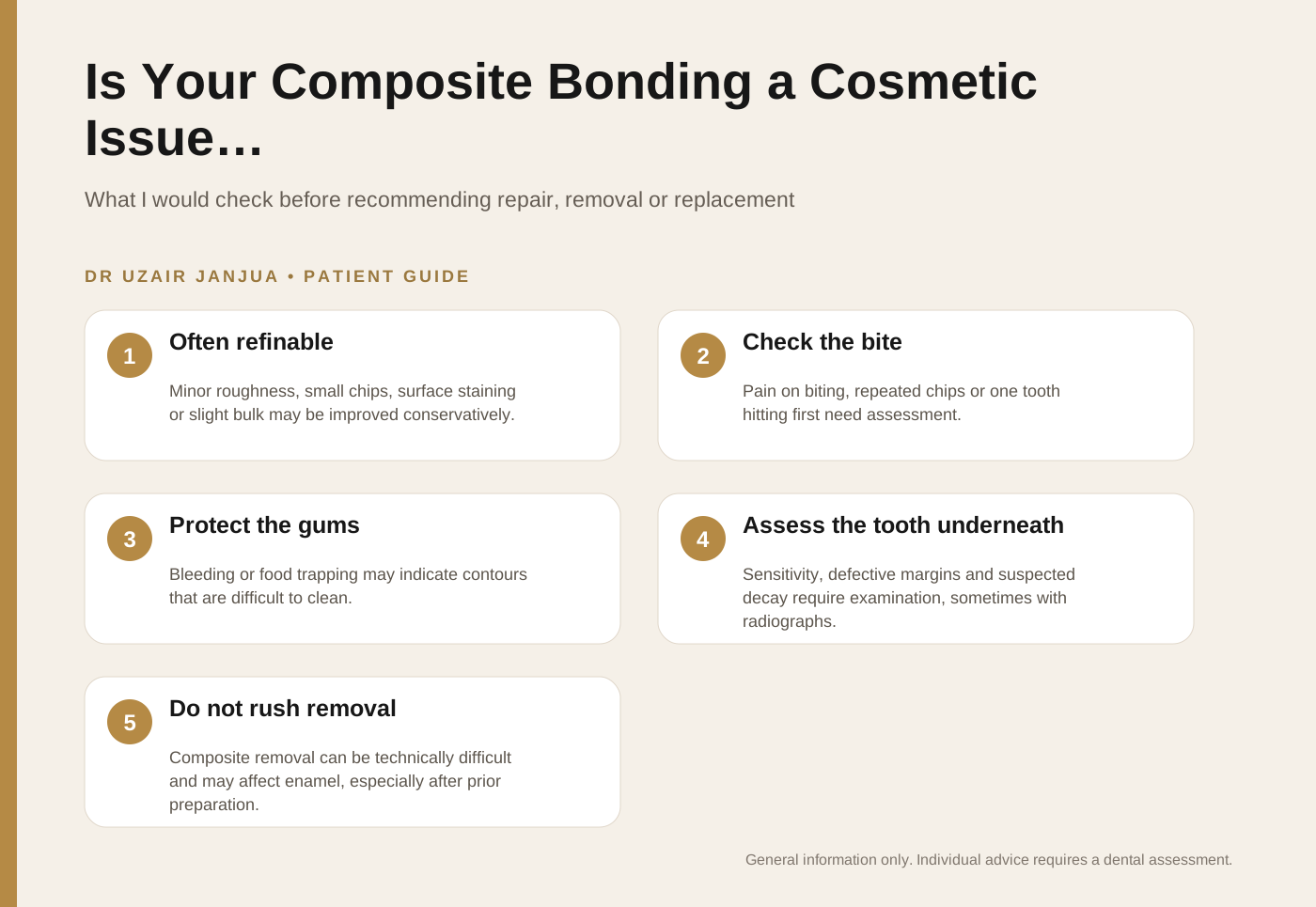
- The condition of the enamel and dentine, including any signs of previous preparation or exposed tooth tissue.
- The edges of the composite, its polish, thickness, colour, contact points and whether it can be cleaned properly.
- The gums and plaque levels around the treated teeth.
- Your bite in normal closure and during chewing movements.
- Signs of clenching, grinding, tooth wear, cracking, nail biting or other forces that can chip composite.
- Whether there is sensitivity, decay risk, a damaged tooth nerve or another reason for pain.
- The shape and position of the natural teeth, including whether crowding or spacing has been disguised rather than addressed.
- Clinical photographs, where helpful, to document the current condition and compare changes over time.
- Vitality testing or radiographs where the symptoms and examination indicate they are needed.
- Photographs, previous records and the original treatment plan where these are available.
If you are seeking a second opinion for composite bonding in Birmingham or the West Midlands, I would encourage you to request copies of your pre-treatment photographs, written plan, consent information and any records of which teeth were treated. Keep dated photographs and written correspondence as well, particularly if the appearance, comfort or function has changed over time.
An independent opinion can be especially useful if extensive removal, veneers or crowns have been proposed without a clear explanation of the condition of your natural teeth, the amount of composite present and why the original result has failed. For anyone unsure whether repair or replacement is appropriate, a consultation should begin with diagnosis rather than an immediate promise to make the teeth whiter, longer or straighter.
Can bad composite bonding be repaired or removed?
Bad composite bonding can often be improved, but the least invasive option is usually preferable when it is safe and likely to meet your aims. What I recommend depends on the amount of sound material present, the condition of the tooth underneath, the bite and whether the concern is localised or affects several teeth.
Polishing or reshaping
If the issue is minor roughness, a sharp edge, surface stain, slight bulk or a small bite discrepancy, careful finishing and polishing may be enough. I would be cautious about repeated adjustment, because excessive contouring can weaken the restoration or remove useful material.
Conservative repair
A chip, small gap, localised stain or limited edge defect can sometimes be repaired without removing all of the original bonding. This may preserve more tooth tissue and reduce the amount of treatment, provided the underlying design and bite are otherwise sound.
Selective removal or full replacement
If the composite is poorly designed, extensively stained, repeatedly failing, badly matched in colour, associated with a defective margin or concealing a tooth problem, replacement may be more sensible. Removal needs care, especially where there may have been prior enamel reduction. I would explain what can realistically be preserved before starting.
For a clearer explanation of how thoughtful planning affects shape, proportion and maintenance, you can read about composite bonding in Birmingham. A good result should be judged not only on the day it is fitted, but also on whether it is comfortable, cleanable and manageable over time.
Why adding more bonding can make the problem worse
When someone dislikes their bonding, it can be tempting to add more material to hide the original result. I would pause before doing that. More composite may make teeth thicker, close cleaning spaces further, affect the bite and make future correction more complicated.
Repeated chipping is a good example. Adding material again may solve the visible chip temporarily, but it may fail again if the tooth is hitting too heavily, you are grinding at night, the teeth are worn, or the shape is extending into an area that cannot tolerate the force.
Similarly, attempting to make crowded teeth look straight with increasingly wide bonding may create an unnatural shape. In these cases, tooth alignment may be the real issue. Clear aligners can sometimes move teeth into a more favourable position before minimal finishing work, reducing the need for bulky composite. This is not necessary for everyone, but it is worth considering before committing to repeated restorative changes.
When composite bonding may not be the best next step
I would not recommend new bonding immediately if active decay, gum disease, poor plaque control, unstable tooth wear, significant grinding or an unresolved bite problem is present. These do not always rule out future cosmetic treatment, but they change the order in which treatment should happen.
If colour is the main issue and the teeth and gums are suitable, professional whitening may be considered before replacing composite. Existing composite does not whiten in the same way as natural tooth, so timing and shade planning matter.
Where crowding, rotations or gaps are driving the appearance, alignment may be more conservative than building outward with composite. Where a tooth is already structurally compromised, it may need a more protective restorative plan rather than another cosmetic repair.
Porcelain veneers can offer different surface and colour properties in selected cases, but they are not a universal rescue treatment. They commonly involve more irreversible tooth preparation than composite, so I would discuss the trade-offs carefully. My comparison of composite bonding and veneers for natural teeth explains why moving to veneers should be a considered clinical decision, not a reaction to one disappointing result.
What should a Birmingham consultation clarify?
If you are travelling from elsewhere in Birmingham, Coventry, Solihull, Wolverhampton, Dudley, Walsall or another part of the West Midlands, continuity of care is worth considering. Refinement, bite review, removal and staged replacement may take more than one visit, particularly where several teeth are involved.
I would want you to leave a consultation understanding the likely cause of the problem, whether your natural teeth appear healthy, what can be improved conservatively and what limitations remain. Useful questions include:
- Is this mainly a polish, shape, bite or gum-health issue, or is there concern about the tooth underneath?
- Can the composite be repaired rather than completely removed?
- Was tooth tissue likely to have been reduced, and what does that mean for replacement options?
- Do I need photographs, radiographs, hygiene treatment, vitality testing or bite assessment before cosmetic work?
- Could grinding, tooth wear or alignment be causing the repeated problem?
- If veneers or crowns have been suggested, what evidence shows that they are necessary rather than a conservative repair?
- How many review appointments might be needed, and who will manage aftercare if I travelled for the original treatment?
The next sensible step is an examination before further cosmetic work. If your composite bonding feels bulky, painful, difficult to clean or repeatedly fails, I can assess the teeth, gums and bite and discuss whether conservative adjustment, repair, replacement or a different approach is most appropriate.
Composite bonding does not automatically mean your teeth are ruined. The important point is not to let a genuine concern be covered over with more material. I would first identify what has changed, protect as much healthy tooth structure as possible and make a plan that is realistic for your smile and long-term maintenance.