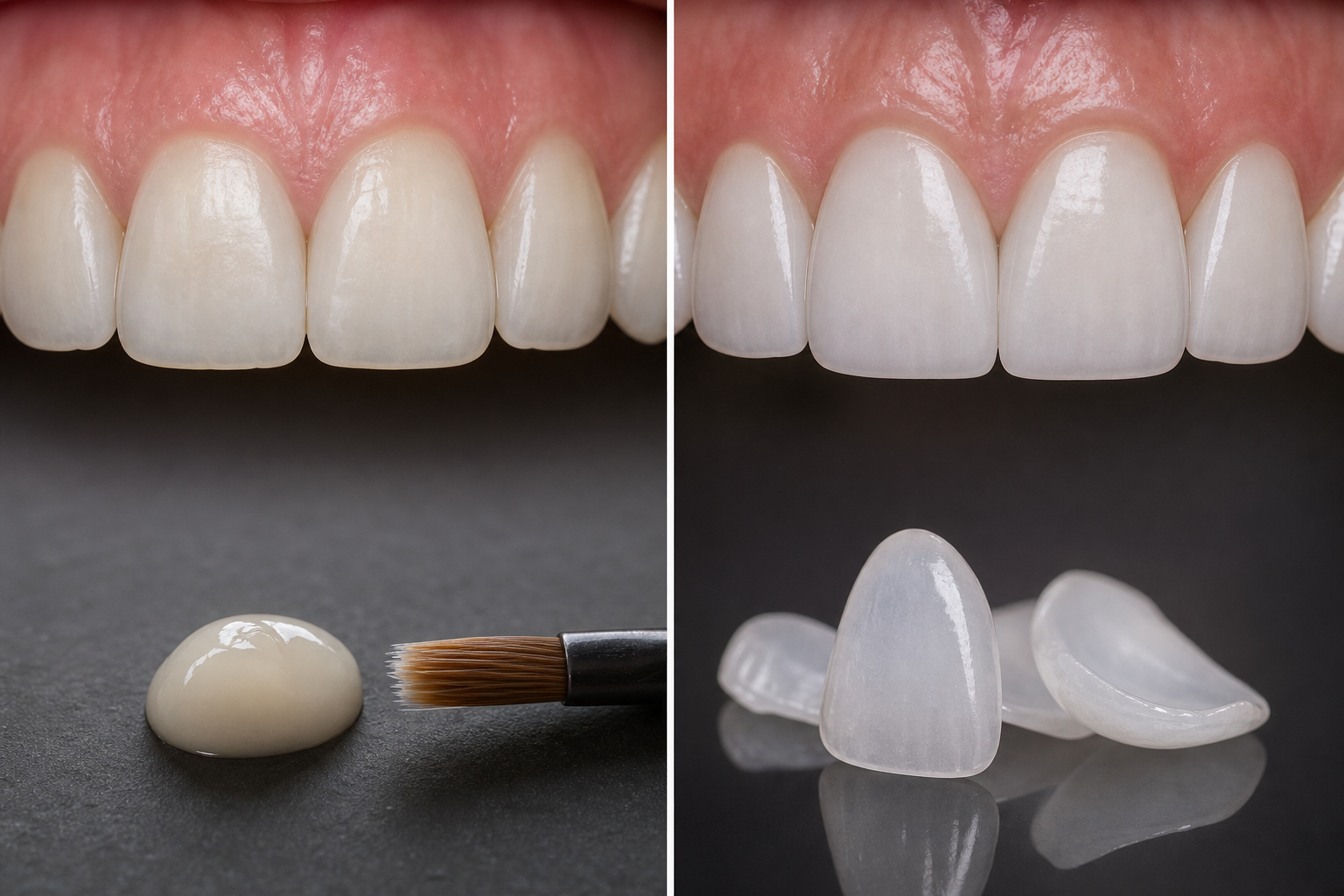
If protecting healthy tooth structure is your priority, I would usually start by considering composite bonding. Composite is added to the tooth and often needs little or no enamel removal, whereas porcelain veneers commonly need some preparation to create room for the ceramic. That does not make veneers harmful or unsuitable, but it does mean they are usually a bigger long-term commitment.
For composite bonding vs veneers, the right answer depends on how much you want to change, the position of your teeth, your bite, existing fillings, tooth colour and the health of your gums. My aim is to recommend the least invasive option that can still give a natural-looking, cleanable and functional result.
Is composite bonding or veneers kinder to natural teeth?
Composite bonding is generally kinder to natural teeth because I can often add tooth-coloured resin directly onto sound enamel with minimal adjustment. Bonding is usually most predictable where there is healthy enamel available, although suitability still depends on the individual tooth, bite and planned shape.
Porcelain veneers are thin ceramic coverings bonded to the front of teeth, and they usually require some enamel preparation so that the final teeth do not look too thick or protrude too far forward. One thing I usually explain to patients is that the biological question is not simply whether bonding is good and veneers are bad. It is how much healthy tooth tissue needs to be changed to achieve the result you want, and whether that result will work with your gums and bite.
A small chip, slight unevenness or narrow gap may be managed very conservatively with composite. Trying to use bonding to hide markedly rotated teeth, heavy discolouration or a large change in tooth length can sometimes make the teeth look bulky or place too much pressure on the material. In those situations, veneers, orthodontics or a staged approach may be more predictable.
What I would assess before recommending either treatment
I would not recommend cosmetic bonding or veneers from photographs alone. Before deciding which approach is kinder to your teeth, I need to assess the teeth, gums and bite in person.
- Available enamel: I look at how much healthy enamel is present, as this is often the most favourable surface for predictable bonding.
- Tooth position: A prominent, rotated or crowded tooth may need alignment first, rather than being made wider with restorative material.
- Your bite: I check how the front teeth meet and move against one another. This matters particularly where there is edge wear, clenching or grinding.
- Gum health and hygiene: Gum inflammation, plaque build-up or active decay should be stabilised before elective cosmetic work.
- Existing restorations: Old fillings, cracks and heavily restored teeth can alter what is sensible and predictable.
- Colour and your actual goal: I clarify whether you want whiter teeth, straighter-looking teeth, repaired edges, closed gaps or a more balanced smile. Different goals need different solutions.
If you are considering composite bonding or veneers in Birmingham or the wider West Midlands, a proper consultation should include this conversation before any teeth are altered. It is also the right time to discuss whether a preview, mock-up or planning stage would be useful for the amount of change proposed.
A mock-up can be a useful planning aid because it helps us discuss proposed shape and proportions before treatment. It is not a guarantee of the exact final appearance, bite or future maintenance needs, which can only be assessed properly as treatment is planned and completed.
Composite bonding versus porcelain veneers at a glance
I find that a direct comparison helps people move beyond the simple idea that one option is always better. Both can be appropriate, but they involve different compromises.
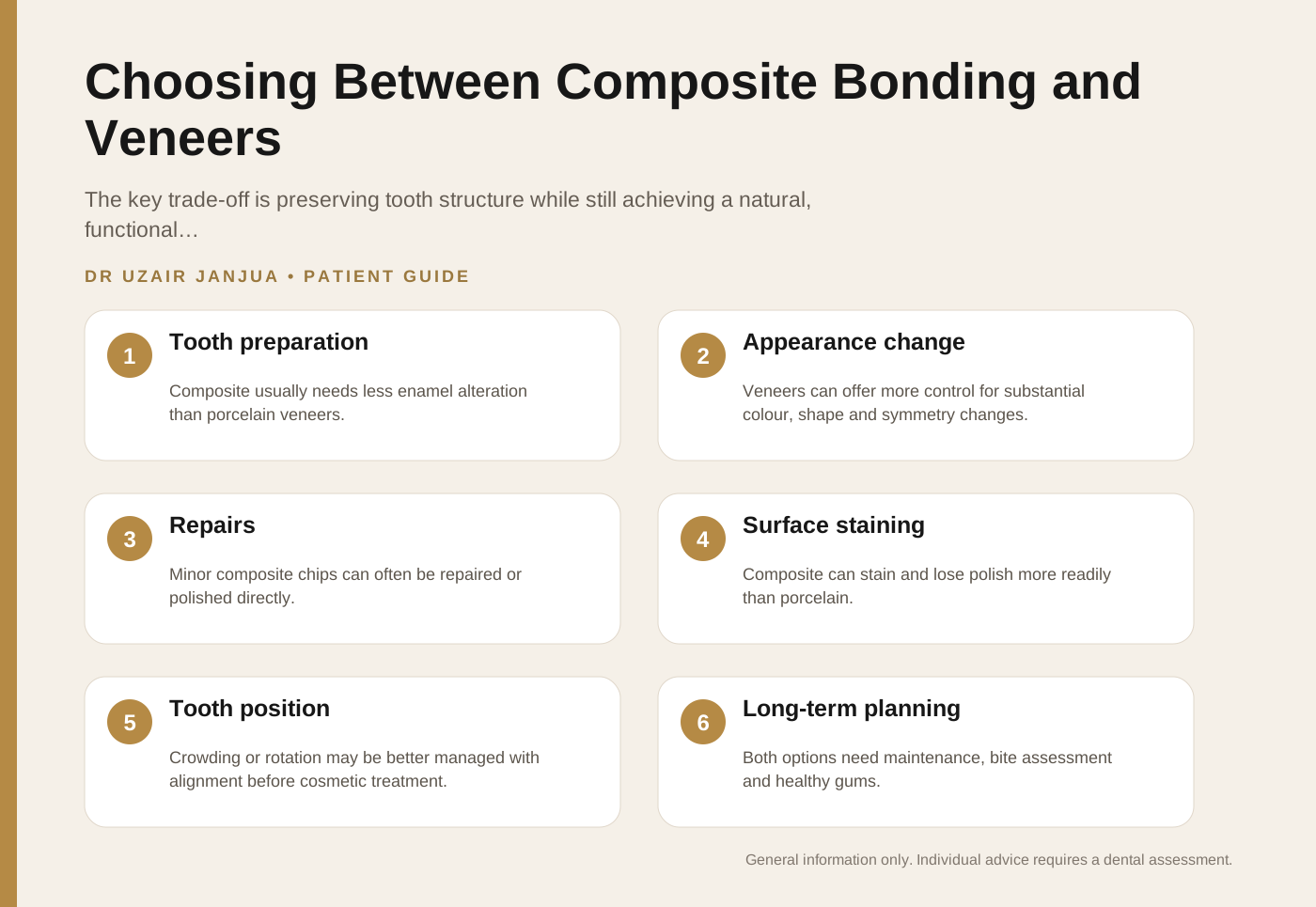
| Question | Composite bonding | Porcelain veneers |
|---|---|---|
| How is it placed? | Resin is sculpted directly onto the tooth. | A ceramic veneer is made to fit the prepared tooth surface. |
| Enamel removal | Often little or none, although small adjustments may sometimes be needed. | Usually some preparation is needed, depending on tooth position and the planned result. |
| Can it be changed later? | Often easier to polish, reshape, add to or repair, although removal still needs care to protect the tooth surface. | Usually a long-term restorative commitment once meaningful tooth preparation has been carried out. |
| Staining and surface finish | Can stain, lose shine or become rougher over time. | Generally more resistant to surface staining and may retain its finish well with appropriate care. |
| Minor damage | Small chips can often be repaired directly. | A chip or fracture may require more extensive repair or a replacement veneer. |
| Best suited to | Subtle reshaping, small chips, limited gaps and localised improvements. | More substantial, coordinated changes in shape, colour and symmetry. |
| Long-term care | May need polishing, repair or replacement over time. | Still needs review and may eventually need replacement or another restorative solution. |
Why composite bonding is often the more conservative starting point
When I assess someone with healthy teeth who wants a modest cosmetic improvement, composite is often my first consideration. It can be an effective way to restore a chipped edge, soften an uneven shape, close a small space or improve symmetry without covering the entire tooth in every case.
The main advantage is that it usually preserves more natural tooth tissue. Composite is also relatively adaptable. If a small area chips, loses polish or needs refinement, I can often repair or adjust it without replacing the whole restoration.
That does not mean composite bonding is completely reversible or maintenance-free. Removing composite cleanly can be difficult when it is closely integrated with enamel, and some cases need minor tooth adjustment for shape or bite. It can also stain, wear or chip, particularly where someone grinds their teeth, bites hard objects or has a front bite that places heavy forces on the edges.
For a closer look at where this approach can be useful, you can read about composite bonding in Birmingham. The important point is that a conservative treatment still needs careful design. Adding too much material is not kind to teeth or gums if it creates an over-contoured result that is difficult to clean.
When porcelain veneers may make more sense
I may discuss porcelain veneers when composite is unlikely to deliver the desired result in a natural and maintainable way. Veneers can provide more control over colour, shape, surface texture and symmetry, particularly when several visible teeth need coordinated changes.
For example, a more substantial colour change, significant differences in tooth shape, older discoloured restorations or multiple worn front teeth may be difficult to manage with composite alone. Porcelain is generally more resistant to staining than composite and can provide a stable, polished surface.
However, I would always explain the commitment clearly. Once meaningful enamel has been prepared for a veneer, the tooth is usually committed to long-term restorative maintenance and may need a replacement veneer or another restoration later. Porcelain can chip, fracture or debond, and the underlying tooth still needs to remain healthy.
Veneers are not automatically the better choice simply because they can create a more comprehensive change. I would only recommend them where the benefit justifies the preparation required and where the planned contours, bite and gum health support a predictable outcome. You can also explore how I approach porcelain veneers in Birmingham before deciding whether that level of treatment fits your goals.
Are no-prep veneers really safer?
No-prep veneers are not automatically safer. In carefully selected cases, very thin veneers may be placed with minimal or no tooth preparation. But if there is not enough space for the ceramic, simply adding material can make teeth look bulky, push the contour towards the gums or affect how the teeth meet.
What I would look at first is whether the existing teeth sit slightly behind the ideal final position, whether there is room to add material without overbuilding the tooth, and whether the gumline will remain easy to clean. Teeth that already project forwards, or are significantly rotated, may not be suitable for a no-prep approach.
The phrase can sound reassuring, but it should not replace proper planning. Sometimes a small amount of carefully planned enamel preparation produces a more natural, cleaner and better-functioning result than an overly thick no-prep veneer.
Which option lasts longer and needs less maintenance?
Porcelain generally has better resistance to staining and surface wear than composite, so it may retain its colour and polish for longer in suitable circumstances. Composite is more likely to need polishing, repair or refinement because it can become rougher, pick up surface staining or chip at the edges.
That said, I would not give a fixed lifespan without examining you. Longevity depends on the design, the tooth being treated, the quality of the bond, oral hygiene, diet, habits, bite forces and whether you clench or grind your teeth. Neither option is permanent or indestructible.
Composite has a useful advantage if minor damage occurs because it can often be repaired locally. A porcelain veneer may need to be remade if it fractures or the appearance is compromised. For people who grind their teeth, I would assess the cause and severity before recommending either option, and I may advise a protective night guard where appropriate.
Whitening is also worth planning in advance. Whitening changes natural tooth colour but does not change the shade of existing composite or porcelain. If your main concern is the overall colour of healthy teeth, I would normally discuss whitening before selecting the final shade for bonding or veneers.
When neither bonding nor veneers is the best first treatment
Sometimes the kindest answer is to avoid covering or adding to teeth until the underlying issue has been addressed. If tooth position is the main concern, moving the teeth can be more conservative than disguising crowding or rotation with wider bonding or prepared veneers.
For spacing, crowding, rotations or bite-related unevenness, I may suggest exploring clear aligner treatment first. Alignment can reduce the amount of restorative work needed afterwards, and some people only need whitening or small edge refinements once their teeth are in a better position.
Other sensible starting points can include professional whitening for general discolouration, replacing a failing old filling, improving gum health, managing tooth wear or treating grinding. In some cases, no treatment is the right choice if the concern is small and the tooth is healthy.
If a tooth has substantial structural loss, a crack or a large existing restoration, a veneer may not provide the right level of support. I would discuss the restorative options that protect function as well as appearance rather than treating every tooth as a cosmetic veneer case.
What changes the final cost of bonding or veneers?
The initial fee matters, but I encourage patients to compare complete treatment plans rather than a headline price per tooth. Composite may cost less initially in some cases, while veneers often involve laboratory work and additional planning. Neither option is automatically the lower-cost choice over the long term.
Advertised per-tooth figures may not include the examination, photographs, planning, mock-up, laboratory work, whitening, hygiene treatment, orthodontics, review appointments, repairs or a protective night guard where one is advised. I would want you to understand what is and is not included before comparing one plan with another.
Factors I would discuss include the number of teeth involved, the complexity of the shape and bite, whether photographs or a mock-up are needed, and whether whitening, hygiene treatment, replacement fillings or orthodontics should happen first. With veneers, the ceramic material, laboratory work and design complexity affect the plan. With composite, the time needed for layering, shaping, polishing and bite adjustment matters.
Future maintenance should also be part of the decision. Ask about polishing, repairs, replacement and review appointments. If you are travelling to Birmingham from Coventry, Solihull, Wolverhampton, Sutton Coldfield, Dudley, Walsall or elsewhere in the West Midlands, it is sensible to ask how many visits are expected and how follow-up care would be arranged.
Questions I suggest asking before you decide
A good cosmetic consultation should make the long-term implications clear, not just show an attractive end result. I would encourage you to ask direct questions and make sure the answers feel specific to your mouth.
- How much, if any, healthy enamel would need to be removed from each tooth?
- Could whitening, alignment or a smaller local repair achieve my goal more conservatively?
- Can I see a mock-up or planned shape before committing, where appropriate?
- How will my bite be checked when I speak, chew and move my jaw?
- What happens if the bonding chips, stains or loses polish?
- If a veneer fails later, what are the likely repair or replacement options?
- How will my gums, existing fillings and any grinding habits affect the plan?
The most appropriate choice is usually the least invasive option that can realistically achieve a healthy, balanced and maintainable result. If you are deciding between composite bonding and veneers in Birmingham or the West Midlands, I can assess the condition of your teeth, gums and bite and talk you through the options without assuming that one treatment suits everyone.
If you would like an individual recommendation, arrange a consultation so I can assess how much change is genuinely needed and whether bonding, veneers, alignment, whitening or a combination approach makes the most sense for your natural teeth.