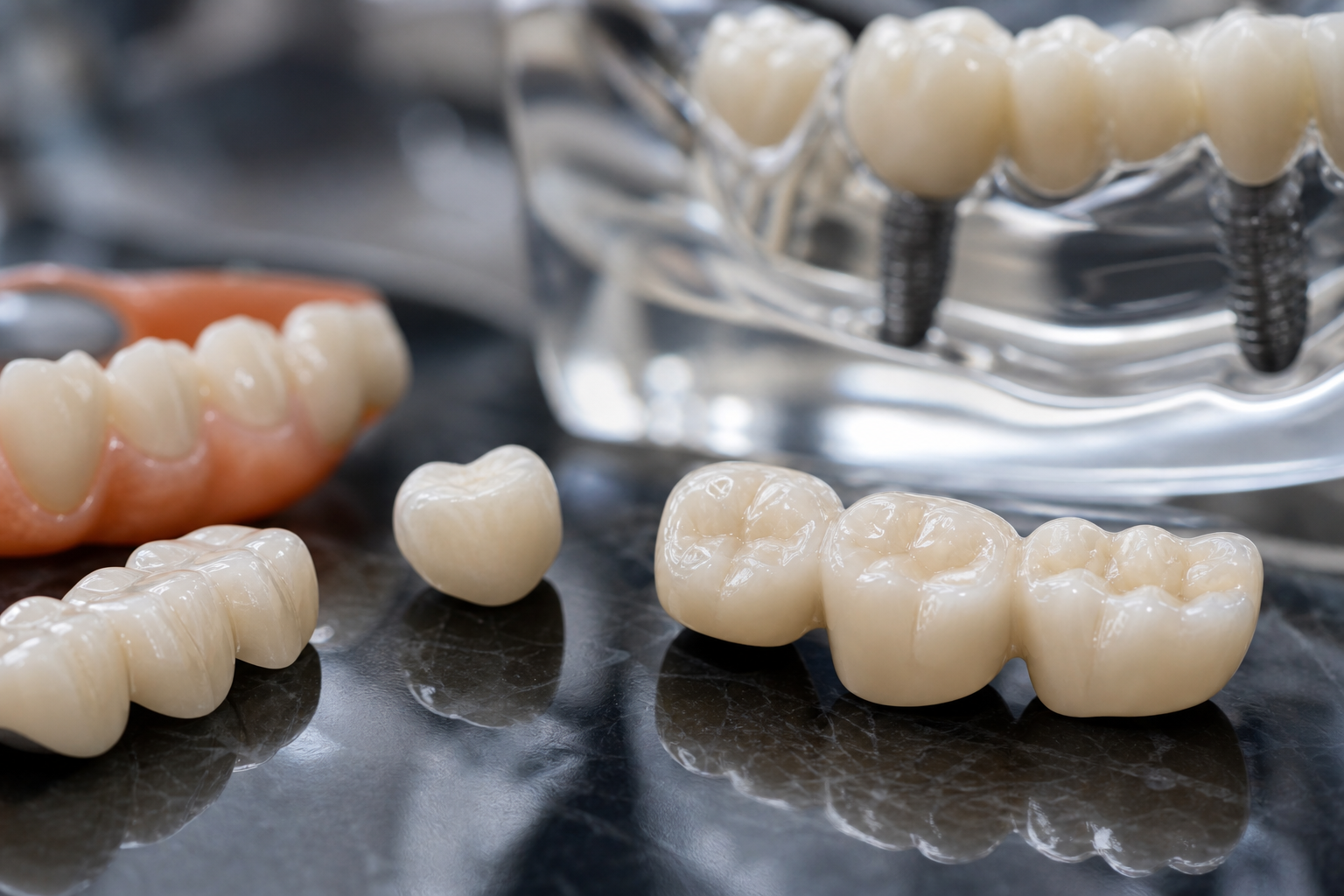
The main alternatives to dental implants are conventional bridges, resin-bonded bridges, partial or complete dentures, orthodontic space closure and, in some situations, leaving the space under review. I would not choose between these options simply because one is labelled an ‘implant alternative’. I would look at the missing tooth position, your remaining teeth, gums, bite, health, priorities and the practical commitment involved.
An implant can be an excellent way to replace a missing tooth, but it is not automatically the best answer for every mouth. I may recommend something else where surgery is not right for you, where a bridge would make sensible use of existing crowned or heavily filled teeth, where several gaps make a denture more practical, or where your mouth needs stabilising before any definitive treatment.
The best option is usually the one that restores appearance and function without creating a bigger long-term problem for the teeth, gums and bite that remain.
What are the alternatives to dental implants?
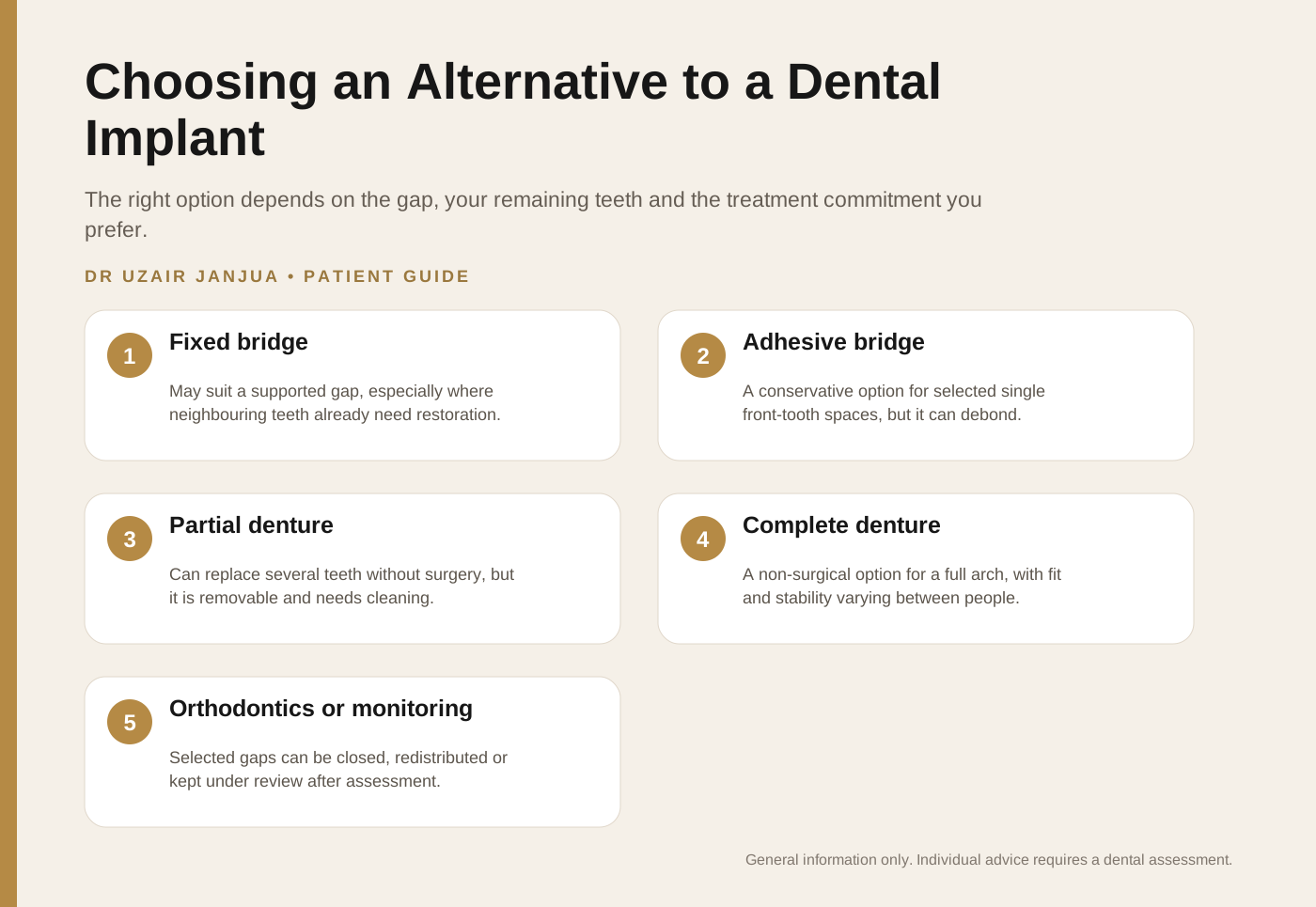
The most common non-surgical alternatives to dental implants are a tooth-supported bridge, an adhesive bridge and a removable denture. In selected cases, I may also consider orthodontic treatment to close or redistribute a space, or agree that a gap can be monitored rather than restored immediately. Each route has a different effect on neighbouring teeth, treatment time, cleaning and future maintenance.
| Option | May suit | Main trade-off |
|---|---|---|
| Conventional bridge | A fixed replacement where neighbouring teeth need crowns or have large restorations | Supporting teeth may need preparation |
| Resin-bonded bridge | A selected single front-tooth gap with suitable enamel and bite | The bridge can debond and is not suitable for every position |
| Partial denture | Several missing teeth, widely spaced gaps or a non-surgical route | It is removable and needs an adjustment period |
| Complete denture | All teeth missing in the upper or lower arch | Stability and chewing comfort vary between people |
| Orthodontic space management | Selected spacing and bite problems, often as part of a wider plan | It does not create a replacement tooth by itself |
| Leave the gap under review | A gap with little impact on appearance or chewing | Teeth may drift and future treatment can become harder |
If you are weighing up an implant, bridge or denture, you may find it helpful to compare the main missing-tooth replacement options before deciding what matters most to you.
When would I recommend something other than a dental implant?
When I assess someone for tooth replacement, I first establish whether an implant is clinically possible, but also whether it is genuinely the most sensible route. Being able to place an implant does not mean it is necessarily the right choice for your circumstances.
I may recommend an alternative if you would prefer to avoid surgery, if active gum disease, decay or infection needs treating first, or if healing could be affected by medical factors or smoking. Bone volume and quality matter too, although limited bone does not always rule implant treatment out. It may mean more planning, further procedures or a different treatment pathway is needed.
I also consider whether the teeth beside the gap are already heavily restored. If one or both already need crowns, a conventional bridge can sometimes be a logical way of restoring the area without adding implant surgery. Conversely, if those neighbouring teeth are healthy and untouched, I would be cautious about preparing them simply to support a bridge.
Time, budget and maintenance matter, but I would not advise choosing solely on the lowest starting fee. A bridge or denture can often be completed sooner than implant treatment because there is no period for an implant to integrate with bone. However, every option has future needs, such as repairs, rebonding, relines or replacement.
When does a conventional bridge make sense?
A conventional bridge is a fixed replacement tooth supported by one or more natural teeth beside the gap. I would consider it when those teeth are strong enough, suitably positioned and able to cope with the additional biting forces. It can be particularly reasonable when the supporting teeth already have large fillings, existing crowns or damage that means they would benefit from crowning anyway.
The important compromise is that a conventional bridge usually involves shaping the supporting teeth. This is a significant decision if those teeth are healthy. I would assess the length of the gap, the health of the roots and gums, your bite and whether there is enough support for a predictable design.
A bridge is fixed, so many people find it feels more tooth-like in daily use than a removable denture. It does, however, depend on the health of the supporting teeth for its long-term success. Cleaning beneath the replacement tooth is also part of ownership, not an optional extra.
A bridge is not always the quickest or easiest answer
This is where people sometimes get confused. A bridge may avoid implant surgery, but it still needs careful preparation, impressions or digital records, laboratory work, fitting and bite checks. If decay, gum problems or a difficult bite are present, these need attention before the final bridge is fitted.
Is a resin-bonded or Maryland bridge a good alternative?
A resin-bonded bridge, often called an adhesive or Maryland bridge, can be one of the most conservative alternatives to dental implants for a single missing front tooth. It usually has a thin wing bonded to the back of a neighbouring tooth, often requiring little or no drilling into that tooth. I would assess whether there is enough healthy enamel, sufficient space and a bite that will not overload the bridge.
This approach can be particularly useful where preserving healthy neighbouring teeth is a priority. It is not, however, a universal solution. Adhesive bridges can come loose, especially if the bite places heavy force on the wing, and they are less suitable for some back-tooth gaps or people who heavily load or grind their teeth.
I usually explain that a bridge coming loose is not necessarily a disaster, but it does mean you need access to a prompt review and possible rebonding. The design of the bridge, the tooth position, moisture control during fitting and your bite all affect suitability.
For a visible front-tooth gap, I would compare the appearance, tooth preservation, likely loading and long-term plan before recommending either an adhesive bridge or implant treatment. If you later decide to explore implant treatment, my guide to how dental implants are planned explains the broader pathway.
When would I recommend a partial denture?
A partial denture can replace one or several teeth without surgery. I would often discuss it where there are multiple gaps, where missing teeth are spread across the mouth, or where a fixed bridge is not suitable because there are not enough strong supporting teeth.
It is removable, which some people see as a disadvantage, but this can also make it practical. A denture can replace several teeth within one appliance and can be easier to modify than a fixed restoration if the mouth changes. An acrylic partial denture may be used as a transitional or more economical option, while a cobalt-chrome design may be considered where a thinner, more rigid framework is appropriate.
The fit and comfort depend on the design, the remaining teeth, gum support and the shape of the mouth. I would explain from the outset that there can be an adaptation period. Some dentures need adjustments after fitting, particularly if they rub, affect speech initially or need refinement to the bite.
Care matters. I would ask you to remove the denture for cleaning and to clean the supporting teeth and gums carefully. Dentures are normally removed overnight unless I have given you specific advice to do otherwise.
What if all the teeth in one arch are missing?
If all upper or lower teeth are missing, a complete denture is the principal non-implant option. I would assess the gum and bone shape, saliva flow, bite, facial support and the condition of the opposite arch before advising what is realistic. A well-made complete denture can restore appearance and provide useful function, but retention and chewing confidence vary considerably between individuals.
Over time, gums and the bone underneath a denture can change. This may mean a denture needs adjustment, a reline to improve its fit, repair or eventual replacement. Planning for this is more realistic than expecting one appliance to remain unchanged indefinitely.
An implant-retained denture may be relevant if the main difficulty is a loose lower denture, but it is not a non-implant alternative. It still involves implant placement, surgery, regular hygiene and replacement of components as they wear.
Can I leave a missing tooth gap or close it with orthodontics?
Sometimes I would advise that no immediate replacement is needed, particularly if the gap is not visible, does not affect chewing and the surrounding teeth are stable. That should be a considered and monitored choice rather than an assumption that a missing tooth has no consequences. Neighbouring teeth can drift into the space, and the tooth opposite the gap can move further out over time.
Orthodontic treatment can close a space or redistribute it in selected cases. This is more likely to be relevant where a tooth has been missing from development, where there is crowding or spacing elsewhere, or where the bite would benefit from wider correction. Orthodontics does not replace a tooth by itself, but it can sometimes remove the need for a replacement or create a better-sized space for one.
I would only recommend space closure after assessment of the whole bite, the final tooth arrangement and the long-term retention needed. This should involve assessment by an appropriately trained orthodontic clinician. Depending on the case, treatment may use clear aligners, fixed braces or another orthodontic approach, and it is not suitable for every missing-tooth gap.
How I compare alternatives to dental implants in a Birmingham consultation
What I would look at first is why the tooth was lost and whether the rest of the mouth is stable. A tooth lost through decay, gum disease, trauma or a failed root treatment can raise different planning questions. I would examine the remaining teeth, gums, bite, available space, bone levels visible on appropriate radiographs and the condition of any existing crowns, fillings or dentures.
I also need to understand what matters to you. Some people want a fixed tooth and do not want surgery. Others want the most conservative option for neighbouring teeth, even if that means accepting a removable denture or the possibility of a bridge needing rebonding. There is no right answer without that conversation.
- Whether the gap is at the front or back of the mouth.
- How many teeth are missing and whether the gaps are together or spread out.
- The health and strength of teeth beside the space.
- Your gum health, cleaning routine and ability to attend maintenance visits.
- Your bite, including signs of clenching or grinding.
- Medical history, smoking status and healing considerations.
- How quickly you need a temporary or definitive replacement.
- Whether preserving future implant options is important to you.
If you are travelling from Birmingham, Solihull, Sutton Coldfield, Wolverhampton, Coventry or elsewhere in the West Midlands, I would also encourage you to factor in review appointments. An adhesive bridge that loosens or a denture that rubs may need a timely adjustment, so aftercare access is part of choosing the right treatment.
If you are unsure whether a bridge, denture, adhesive bridge or implant is appropriate, an examination allows me to compare the realistic options using your actual teeth and bite rather than a generic online checklist.
Cost is more than the starting fee
I would always encourage you to compare the whole treatment pathway rather than only the initial quote. A less expensive option at the outset may still need repairs, relines, rebonding or replacement later. Equally, a more involved treatment is not automatically better value if it does not suit your needs or maintenance routine.
| What can affect the final cost? | Why it matters |
|---|---|
| Number and position of missing teeth | A single front tooth and several back-tooth gaps require very different designs. |
| Condition of neighbouring teeth | Fillings, crowns, cracks, root treatment or decay can alter the bridge plan. |
| Type of restoration | Adhesive bridges, conventional bridges, acrylic dentures and cobalt-chrome dentures have different laboratory and clinical stages. |
| Preparatory treatment | Gum treatment, fillings, extractions, infection control or bite stabilisation may be needed first. |
| Temporary replacement teeth | A temporary bridge or denture may be needed during healing or planning. |
| Maintenance over time | Denture relines, repairs, bridge rebonding and eventual replacement should be considered. |
| Appointments and travel | Records, fittings and adjustment visits are especially relevant if you travel for treatment. |
When comparing clinics in Birmingham or the wider West Midlands, I suggest asking what is included in the proposed plan. It is useful to know whether examinations, radiographs, temporary teeth, laboratory work, fitting visits and anticipated review appointments are included or charged separately.
Questions I would encourage you to ask before deciding
A good decision is easier when you understand the compromises. I would be happy to talk through these questions during a consultation:
- Will this option require preparation of healthy neighbouring teeth?
- What makes this restoration suitable for my bite and the position of my gap?
- What happens if an adhesive bridge comes loose or a denture becomes uncomfortable?
- How will I need to clean around or underneath the replacement tooth?
- How many fitting and review appointments should I expect?
- What repairs, relines or replacements may be needed in future?
- Would this choice make later implant treatment more difficult, easier or unchanged?
- Is a temporary replacement sensible while my mouth heals or I consider the longer-term plan?
Alternatives to dental implants are not second-best by default. A bridge, adhesive bridge, denture, orthodontic plan or monitored gap can be the right choice when it fits your mouth and priorities. I would recommend the option that deals with the missing tooth while protecting the health and future options of the rest of your mouth.
If you are comparing alternatives to dental implants in Birmingham or the West Midlands, I can examine the gap, assess the supporting teeth and explain which options are realistic for you. A consultation is the sensible next step if you want an individual recommendation based on your bite, gum health and longer-term plans.