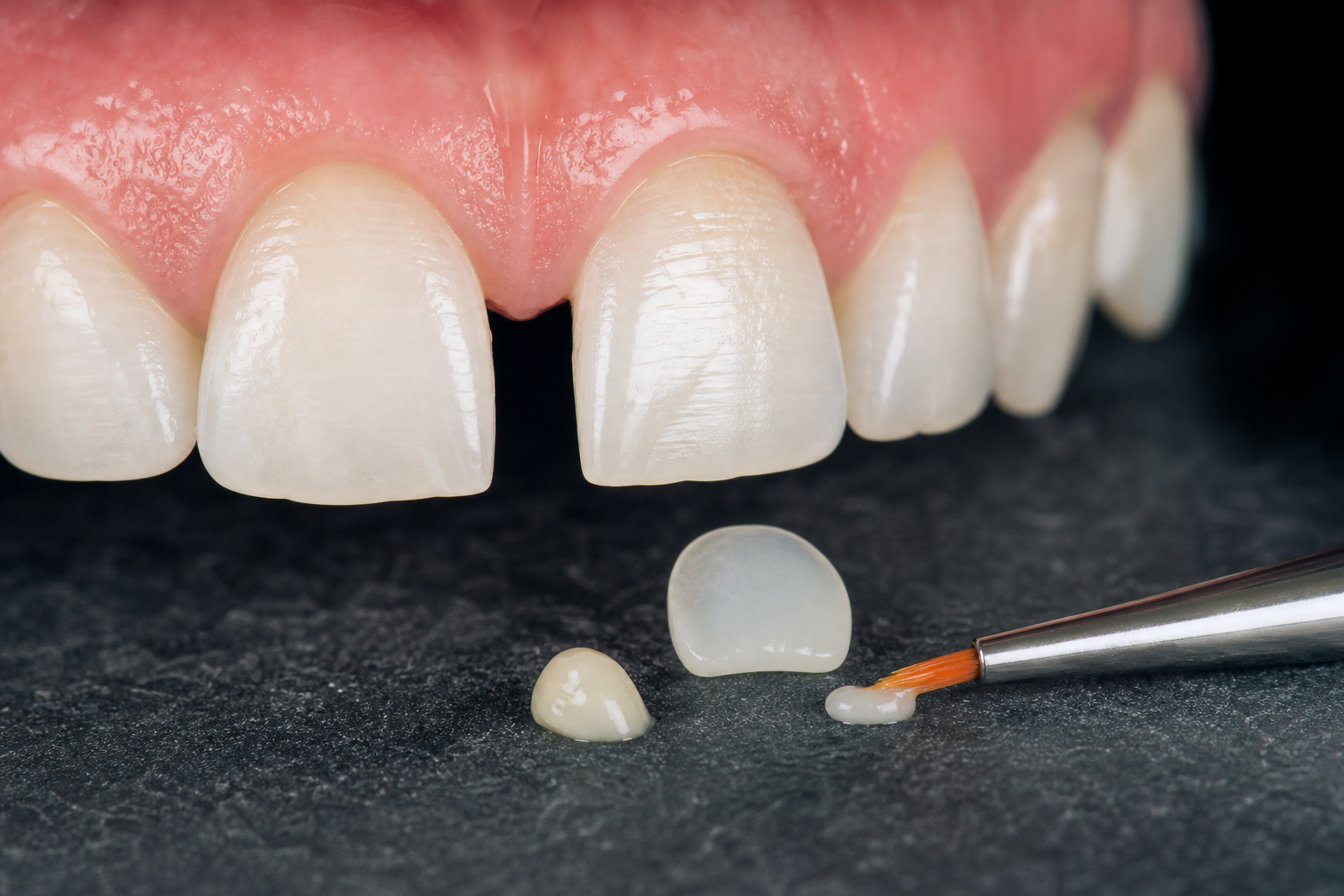
Yes, I can use composite bonding for gaps between teeth in selected cases, particularly small spaces between the front teeth. I add tooth-coloured resin to the sides of the teeth facing the gap, rather than physically moving the teeth together. There is no single maximum gap size that makes bonding automatically suitable or unsuitable. What I would assess first is whether the added width will still look natural, work comfortably with your bite and address the reason the gap exists.
A small gap can sometimes be closed very conservatively. A wider gap may still be possible, but it can make the front teeth appear too broad or create an unnatural shape near the gums. In those situations, clear aligners, braces or a combined approach may give a better long-term result.
Can composite bonding close a gap between front teeth?
Composite bonding can close a gap between front teeth by building resin onto the sides of the teeth facing the space. This is often a useful option where the teeth are healthy, the gums are stable and only a modest amount of shape needs to be added. It can be a conservative way to improve a gap without moving the teeth.
One thing I usually explain is that bonding changes the visible shape of the teeth. It does not move tooth roots, correct a rotation or change an underlying bite relationship. That distinction matters if the spacing is part of a wider alignment issue rather than an isolated cosmetic gap.
For some people, a central gap, often called a diastema, is a natural and healthy feature that needs no treatment at all. Closing it is a personal cosmetic choice, not an automatic dental need.
What size gap is usually suitable for composite bonding?
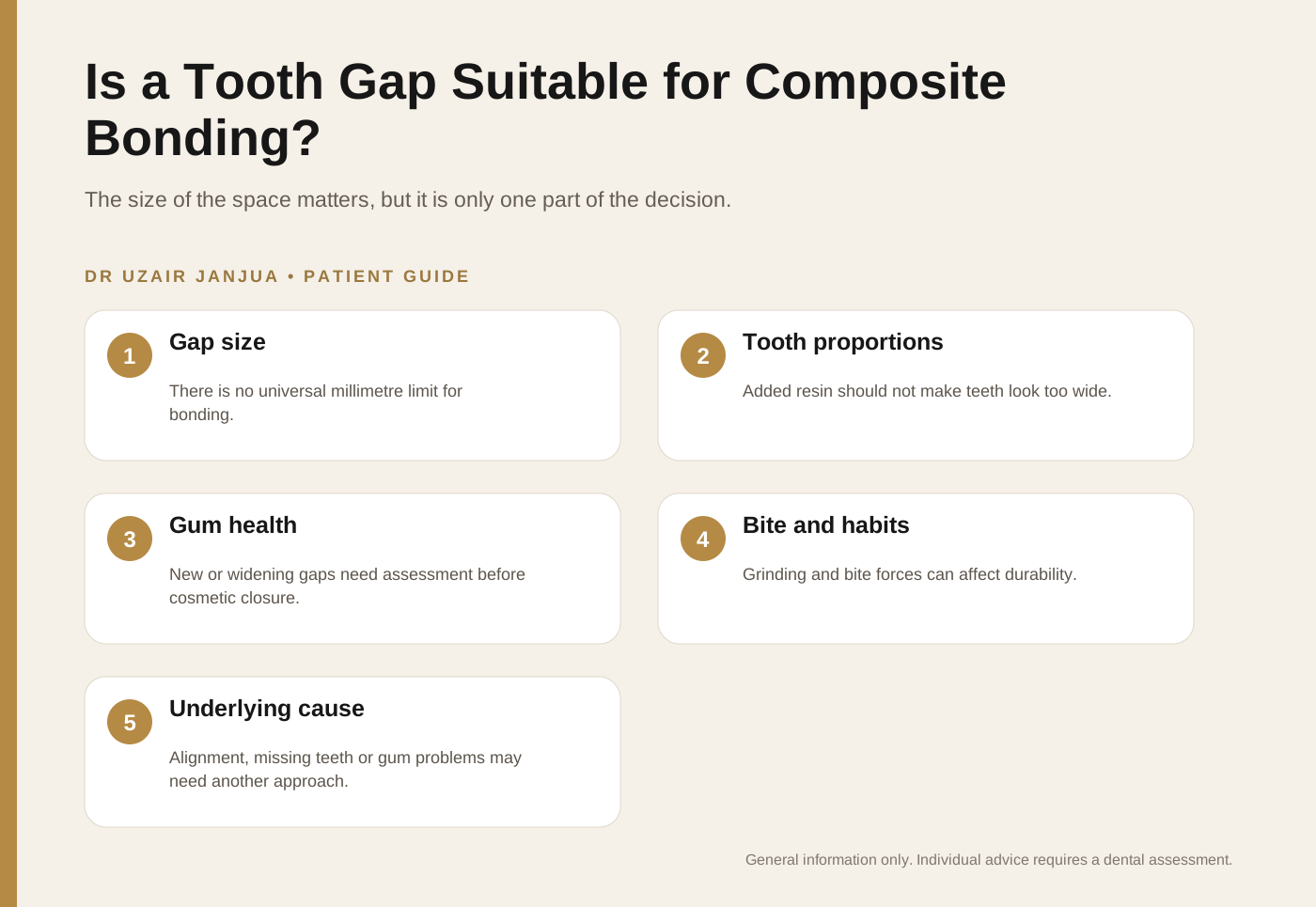
I would not use a fixed millimetre cut-off to decide whether composite bonding is right for a gap. A similarly sized gap in two people can need completely different treatment because the teeth, gum line, bite and facial proportions are different. Smaller, even spaces can sometimes be more straightforward to close, but tooth shape, contact position and gum contours remain just as important as the measurement.
| Type of space | What I would consider | Possible direction |
|---|---|---|
| Small, even gap | Healthy teeth and gums, good tooth proportions and sufficient room to add material without bulk. | Bonding may be a sensible option. |
| Moderate or uneven gap | Whether adding resin would make the teeth too wide, especially near the gum line. | Bonding, aligners or a combined plan may be considered. |
| Large or complex space | Tooth position, root position, missing teeth, gum shape and bite need more detailed assessment. | I may consider orthodontics or another restorative option. |
These are general descriptions, not millimetre-based clinical rules. I would assess the whole smile and the reason for the spacing before recommending a treatment.
For example, people often ask whether composite bonding can close a 2 mm gap. It may be suitable in some mouths, but I would not answer that responsibly without looking at the full smile. If both front teeth are already broad, adding equal amounts of composite could produce a result that looks square or disproportionate. Conversely, slightly narrow or tapered teeth may have more scope for careful reshaping.
Why the gap measurement is not the whole answer
What I would look at first is the width-to-length proportion of the teeth. Closing a space means making one or both neighbouring teeth wider. The aim is not simply to make the gap disappear, but to create teeth that still look balanced from the front, side and when you smile.
The shape of the space matters too. A gap that is narrow at the gum line and wider at the biting edges behaves differently from one that is wider closer to the gums. Triangular spaces and dark areas between teeth, sometimes called black triangles, can be more demanding because the gum tissue and the position of the contact point affect how the space appears.
I also assess symmetry, the shape of the gum line, lip position and how much tooth shows when you speak and smile. A result may look acceptable in a close-up photograph but appear too bulky from the side, or feel uncomfortable, if the contour and bite have not been planned carefully.
Photographs and diagnostic planning can help me explain the proposed change. In some cases, a mock-up can be useful to show the intended direction, although it is not a guarantee of an identical final appearance.
What I would assess before recommending bonding for a gap
Before I recommend composite bonding in Birmingham, I would examine more than the gap itself. I need to establish whether the teeth and gums are healthy, whether the space is stable and whether bonding is the most conservative way to meet your goal.
- The cause of the gap: naturally small teeth, tooth position, previous orthodontic movement, a prominent frenum, a missing tooth or gum problems can all contribute.
- Gum health: bleeding, swelling, recession or loose teeth need attention before cosmetic treatment. A new gap in adulthood should not be assumed to be cosmetic.
- Tooth condition: decay, old restorations, cracks and enamel quality may affect how bonding is planned.
- Your bite: I check where your teeth meet, including movements that could chip or dislodge composite.
- Cleaning access: the final contour must allow you to clean between the teeth effectively.
- Habits: clenching, grinding, nail biting, pen chewing and biting hard foods can increase maintenance needs.
I may recommend photographs and, where clinically needed, radiographs or further assessment before making a final recommendation. If you have had braces or aligners before, I would also ask about retainers. Bonding can disguise a small residual space, but it does not stop teeth moving again.
When composite bonding may not be the best choice
I would not recommend cosmetic closure first if there is active gum disease, untreated decay or an unexplained gap that has recently appeared or widened. The priority is to understand and stabilise the underlying issue. Covering the space without doing that can delay appropriate care.
Bonding may also be the wrong compromise where teeth are significantly rotated, positioned too far apart, tipped at an angle or involved in a substantial bite problem. Adding composite might close the visible space while leaving the cause unchanged and making the teeth look overly wide.
A missing-tooth space is different from a gap between present teeth. Widening adjacent teeth is not usually a predictable replacement for a missing tooth. Depending on the situation, I may discuss orthodontic space management, a bridge, denture or an implant instead.
Heavy grinding does not always rule bonding out, but it affects the risk of chipping and the maintenance plan. Where appropriate, I would discuss bite protection and whether another option is likely to be more robust.
Composite bonding or clear aligners for gaps?
The key difference is simple: composite bonding makes teeth wider, while aligners move teeth. If the teeth are otherwise well positioned and the gap is small, bonding may offer a focused solution. If the teeth need to move closer together to preserve natural proportions, clear aligners are often the more logical route.
| Composite bonding | Clear aligners |
|---|---|
| Changes tooth shape by adding resin. | Moves teeth gradually into a different position. |
| May suit isolated spaces with favourable proportions. | May suit spacing with rotations, tipping or broader alignment concerns. |
| Can often be localised to one or more teeth. | Usually requires a full plan and retention afterwards. |
| May need future polishing, repair or replacement. | Requires wear commitment and retainers to help maintain tooth position. |
Sometimes the best answer is both. I may recommend moving the teeth first, then using very limited bonding to refine the shape of naturally small, tapered or uneven teeth. You can read more about clear aligners for spacing and tooth movement if the issue is not simply the size or shape of the front teeth.
Porcelain veneers can be another option where several teeth need a more extensive change in shape and shade, but they generally involve a greater long-term commitment. I would not suggest veneers simply because they are available if a more conservative plan can meet your aims.
What are the disadvantages and maintenance needs?
Composite bonding is not maintenance-free. Over time, the material can pick up surface staining, wear at the edges, chip or need polishing. Small repairs are often possible, but the need for maintenance depends on your bite, habits, diet, oral hygiene and how much composite has been added.
Composite may remain serviceable for several years, but polishing, repair or replacement can be needed sooner or later depending on your individual circumstances. I usually explain that composite is generally more conservative than porcelain veneers, while porcelain is typically more resistant to surface staining and wear. Repeated composite repair can also gradually affect surface texture, contour or shade. Good planning reduces avoidable problems, but no restoration is permanent.
After gap closure, cleaning remains important. I would show you how to clean around the contact area and advise you to attend routine reviews. If you clench or grind, I may discuss whether a protective appliance is appropriate for your circumstances.
Shade planning also matters. Composite cannot be whitened after it has been placed. If you are considering whitening, it is usually better to discuss the order of treatment before choosing the composite shade.
What happens at a composite bonding assessment in Birmingham?
When I assess someone for composite bonding for gaps in Birmingham, I look at the whole smile rather than only the space between two teeth. We discuss what you would like to change, how your teeth meet, whether the proportions will remain natural and whether the gap is stable.
I would explain the realistic options, which may include leaving the gap alone, bonding, aligners, orthodontics followed by bonding, or another restorative approach. We can also discuss how many teeth may need treatment for symmetry, what planning is involved and what maintenance may be needed in future.
If you are travelling from elsewhere in the West Midlands, it is sensible to ask whether planning and fitting are separate appointments, what is included in the fee and how adjustments or repairs are managed later. Comparing only a headline price can miss important details such as photographs, bite checks, finishing, review appointments and aftercare.
If you would like an individual recommendation, a consultation allows me to assess whether closing the gap with composite will improve the overall balance of your smile or whether moving the teeth first would be the better choice.
Questions I would encourage you to ask before treatment
- Is this plan closing the gap, or mainly disguising an alignment issue?
- How will adding composite change the width and proportions of my front teeth?
- Does the gap look different near the gums than it does at the biting edge?
- Do my gums, bite or tooth position need treatment first?
- Would aligners produce a more natural result in my case?
- What maintenance, repair or replacement might I need over time?
- What happens if my teeth move and the gap reopens?
The right answer is not always the quickest cosmetic treatment. I would want you to understand the trade-off between immediate improvement and preserving natural tooth proportions, healthy gums and a stable bite.
Is composite bonding for gaps right for you?
Composite bonding can be a suitable option for selected gaps, especially where the teeth are healthy, the space is stable and a small change in shape will look natural. It is less suitable where the gap is new, widening, caused by gum disease or a missing tooth, or where closing it would make the teeth look too broad.
If you are deciding between bonding, aligners or veneers, I can assess the cause of the spacing and explain the most appropriate route for your teeth. A careful examination is the sensible next step before committing to a treatment that changes the shape of your front teeth.