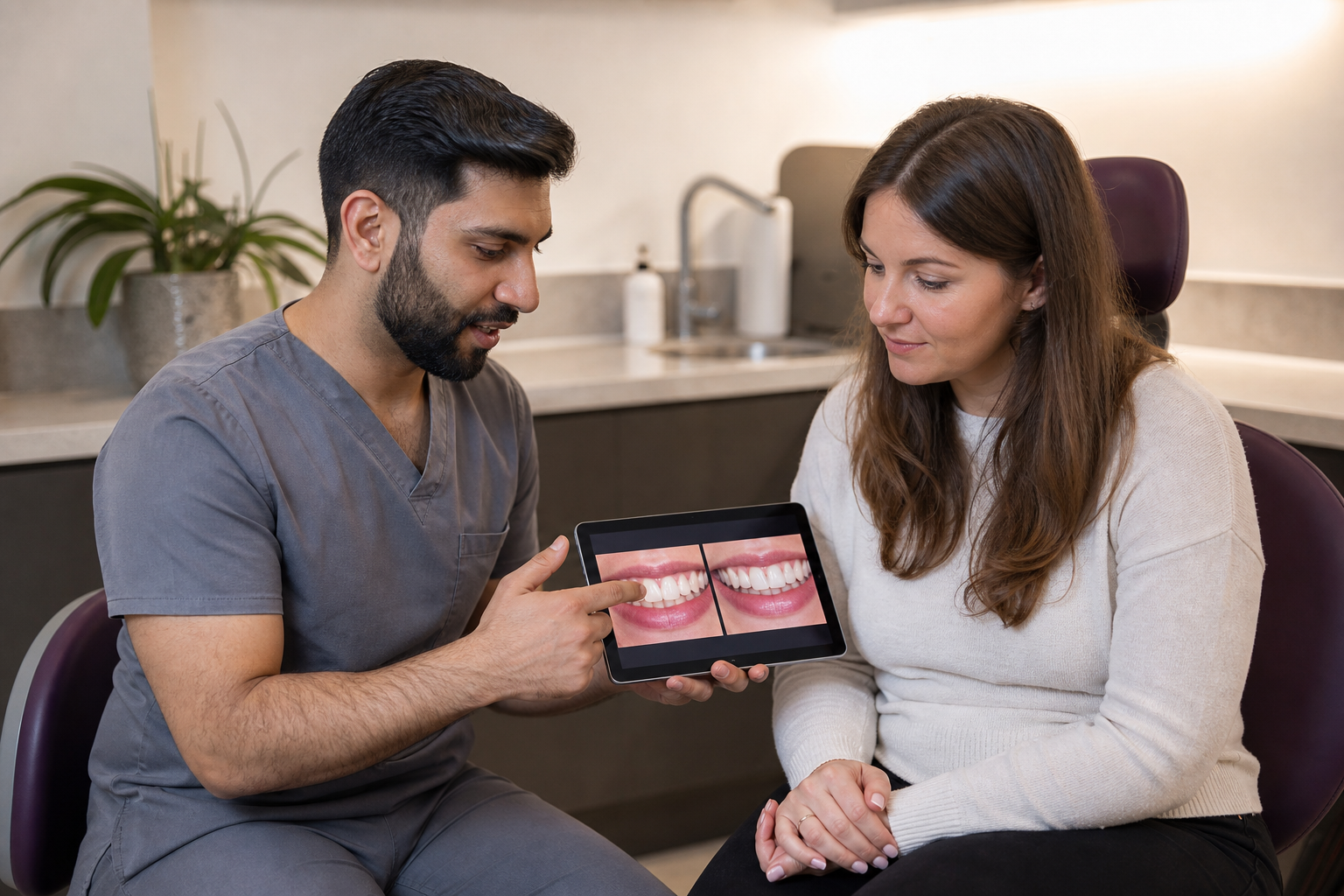
Composite bonding before-and-after photographs can be genuinely useful. They show you the type of change that is achievable when tooth-coloured composite is added to a tooth to alter its shape, edge or surface. What they cannot show is whether that same change will suit your own teeth, bite and facial proportions. That question can only be answered properly after an examination, not by comparing your smile to someone else's photograph.
When I assess someone for this treatment, I am looking at far more than the cosmetic concern they arrived with. I am looking at whether bonding is the right tool for the job, or whether whitening, aligners, gum treatment or veneers would actually serve them better.
What can composite bonding change before and after treatment?
Composite bonding can improve chipped edges, uneven or worn tooth outlines, minor shape irregularities, slightly small or peg-shaped teeth, and small gaps between front teeth. It works by bonding tooth-coloured resin directly onto the existing tooth surface, then shaping and polishing it to blend with the teeth around it.
It is generally most predictable when the change needed is modest. Rebuilding a chipped incisor, softening an uneven smile line, or closing a small gap tends to produce a result that looks like a natural extension of the tooth. Larger changes, such as rebuilding several worn teeth or altering the whole shape of a smile, are still possible in selected cases, but they involve more planning, more composite, and more long-term maintenance.
Bonding does not change tooth position within the jaw. It changes the shape and surface you see. That distinction matters a great deal when teeth are rotated, overlapping or significantly out of alignment. It is also worth separating two different situations: repairing a tooth that has been weakened by decay or trauma, and adding composite to an otherwise healthy tooth purely for appearance. The first is a restorative decision that needs its own assessment of the remaining tooth structure, not just a cosmetic one.
What I look for before I say yes to composite bonding
When I assess someone for bonding, I want to understand the starting condition of the mouth, not just the cosmetic request. That means checking the health of the teeth and gums, the presence of any decay, the amount of healthy enamel available, and whether there are existing fillings or old restorations that will affect how new composite matches and bonds.
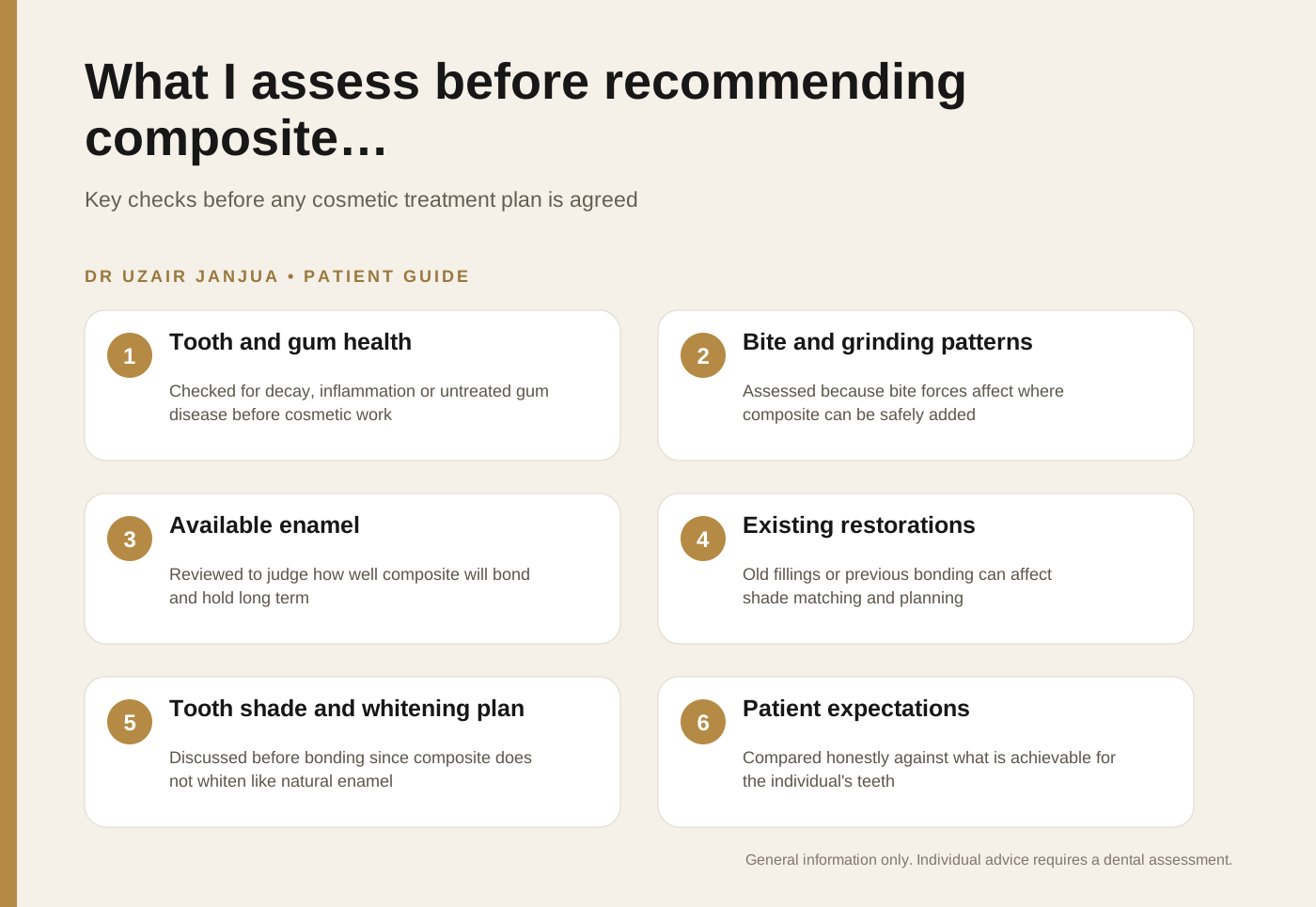
I also assess the bite. How the upper and lower teeth meet affects where composite can safely be added and how long it is likely to hold up. Signs of grinding or clenching are relevant here, because added composite on the edges of teeth is more exposed to those forces.
Tooth shade matters too. Composite does not lighten in the same way as natural enamel when whitening gel is applied later, so shade planning is usually discussed before bonding begins, not after.
Finally, I want to understand what the patient is expecting. A photograph they have brought in is a useful conversation starter, but the honest answer depends on whether that same number of teeth, that shape, and that degree of change is realistic for their own mouth.
How to read composite bonding before-and-after photographs properly
A convincing bonding result should look proportionate, not simply brighter or bulkier. When you look at before-and-after photographs, it helps to notice a few things rather than just the overall impression.
- How many teeth were treated, since a full smile change is a different undertaking to repairing one chipped tooth
- Whether whitening appears to have been carried out alongside bonding, which can make the result look more dramatic than the shape change alone
- Whether the lighting, angle or lip retraction in the photograph might be exaggerating the change
- Whether the tooth proportions look natural for the person's face and lip line, rather than uniformly square or oversized
- Whether the gum line and gum symmetry were part of the change, which is a separate treatment area to the tooth itself
It is also worth asking, rather than assuming, what was actually done to produce a particular image. A striking before-and-after comparison might combine bonding with whitening, orthodontic alignment or gum reshaping, treated together over more than one appointment. A photograph on its own cannot tell you which parts of the change came from composite and which came from something else, or how many teeth were involved.
This is where people sometimes get confused. A dramatic-looking transformation photograph does not automatically mean more composite was used or that the technique was better. In many cases, a subtle, well-proportioned result is the more skilled outcome, even though it photographs less dramatically.
When bonding may not be the best first step
Composite bonding is an elective cosmetic and restorative option, and it is not automatically the right starting point for every concern. Active tooth decay, untreated gum disease or inconsistent oral hygiene usually need to be addressed first, because bonding placed over unstable oral health is unlikely to hold up well or look right for long.
Where a tooth has been damaged by decay, injury or a failed old filling, the priority is assessing how much sound tooth structure remains and what that tooth actually needs functionally. In that situation, composite may still be the material used, but the decision is a restorative one first, and a cosmetic one second.
Significant crowding, rotated teeth or noticeable gaps across several teeth are often better managed with orthodontic treatment first. Adding composite around misaligned teeth can sometimes disguise the problem in a photograph without truly correcting it, and the result can look uneven once you look beyond the smile in a still image.
Uncontrolled grinding or clenching is another factor I take seriously. If the underlying bite forces are not addressed, added composite on the edges of teeth is more likely to chip or wear down again, regardless of how well it was placed initially.
If someone's expectations are for a dramatic change that would realistically need more comprehensive treatment, I would rather explain that clearly at the consultation stage than proceed and produce a result that does not match what they had in mind.
Small cosmetic correction versus a larger smile change
Repairing a single chipped tooth or softening one uneven edge is a fundamentally different decision to building up eight or ten teeth to change the whole smile. The single-tooth repair is usually quicker to plan, easier to match to the surrounding teeth, and has a smaller margin for error if something needs adjusting later.
A full arch of composite build-ups involves more decisions: overall tooth proportions, symmetry from left to right, how the new edges meet during biting and speech, and how the shade will read under different lighting. It also means more composite surface area that will eventually need polishing, and potentially more areas that could need repair over the years.
Neither approach is automatically better. The right choice depends on how many teeth are actually affected, and whether a smaller, more targeted correction would already achieve what the patient is looking for.
What this looks like in practice
A minor chip on one front tooth might need a single, fairly short appointment. A generalised pattern of tooth wear across the front teeth needs a more considered plan, often including a discussion about the cause of the wear, not only its repair. If you are exploring your own options, you can read more about how composite bonding is planned and carried out on the composite bonding page.
Whitening, clear aligners, gum treatment or bonding first?
The answer depends on what is actually driving the concern in the photograph you are comparing yourself to. If the main issue is tooth colour and the shapes are already acceptable to you, teeth whitening alone may achieve much of the improvement without adding any composite at all.
If the teeth are a shade you are happy with but crowded, rotated or unevenly spaced, straightening with clear aligners may be worth considering first when tooth position is the main concern. Composite added around misaligned teeth cannot correct their position, and treating alignment beforehand can sometimes reduce or remove the need for bonding altogether. This can be a sensible sequence in selected cases, though the right order for you depends on an individual assessment of your bite and tooth position, which you can read more about on the clear aligners page.
If the gum line is uneven or gums cover more of the tooth than you would like, that is a separate consideration from the tooth shape itself, and gum contouring or a gum lift may be the more relevant discussion alongside, or instead of, bonding.
Where someone needs broader changes to colour and shape across several teeth, and accepts a different maintenance pathway and level of preparation, porcelain veneers become a reasonable alternative to compare against bonding. You can see how that comparison is usually framed on the porcelain veneers page.
If you already have specific photographs or a particular concern in mind, the most useful next step is usually a consultation where I can look at your bite, gum health and tooth structure directly, rather than trying to match a picture from somewhere else.
What can change the cost in Birmingham?
I am not going to quote a price here, because the right figure depends entirely on what your teeth need, and that can only be judged after an assessment. What I can outline is what tends to move the cost up or down once a plan is discussed, and what a fee should normally clarify before you agree to treatment.
| Factor | How it affects planning |
|---|---|
| Number of teeth treated | A single chip repair is a smaller undertaking than building up a full smile |
| Complexity of shape or bite changes | Closing gaps or correcting wear patterns takes more planning time than a simple edge repair |
| Whitening beforehand | If whitening is appropriate, it is usually planned and completed before shade matching for bonding |
| Alignment needs | Teeth that need straightening may require aligners first, which is a separate treatment stage |
| Existing dental health | Decay, gum disease or old restorations may need treating before cosmetic work begins |
| Future maintenance | Polishing, repairs or eventual replacement should be factored into your expectations, not just the initial fee |
Before agreeing to a plan, it is worth confirming exactly what the quoted fee includes, such as any mock-up or trial shape, review appointments, polishing visits, and the practice's approach if a repair is needed sooner than expected.
For patients travelling in from Coventry, Wolverhampton, Solihull, Sutton Coldfield, Walsall or Dudley, it is worth allowing time for an initial assessment appointment, any preparatory treatment, and at least one review visit, rather than assuming everything is completed in a single trip.
What should I realistically expect after treatment?
Straight after bonding, the treated teeth should look smooth and well matched to their neighbours. Your bite is checked at the appointment, though minor adjustment is sometimes needed as the teeth settle together, and this is a normal part of finishing the work rather than a sign of a problem.
Some people take a short time to adapt to a changed edge or a slightly different feel when speaking, while others notice very little adjustment at all. If anything feels persistently uncomfortable beyond the first week or so, that is worth mentioning at a review appointment.
Composite can be more prone to surface staining and chipping than some other restorative materials, particularly with habits such as tea, coffee, red wine or smoking, or if grinding is not controlled. It can also, less commonly, debond from the tooth. Because composite is added directly to the tooth, it can usually be polished, repaired or added to without starting again from scratch. That repairability is one of the practical advantages of bonding compared with some other restorative options, though it does mean review appointments and occasional maintenance should be expected as part of owning the result, not as a sign that something has gone wrong.
Questions to ask before agreeing to composite bonding
Before agreeing to any treatment plan, it is reasonable to ask exactly how many teeth are being treated and why, whether whitening is being planned before or after bonding, and whether a trial shape or mock-up will be shown to you first.
It is also worth asking who will review the results, what the process is if a tooth chips or stains earlier than expected, and whether grinding or clenching has been assessed as part of your bite. If alignment or gum position could also be contributing to the concern, ask whether those have been considered as alternatives or as treatment done alongside bonding.
A dentist who takes the time to answer these questions clearly, rather than moving straight to booking a treatment date, is generally giving you a more honest basis for comparison than any single photograph could. If you would like your own teeth, bite and gum health looked at directly, arranging a consultation is the most reliable way to find out whether bonding is a realistic option for you, and what result you could genuinely expect.
Getting the decision right, not just the photograph
A good before-and-after result starts with the decision about whether bonding is the correct treatment for your teeth, not with finding a photograph you would like to copy. If you want an individual view on whether composite bonding, whitening, alignment or another approach fits your teeth, bite and expectations, the next step is an examination where that can be assessed properly, rather than judged against someone else's picture.