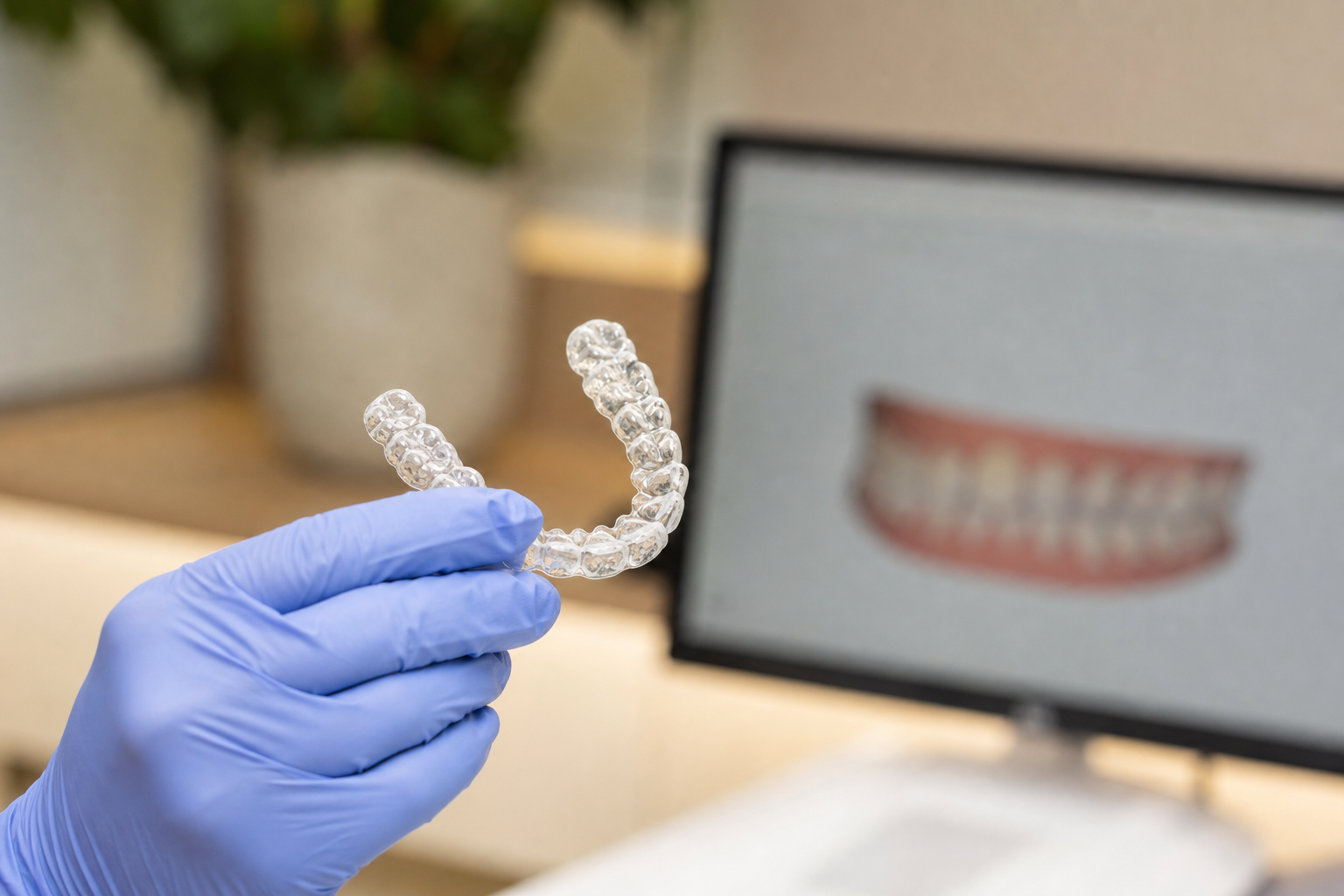
In the UK, private clear aligner treatment with a dentist commonly ranges from roughly £1,500 for a straightforward, limited case to £5,500 or more for complex treatment involving both arches and bite correction. These are broad guide figures rather than a personal quotation, and the terms different practices use for their packages are not standardised, so a "limited" plan at one practice may not match another. The exact clear aligners cost for you depends on how your teeth and bite need to move, which can only be confirmed after an examination.
What I would look at first is not the headline price at all, but what that price actually includes. Two quotes that look similar on paper can cover very different amounts of treatment, monitoring and aftercare.
How much do clear aligners cost in the UK?
Guide prices for private clear aligner treatment generally fall into three broad bands, though the exact terminology varies between aligner systems and practices. Limited treatment, often used for mild crowding or spacing on the front teeth of one arch, tends to sit towards the lower end, roughly £1,500 to £2,500. Moderate treatment, correcting more teeth or making small bite adjustments, often falls somewhere between £2,500 and £4,000. Comprehensive treatment, addressing more significant crowding, spacing or bite problems across both arches, commonly runs from around £4,000 up to £5,500 or more.
These bands are a starting point for budgeting rather than a promise, and they should not be read as an industry standard. The only way to get a figure that means anything for your own teeth is a clinical assessment, which is why I explain the plan before giving you a price rather than the other way round.
Why can two clear aligner quotes be so different?
The most common reason is that the quotes are not actually for the same treatment. A price built around straightening a handful of front teeth is not comparable to one covering full arch alignment and bite correction, even if both are marketed under the same aligner brand.
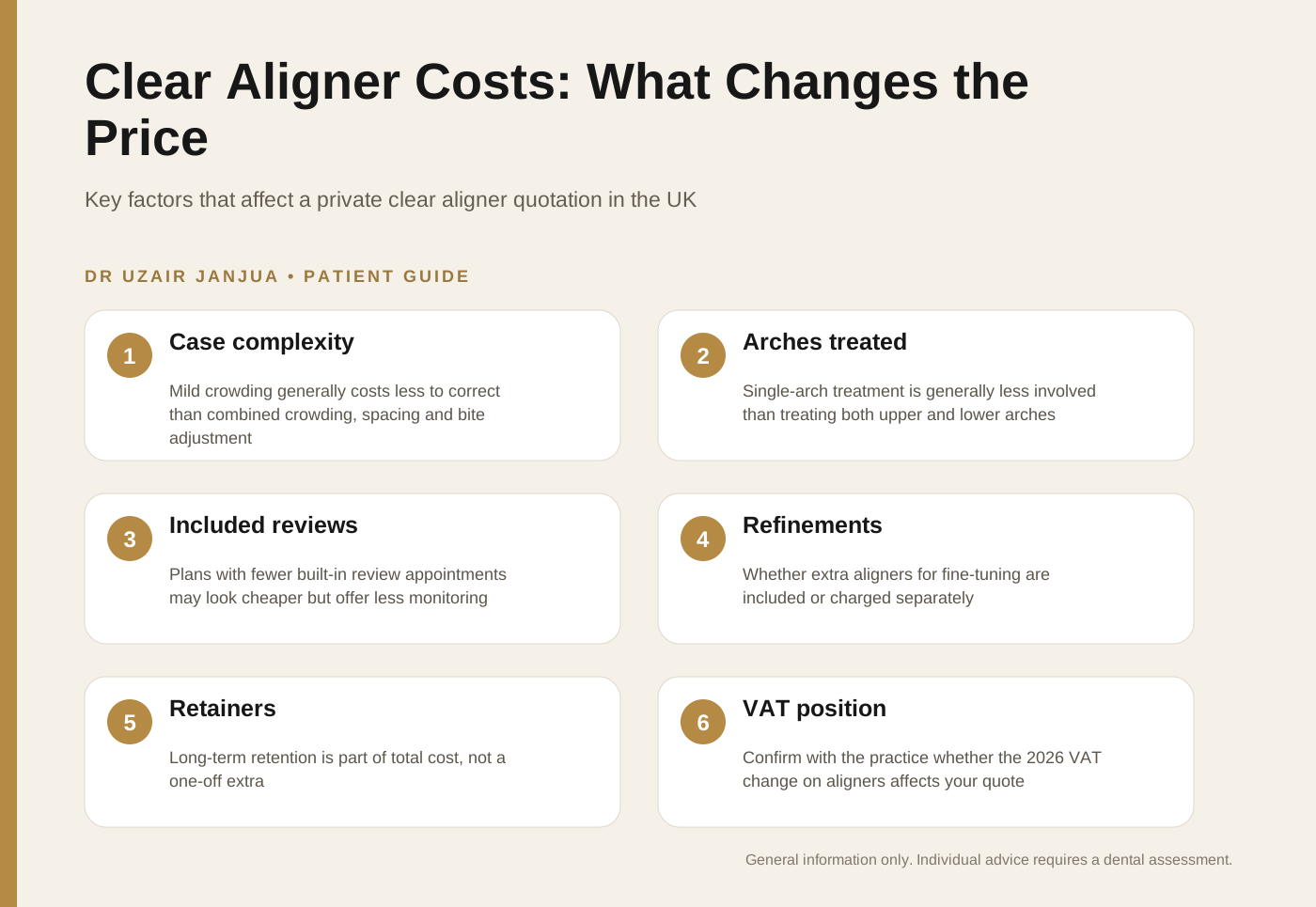
Other genuine differences include whether one arch or both arches are being treated, which aligner system or laboratory is used, how many appointments and reviews are built into the plan, and how experienced the treating clinician is with more complex cases. The British Orthodontic Society notes that private orthodontic fees generally vary according to complexity, location, the clinician's experience and the type of appliance used, with a written quotation normally provided once you have been assessed. Local practice overheads also play a part. Birmingham and West Midlands practices set fees independently, so there is no single "city average" figure that applies to every case.
What is usually included in the price?
Before comparing numbers, it helps to see what a typical quote should set out. This is not a fixed template every practice will follow, but it gives you a sensible checklist.
| Item | Why it matters |
|---|---|
| Initial consultation | Confirms whether aligners are appropriate before you commit to a plan |
| Photographs, scans and X-rays where needed | Used to plan tooth movement accurately, not guessed from photos alone |
| Digital treatment plan | Shows the intended tooth movements and expected number of aligners |
| Full set of planned aligners | Should match the agreed treatment plan, not a reduced starter set |
| Attachments or interproximal reduction, if needed | Case-dependent extras that help certain tooth movements track properly |
| Progress review appointments | Checks that teeth are moving as planned and catches issues early |
| Refinement aligners | Extra trays if teeth need further movement to finish the plan |
| Retainers after treatment | Needed to help hold the result once active movement is complete |
If a quote is silent on any of these, it is worth asking directly rather than assuming it is included.
The hidden or additional costs to check before you agree to treatment
This is where people sometimes get confused, because the advertised figure is not always the final figure. It helps to separate two types of extra cost. Some are clinical, meaning they depend on how your teeth respond to treatment, such as needing dental work sorted first, further movement through refinement aligners, or retainers afterwards. Others are practice-specific and contractual, such as charges for a lost or damaged tray, a missed appointment fee, or what happens if you transfer to another dentist, pause treatment, or move away partway through.
Before agreeing to anything, it is also worth asking whether the consultation fee is refundable or deducted from the cost of treatment if you go ahead, and how long the quoted price remains valid for.
There is also a VAT point worth raising directly with any practice you are considering. Following changes to how VAT applies to orthodontic aligner treatment from 2026, the exact position can depend on the practice and how the treatment is structured. Rather than assume how this applies to you, ask whether your quoted price already includes any VAT due, and whether the practice expects fees to change as a result. A practice that has looked into this properly should be able to give you a clear answer.
Is a cheaper clear aligner package actually better value?
Not necessarily, and this is one of the most common misunderstandings I see. A lower starting price can be entirely appropriate for a very limited correction, such as a small amount of front-tooth crowding. It is not automatically comparable to a comprehensive package covering both arches and bite correction.
The same logic applies to how treatment is supervised. A model built around infrequent contact with a dentist may look cheaper month to month, but it offers less opportunity to check tracking, gum health and bite changes as treatment progresses. Seeing a dentist regularly can cost more in some cases, but it means problems can be picked up and adjusted for rather than discovered at the end.
A genuinely useful comparison looks at the total cost of completing the agreed treatment plan and maintaining it afterwards, not just the number on the first invoice.
What I would assess before recommending clear aligners
When I assess someone for aligner treatment, I am not just looking at how crowded or gappy the front teeth appear. I check gum health, because if gum disease is active, this usually needs to be assessed and, where needed, brought under control before a dentist can safely plan aligner treatment. I also check the bite, because some overbite, underbite or crossbite patterns are more suited to certain appliance types than others.
I look at existing fillings, crowns or missing teeth too, since these can affect how predictably aligners move teeth. Realistic expectations matter as well. Aligners can be effective for mild to moderate alignment and some bite issues, though more complex cases, particularly where extractions or significant control of tooth position are needed, may be better suited to a different approach.
Wear discipline is part of the assessment too. Aligners generally need to be worn for more than 22 hours a day unless your dentist advises otherwise for your specific plan, and I would rather discuss that honestly before treatment starts than assume it afterwards.
If you want to see how this is applied specifically to Birmingham patients, our dentist-supervised clear aligner treatment in Birmingham page sets out the assessment process in more detail, and a consultation is the only way to get a plan and price built around your own teeth rather than an average case.
Clear aligners versus braces: which costs less?
There is no single answer here, because the appropriate appliance depends on what movement your teeth actually need. Metal fixed braces can sometimes cost less than aligners, though this varies between practices and depends on the complexity of the case rather than being a fixed rule. Ceramic fixed braces usually cost more than metal but are less visible. Lingual braces, fitted behind the teeth, are usually the most expensive option.
Clear aligners sit within that range depending on complexity, and their main practical advantage is that they are removable, which many adults find easier for eating and cleaning. The trade-off is that the result depends heavily on wear compliance in a way that fixed braces do not.
Rather than asking which appliance is cheapest in general, the more useful question is which appliance suits the movements your teeth need, since choosing the wrong one can mean paying twice.
How much should I budget for retainers after clear aligners?
Retainers are part of the real cost of aligner treatment, not an optional add-on at the end. Once active movement is complete, some form of long-term, and often lifelong, retainer wear is usually advised to help maintain tooth position, since teeth can drift after treatment finishes.
It is worth asking exactly how many retainers are included in your quote, whether they are fixed, removable, or both, and what it costs to replace or renew them in future. Retainers do not last indefinitely. Building this into your budgeting from the outset avoids an unexpected cost once the visible part of treatment is finished.
Questions to ask before accepting a clear aligner quotation
Before agreeing to any treatment plan, it is reasonable to ask a few direct questions and expect clear answers.
- Does this price include all planned aligners, or only an initial set?
- How many refinement aligners are included, and what happens if more are needed?
- Are retainers included, and how many sets?
- Who will be reviewing my progress, and how often?
- What happens if I lose or damage an aligner during treatment?
- Is the consultation fee refundable or deducted from treatment, and how long is this quote valid for?
- What happens if I need to pause treatment, transfer to another dentist, or move away partway through?
- Is this price inclusive of VAT, and could that change during treatment?
You should receive clear information about the proposed treatment, its risks, reasonable alternatives and realistic costs before deciding whether to go ahead, generally alongside a written plan before treatment starts. A practice that answers these questions clearly, in writing, is giving you what you need to make an informed decision.
Making the comparison that actually matters
The lowest advertised starting price is rarely the most useful figure to compare. What matters is the total cost of completing the agreed treatment plan and maintaining it afterwards, including reviews, refinements and retainers.
If you are weighing up clear aligners against another way of improving how your teeth look, it is also worth understanding where the limits of tooth movement lie. Composite bonding can reshape or close small gaps but does not move teeth or correct a bite, and porcelain veneers can change shape and colour but involve permanent tooth preparation and future replacement. For some patients, a short course of aligners followed by minor bonding is a more realistic route to the appearance they want than either treatment alone.
If you are trying to work out whether clear aligners are financially and clinically realistic for your own teeth, an examination is the only reliable next step, and that starts with a consultation rather than a further round of online comparisons.